By Rachna Kumar
A product team usually asks this question at the worst possible moment—after the technology is locked, the launch date is announced, and commercial conversations have begun. Is an FTO search actually mandatory, or is it just a “best practice” lawyers keep recommending? The uncomfortable truth is that while no statute in India, the United States, or Europe explicitly mandates an FTO search, the legal systems in all three jurisdictions make it dangerously expensive to skip one once commercial risk becomes foreseeable. At that point, an FTO is no longer a checkbox exercise; it becomes a core part of launch risk management.
What does “legally mandatory” really mean for an FTO search?
In patent law, “mandatory” rarely appears as a statutory command. Instead, the obligation arises indirectly through strict liability for infringement. If a product falls within the scope of a granted patent, liability follows regardless of intent, knowledge, or good faith. Courts, regulators, investors, and acquirers therefore assess whether a company behaved reasonably before launch. When a business knowingly enters a patent-dense space without assessing third-party rights, that omission itself becomes evidence of recklessness. This is where an FTO search crosses the line from optional to unavoidable.
Many businesses still misunderstand what a Freedom to Operate assessment actually covers. An FTO search is not about whether your idea is new or patentable; it is about whether your product can be made, used, or sold without infringing existing patents in a specific jurisdiction. We have explained this distinction in detail in What Is a Freedom to Operate (FTO) Search and Why Every Product Launch in 2026 Needs One?, particularly in the context of Indian startups scaling into global markets.
When is an FTO search effectively mandatory before product launch?
An FTO search becomes legally unavoidable when a product is commercially launched in a market where relevant patents exist and infringement risk is reasonably foreseeable. Although not mandated by statute in India, the US, or the EU, failure to conduct an FTO can lead to injunctions, enhanced damages, import bans, and serious investor or acquirer red flags.
India: when courts and commercial reality force the issue
Under the Indian Patents Act, patent infringement is a strict liability offence. Whether the infringer intended to copy or even knew about the patent is irrelevant. Indian courts, particularly in pharmaceuticals, medical devices, electronics, and telecom, have shown increasing willingness to grant interim injunctions that halt sales at an early stage of litigation. From a practical standpoint, an FTO search becomes unavoidable in India once a product moves from internal development to commercial launch, especially where multinational competitors hold active Indian patents or where regulatory approvals are being pursued. In such cases, launching without any freedom-to-operate assessment exposes the business to immediate injunction risk and weakens its defensive position before the court.
United States: enhanced damages turn FTO into a shield
The United States takes the same strict liability approach to infringement, but the real danger lies in enhanced damages for wilful infringement. Courts examine whether the accused infringer took reasonable steps to assess patent risk before launch. When a company is operating in a known patent-crowded field and makes no effort to investigate existing rights, plaintiffs routinely argue reckless disregard. In US-facing products, an FTO search is therefore not just about avoiding infringement; it is about demonstrating good-faith conduct. For companies planning imports, US sales, fundraising, or acquisition exits, skipping an FTO removes one of the strongest legal shields available during litigation.
European Union: injunction risk makes FTO unavoidable
In Europe, particularly in jurisdictions such as Germany, patent enforcement is fast and injunction-friendly. A single national patent or European patent can shut down an entire product line with little warning. The emergence of the Unified Patent Court has further increased enforcement leverage for patentees. For businesses selling across multiple EU countries or operating in sectors like medtech, industrial equipment, automotive, or telecom, an FTO search becomes unavoidable before launch. Even where damages may be manageable, the threat of a market-wide injunction forces companies to treat FTO as a launch prerequisite rather than a legal luxury.
Why filing your own patent does not replace an FTO search
One of the most persistent misconceptions is that filing a patent application automatically provides freedom to operate. It does not. A patent only grants the right to exclude others from using your invention; it does not grant permission to use earlier or broader patented technologies. Courts regularly restrain patentees who infringe third-party rights. This is why patentability searches and FTO searches serve fundamentally different legal purposes and must never be conflated during product strategy planning.
A common and costly mistake is assuming that filing a patent application automatically provides freedom to operate. It does not. Patentability searches and FTO searches answer entirely different legal questions. A patentability search asks whether you can obtain patent rights, while an FTO search asks whether you might infringe someone else’s granted rights. We break this down with practical examples in FTO vs Patentability Search: What’s the Difference and When Do You Need Each?—a distinction that courts, investors, and acquirers take very seriously.
Regulatory approvals do not eliminate patent risk
Another common assumption is that regulatory clearance implies patent safety. In reality, regulators assess safety, efficacy, and compliance—not patent infringement. In pharmaceuticals and medical devices, infringement suits frequently follow regulatory approval within weeks. Courts have consistently rejected the argument that regulatory permission offers immunity from patent enforcement. For regulated products, the absence of an FTO can be particularly damaging because competitors are closely monitoring market entry.
The investor and acquisition lens
Even where litigation risk appears remote, the absence of an FTO analysis often surfaces during investor or M&A due diligence. Sophisticated investors view FTO as a risk-allocation tool. When no FTO exists, transactions are delayed, valuations are discounted, or indemnity escrows are imposed. At that stage, conducting an FTO becomes a defensive exercise rather than a strategic one, often under time pressure and scrutiny.
Practical guidance from real launch scenarios
In practice, the question is rarely whether an FTO is legally mandatory in theory. The real question is whether a business can credibly justify launching without one. Once revenue, competitors, exports, or institutional capital are involved, that justification becomes extremely difficult. A jurisdiction-specific, product-aligned FTO search almost always costs less than a single injunction hearing and provides clarity that directly informs design-around, licensing, or market-entry decisions.
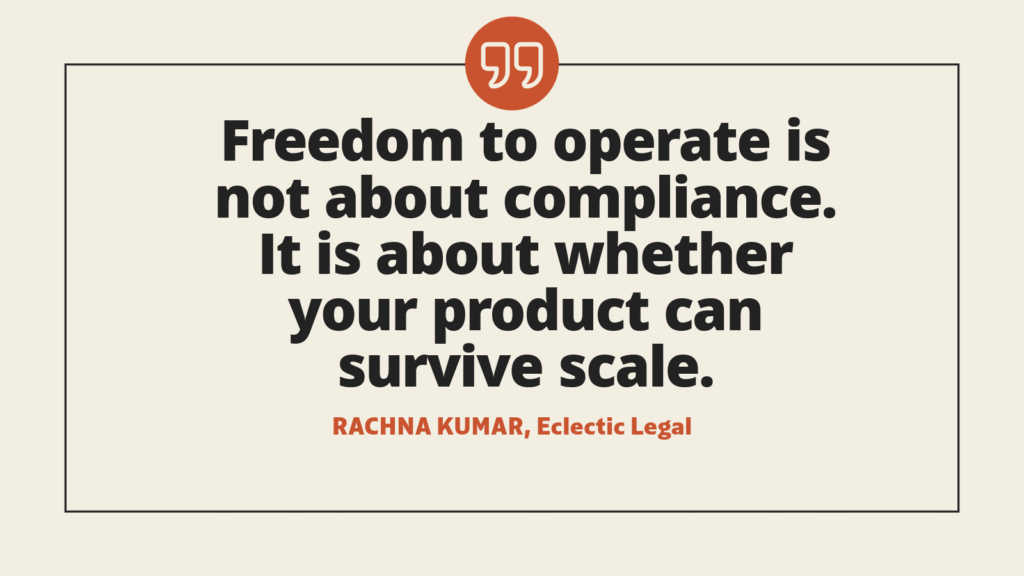
The law does not compel good behaviour through explicit commands. It does so through consequences. An FTO search sits squarely in that space—technically optional, practically decisive. Businesses that understand this early do not merely avoid disputes; they build products that can survive scale, scrutiny, and serious capital.
Once a business recognises that an FTO search is unavoidable, the next question is how deep the analysis needs to go. In practice, this depends on the product architecture, jurisdictions of launch, and the enforcement behaviour of competitors. A well-structured FTO typically involves claim-level analysis, jurisdiction filtering, and risk categorisation—rather than a raw patent dump. For readers looking to understand this process in detail, we have outlined a jurisdiction-specific framework in How to Conduct a Freedom to Operate Analysis: A Step-by-Step Guide (India, US, EU)
About the Author
Rachna Kumar is a registered Patent Attorney with deep expertise in patent drafting, prosecution, and innovation strategy across India, the United States, and key global markets. She advises technology-driven businesses, startups, and R&D teams on protecting high-value inventions through strong patents, clarity in prior art positioning, and commercially aligned filing strategies. Her work spans electronics, software, AI, biotechnology, and emerging technologies, with a focus on building patent portfolios that support scale, investment, and long-term competitive advantage.
Rachna frequently works with founders and in-house teams to navigate the Patent Cooperation Treaty (PCT), national phase entry, office actions, and infringement risk assessments, ensuring clients make informed decisions across the innovation lifecycle.