A Freedom to Operate (FTO) analysis is one of the most practical yet misunderstood tools businesses rely on when entering the Indian, US or EU markets. Most teams assume it’s simply a patent search, but FTO is far more disciplined: it filters market-entry risk, shapes design decisions, strengthens fundraising narratives, and in some industries, becomes part of the compliance dossier for regulators and global clients. In practice, defensibility matters as much as accuracy — especially when companies need to show investors, partners or even courts that they exercised due diligence before launch.
How Do You Conduct a Legally Defensible FTO?
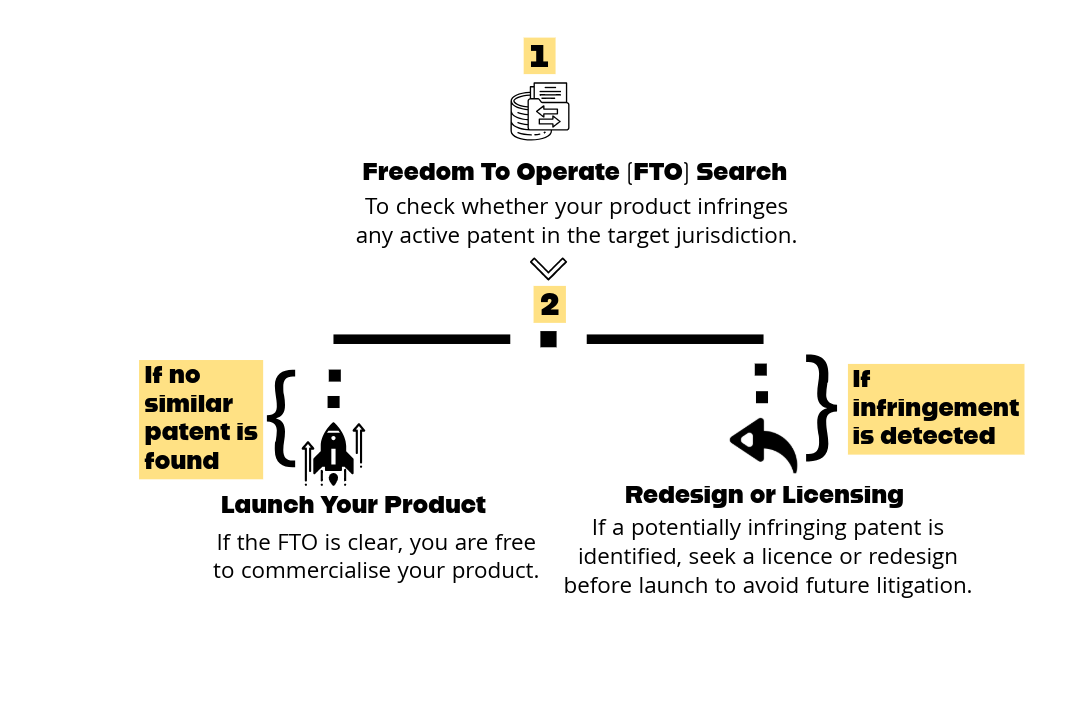
A defensible FTO clearly defines the product, examines active patents in each target market, analyses claim scope, verifies legal status, maps claims against product features and documents the reasoning. It uses credible databases, transparent methodology and a structured evidence trail that can withstand legal or regulatory scrutiny.
Defining the Product With Absolute Clarity
Every meaningful FTO begins with a precise articulation of the product. This goes beyond the marketing description and focuses on the underlying functionality, construction, modules, materials, algorithms, or manufacturing steps. The more detailed the definition, the easier it becomes to identify patent-relevant features. In many engagements, this is where risk is discovered early — not because the entire product is infringing, but because a single internal mechanism, sensor placement, interface logic or processing method overlaps with an existing patent claim.
Identifying the Relevant Technology Space
Once the product is clearly defined, the next step is understanding which part of the patent universe it touches. Patent examiners classify technology into IPC and CPC categories, and an FTO must do the same. Classification prevents blind spots because many important patents never use the exact keywords that teams expect. A product may fall under two or three classification families, and mapping it correctly ensures that the search captures both direct competitors and adjacent industry players.
Selecting the Right Databases (India, US, EU)
An FTO covering India, the US and the EU cannot rely on one database alone. Each jurisdiction maintains unique records, and a defensible FTO requires cross-verifying results. IP India provides legal status and national filings crucial for Indian launch. USPTO captures pending applications, continuations and divisionals that often expand claim scope. EPO’s Espacenet offers a rich view of European filings and detailed family data. WIPO Patentscope helps identify international filings and national phase entries, and Google Patents is useful for exploratory searches but never sufficient as the primary record. The earlier article you published on FTO and product launch in India ties neatly into this step, particularly around jurisdiction-specific clearance.
These cross-jurisdictional database checks are what make an FTO reliable across India, the US and the EU. They also reinforce the foundational principles explained in our earlier piece on FTO and product launch in India, which gives a great primer on understanding jurisdiction-specific clearance: What Is a Freedom to Operate (FTO) Search and Why Every Product Launch in 2026 Needs One?.
Distilling Hundreds of Results Into a Focused Set
A raw patent search often produces an overwhelming list. The core task here is analytical filtering — identifying which documents have enforceable claims in the relevant markets, which are expired or abandoned, and which do not relate to the essential technical features of the product. This stage requires legal judgment: two documents may look similar, but only one may have a claim that extends to your technology.
Reading and Interpreting Patent Claims
Claims are the legal boundary of a patent. A well-conducted FTO examines the independent claims first, breaks them into conceptual elements, and then examines how each element relates to the product. Dependent claims extend or narrow scope and can reveal hidden risks. In several global projects, I’ve seen founders rely on abstracts or diagrams — but infringement risk lives in the claims. This step requires patience, experience, and a technical understanding of how courts read claims in India, the US and the EU.
Mapping Claims to the Product
Claim mapping is the anchor of a defensible FTO. Instead of a simple yes/no assessment, it creates a narrative of why a claim aligns or does not align with the product. Each element is compared with factual product features, and the reasoning is clearly articulated. This narrative is what makes an FTO stand up to challenge — whether in litigation, investor diligence or partner negotiations. It demonstrates that the business engaged in thoughtful analysis, not surface-level searching.
Verifying Legal Status Across Jurisdictions
A patent that appears active may not be enforceable in a particular market. Legal status verification involves checking annuity payments, abandonment, renewal, opposition outcomes, national-phase entries and, in the US, patent term adjustments. Many patents lapse silently in India because annuities are missed. In Europe, oppositions may significantly weaken claim scope. This verification ensures you are not treating dead patents as live threats.
Consolidating Findings Into a Clear Risk Opinion
The final FTO opinion should present a coherent view of risk. It should not promise complete safety — no credible FTO does. Instead, it highlights specific concerns, explains why they matter, and outlines possible design-arounds or strategic responses. This clarity is what founders, compliance teams and investors expect, and it often becomes part of board-level decision-making.
Why Documentation Determines Legal Defensibility
A strong FTO is ultimately judged by its transparency. Courts and regulators respect diligence. A documented trail of search strategy, databases used, claim reasoning and legal status checks shows that the business acted responsibly. In disputes, this record often becomes the company’s strongest protection.
What Makes an FTO Legally Defensible?
A defensible FTO rests on three pillars: a transparent search and analysis methodology, the use of authoritative patent databases, and a structured claim-to-product reasoning trail. When combined with proper legal interpretation, this creates a document that can be relied on by investors, regulators, potential partners and courts in India, the US and the EU.
FAQs
Is an FTO mandatory before commercialising a product in India?
No, it is not mandatory, but it has become a practical necessity. Investors, distributors, OEM partners and even insurers increasingly ask for FTOs before onboarding a product, especially in medical devices, AI systems and high-value engineering products.
How long does an FTO typically take?
A standard consumer product may take ten to fifteen working days. Complex medical devices, AI-driven systems or multi-component engineering products can require three to six weeks due to broader claim interpretation and multi-jurisdictional legal status checks.
Do expired patents have any relevance?
They do not create infringement risk, but they are highly valuable for understanding technical baselines, design-around approaches and what competitors once considered commercially important.
How is an FTO different from a patentability search?
A patentability search checks whether you can obtain a patent. An FTO checks whether you are infringing someone else’s patent. The two serve different purposes and are required at different stages of product development.
Wrap Up
A Freedom to Operate analysis is not a shortcut exercise. It is a structured legal and technical evaluation that determines whether a product can safely enter India, the US or the EU without triggering infringement risk. The value lies not in the number of patents found but in the depth of reasoning, clarity of claim interpretation and quality of documentation. For businesses scaling into competitive or regulated markets, a defensible FTO becomes both a risk shield and a strategic asset.
About the Author
Prashant Kumar is a Company Secretary, Published Author, and Partner at Eclectic Legal, where he advises businesses on corporate governance, regulatory strategy and brand protection. His team regularly assists Indian and global companies with Freedom to Operate (FTO) searches, patent-risk assessments, product commercialisation strategy and international market-entry compliance.
He can be reached for consultations at +91-9821008011 or prashant@eclecticlegal.com



[…] needed, this is where our earlier article on FTO methodology (How to Conduct a Freedom to Operate Analysis: A Step-by-Step Guide (India, US, EU)) becomes a useful reference point for understanding defensibility and claim […]
[…] Once a business recognises that an FTO search is unavoidable, the next question is how deep the analysis needs to go. In practice, this depends on the product architecture, jurisdictions of launch, and the enforcement behaviour of competitors. A well-structured FTO typically involves claim-level analysis, jurisdiction filtering, and risk categorisation—rather than a raw patent dump. For readers looking to understand this process in detail, we have outlined a jurisdiction-specific framework in How to Conduct a Freedom to Operate Analysis: A Step-by-Step Guide (India, US, EU) […]