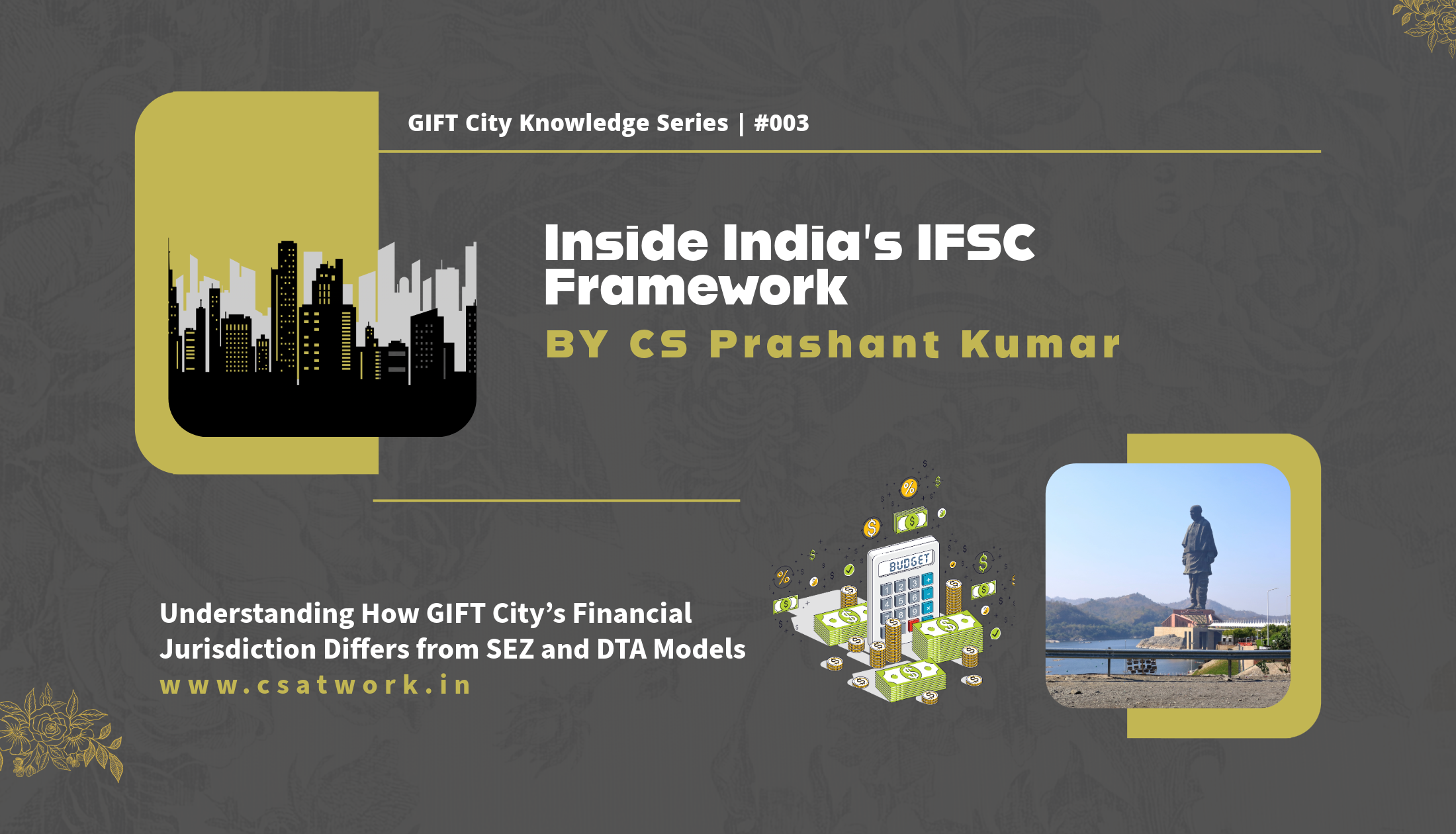
Understanding India’s International Financial Services Centre and its distinct legal and regulatory framework.
By Prashant Kumar
Introduction
India’s growing integration with global financial markets required a jurisdiction that could handle cross-border finance, fund management, and fintech innovation within its own legal boundary. This need gave rise to the International Financial Services Centre (IFSC), first established in GIFT City, Gujarat.
While both SEZ (Special Economic Zone) and DTA (Domestic Tariff Area) models aim to promote economic activity, IFSCs are distinct — they operate as financial jurisdictions with their own regulator (IFSCA) and offer flexibility comparable to global financial hubs like Singapore or Dubai.
What is an IFSC?
An International Financial Services Centre (IFSC) is a designated zone in India that enables financial institutions, fintechs, and global service providers to conduct international transactions in foreign currency, under a unified regulatory framework governed by the International Financial Services Centres Authority (IFSCA).
In essence, an IFSC allows Indian and foreign entities to carry out global financial services — including banking, fund management, insurance, fintech, and capital market activities — from Indian soil, but with offshore-level regulatory and tax flexibility.
The first and only operational IFSC in India today is GIFT City, located between Ahmedabad and Gandhinagar.
How is IFSC governed in India?
The International Financial Services Centres Authority (IFSCA) was established under the IFSCA Act, 2019 to regulate all financial activities within the IFSC.
Unlike SEZs or DTAs, where multiple regulators operate (RBI, SEBI, IRDAI, PFRDA), IFSCA consolidates all powers, ensuring single-window regulation.
This structure reduces redundancy, speeds up licensing, and brings Indian financial regulation closer to global standards.
What is the difference between IFSC, SEZ, and DTA?
| Feature | IFSC | SEZ | DTA |
|---|---|---|---|
| Objective | Facilitate global financial services and cross-border transactions | Promote export-oriented manufacturing and services | Regular domestic business and trade |
| Regulator | IFSCA (unified financial regulator) | SEZ Authority + sector regulators (RBI, SEBI, etc.) | Standard Indian regulators (MCA, RBI, SEBI, etc.) |
| Currency | Primarily foreign currency (USD, GBP, EUR) | INR and foreign currency (for export earnings) | Indian Rupee only |
| Taxation | 100% tax exemption for 10 out of 15 years | Limited tax incentives based on activity | Regular Indian tax regime |
| Permitted Activities | Banking, insurance, fund management, fintech, global trade finance | Manufacturing, IT, export services | Domestic trade and services |
| Examples | GIFT City, Gujarat | Noida SEZ, Kandla SEZ | Any city/town outside SEZ/IFSC boundaries |
Why IFSC is strategically different
The IFSC model represents a policy shift — it’s not about exports or manufacturing, but about bringing offshore financial flows back to India.
It helps:
- Retain capital and fund management activities within Indian jurisdiction.
- Attract global banks and financial institutions.
- Enable Indian fintechs and startups to compete globally without relocating abroad.
- Create a professional ecosystem for lawyers, company secretaries, accountants, and governance experts.
How professionals can engage with IFSC operations
At Pratham Legal, we assist clients in:
- Setting up IFSC entities and obtaining IFSCA approvals.
- Drafting and structuring IFSC compliance frameworks.
- Advising on FEMA integration and cross-border structuring.
- Managing governance and reporting under IFSCA and SEZ laws.
As IFSC regulations evolve, Company Secretaries and legal professionals will play a pivotal role in ensuring governance, risk, and compliance consistency for entities operating in GIFT City and beyond.
Why IFSC is the future of India’s financial globalisation
IFSCs are designed to make India a self-contained hub for international finance, reducing reliance on offshore jurisdictions.
By combining policy innovation, global tax efficiency, and transparent regulation, GIFT City’s IFSC demonstrates how India can host world-class financial activity while maintaining sovereign oversight.
Related Reading
- What Is GIFT City and Why It Matters for Global Business in India
- How GIFT City Is Changing India’s Financial Landscape
- Understanding FEMA Compliance for Foreign Shareholding in Indian Companies
FAQs — Understanding IFSC, SEZ, and DTA in India
1. What is the main purpose of establishing IFSCs in India?
India created IFSCs to bring offshore financial transactions—such as banking, fund management, and insurance—onshore, under an Indian jurisdiction that matches global standards in regulation, tax efficiency, and ease of doing business.
2. How many IFSCs are currently operational in India?
As of now, India has one operational IFSC — at GIFT City, Gujarat. It serves as the country’s hub for global finance, fintech, and fund operations under the unified supervision of IFSCA.
3. Who governs the IFSC in India?
The International Financial Services Centres Authority (IFSCA), established under the IFSCA Act, 2019, is the single regulator overseeing all financial activities — banking, insurance, capital markets, and fintech — within India’s IFSCs.
4. What is the key difference between IFSC and SEZ?
While both promote international business, SEZs focus on exports of goods and services, whereas IFSCs focus on cross-border financial services like banking, insurance, and fund management. IFSCs are regulated by IFSCA; SEZs fall under the SEZ Authority.
5. How is DTA different from IFSC or SEZ?
The Domestic Tariff Area (DTA) covers businesses operating within India’s regular jurisdiction. Unlike IFSCs or SEZs, DTA units deal only in Indian Rupees, are taxed under the regular Income Tax Act, and comply with standard Indian laws.
6. What are the tax benefits of setting up in IFSC?
IFSC entities enjoy 100% income tax exemption for 10 out of 15 years, no GST on export services, no dividend distribution tax, and capital gains exemptions — making it far more attractive than DTA or SEZ setups for global financial operations.
7. Can Indian companies or professionals operate in the IFSC?
Yes. Indian companies can form subsidiaries or branches in the IFSC. Professionals such as Company Secretaries, Lawyers, and Chartered Accountants can provide advisory, compliance, and governance services to IFSC entities under Indian law.
8. What currencies are permitted in IFSC transactions?
Transactions in IFSCs can be conducted in freely convertible foreign currencies (USD, GBP, EUR, etc.). This distinguishes IFSCs from DTA units, which are restricted to Indian Rupees.
9. What types of activities can be carried out in an IFSC?
Permitted activities include banking, insurance, fund management, capital markets, fintech, aircraft leasing, and cross-border financing. These services target non-resident clients and international markets rather than domestic Indian customers.
10. Why is GIFT City considered India’s global financial hub?
GIFT City integrates finance, fintech, and policy under one regulatory umbrella, offering international-level infrastructure and compliance standards. It brings global capital, innovation, and talent together while keeping regulatory oversight within India.
Strategic Takeaway
The International Financial Services Centre (IFSC) is not just a regulatory experiment — it’s India’s bridge to global finance.
For policymakers, it represents financial self-reliance; for professionals, it’s a new horizon of compliance, advisory, and cross-border opportunity.
About the Author
Prashant Kumar is a Company Secretary, Published Author, and Partner at Pratham Legal, a full-service Indian law firm advising on corporate, regulatory, and transactional matters. He specialises in corporate governance, legal compliance, and brand protection, helping businesses build credible and sustainable legal foundations. He can be reached for discussions on brand strategy, compliance, and governance excellence via LinkedIn.