A practitioner’s walkthrough of the complete GIFT IFSC setup process — from office space LOI to IFSCA Certificate of Registration — mapped to the official regulatory workflow.
By Prashant Kumar, Partner, Company Secretary & Compliance Officer, Global Horizons Capital Advisors (IFSC) Private Ltd
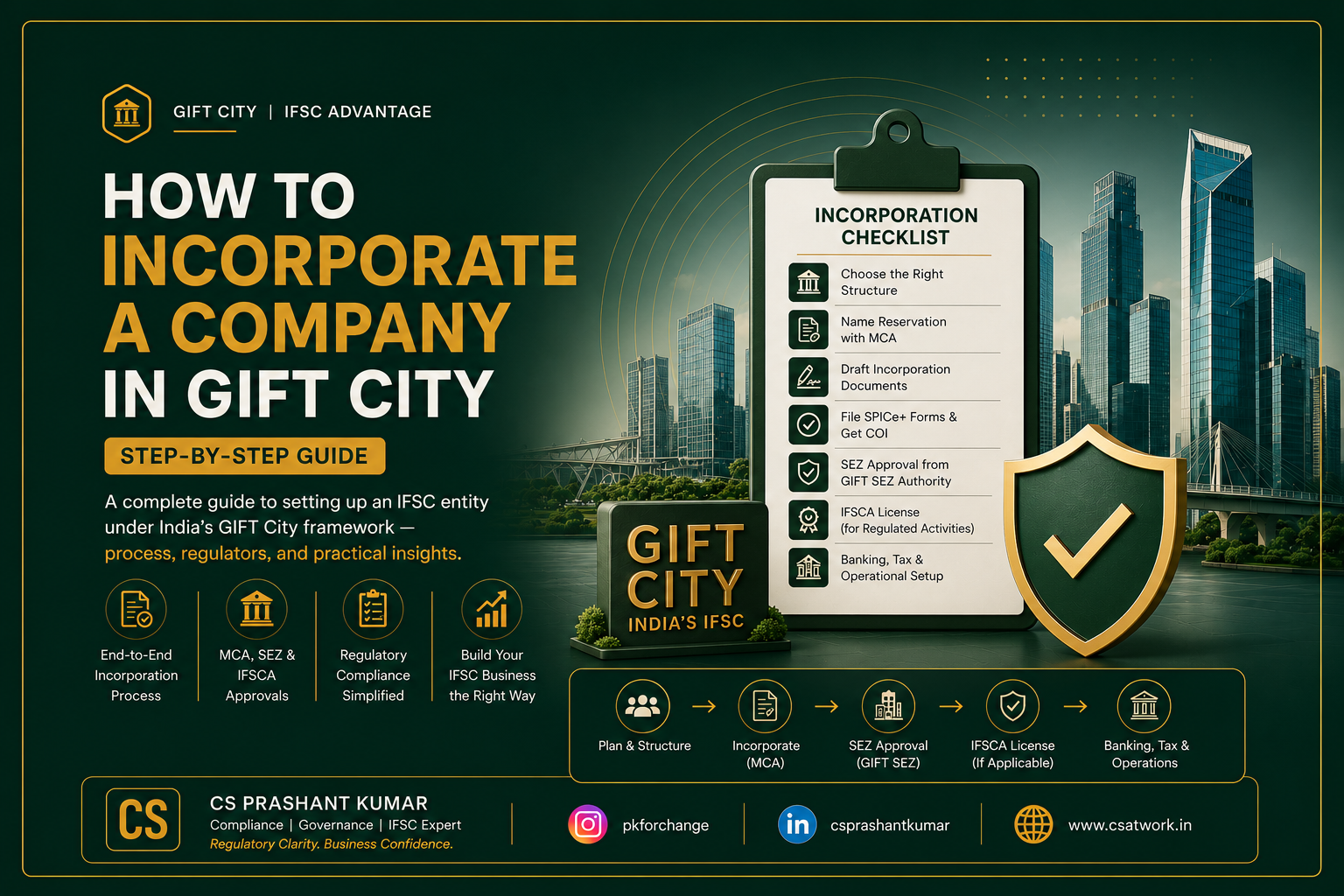
To set up a unit in GIFT IFSC, you must: identify office space and sign an LOI with a co-developer, reserve a company name with MCA, obtain a Provisional Letter of Allotment, incorporate the entity, file a single joint application on IFSCA’s SWIT portal, appear before the Unit Approval Committee, obtain the Letter of Approval and IFSCA in-principle approval, complete BLUT, IEC, banking and GST registrations, execute the lease, and secure the IFSCA Certificate of Registration. The end-to-end process typically takes 8 to 12 weeks, depending on the regulated activity.
One thing to be clear about at the outset: GIFT IFSC is exclusively for financial services businesses. If your activity is not regulated by the International Financial Services Centres Authority (IFSCA) — banking, fund management, capital market intermediation, insurance, aircraft and ship leasing, fintech, bullion, or ancillary services — an IFSC unit is not your route. This is the single most common misconception we correct in initial consultations.
Who Can Set Up in GIFT IFSC?
Every unit in GIFT IFSC must carry on a financial service notified under the IFSCA Act, 2019 and hold a registration, licence, or authorisation from IFSCA. The main entity categories include:
- Fund Management Entities (FMEs) under the IFSCA (Fund Management) Regulations, 2025
- Capital Market Intermediaries — broker-dealers, investment bankers, custodians, investment advisers
- IFSC Banking Units (IBUs) of Indian and foreign banks
- Insurance entities — IIOs and intermediaries
- Finance Companies — including aircraft and ship leasing units
- FinTech entities under the FinTech framework and sandbox
- Ancillary and TechFin service providers — legal, accounting, compliance, and technology services supporting IFSC entities
The permitted legal forms are a company or LLP incorporated in India, or a branch of an existing Indian or foreign company/LLP (branches skip the MCA incorporation steps, as the process flow notes).
What Is the SWIT Portal and Why Does It Matter?
The Single Window IT System (SWIT) at swit.ifsca.gov.in is the operational heart of the setup process. It consolidates what used to be separate applications to the SEZ authority and the financial regulator into one joint application — routed simultaneously to the Administrator (IFSCA), who performs the SEZ-side function for GIFT IFSC, and to IFSCA as regulator for the financial services approval.
This dual-hat structure is worth understanding: IFSCA is both your zone administrator (issuing the SEZ Letter of Approval) and your financial regulator (issuing your Certificate of Registration). Applications that treat these as one homogeneous approval — or draft the business plan for one audience only — routinely attract deficiency letters.
The 13-Step GIFT IFSC Setup Process
Stage 1: Foundation (Steps 1–3) — Space, Name, Incorporation
Step 1(a): Identify office space and execute a Letter of Intent (LOI) with a co-developer in GIFT IFSC. Physical (or approved co-working) space is a precondition — no space, no application.
Step 1(b): Reserve the entity name with MCA through the V3 portal. Steps 1(a) and 1(b) run in parallel. Branch setups skip this step.
Practical tip: align the name with your regulated activity — “IFSC” in the name signals jurisdiction to regulators and counterparties, though naming conventions under the Companies Act still apply.
Step 2: Obtain the Provisional Letter of Allotment (PLOA) and NOC from the co-developer. This is the document that anchors your SEZ application — sequence it before incorporation, not after.
Step 3: Incorporate the company or LLP with MCA via SPICe+/FiLLiP, with PAN and TAN issued alongside. The registered office should reflect the GIFT City address. Again, not applicable for branches.
Stage 2: The Regulatory Gate (Steps 4–6) — SWIT, UAC, LOA
Step 4: File the joint application on SWIT — a single application addressed to both the Administrator (IFSCA) and the IFSCA regulatory division. This bundles the SEZ unit application and the financial services registration application.
Step 5: Rectify deficiencies on the SEZ Online portal and appear before the Unit Approval Committee (UAC). The UAC hearing (online or in-person) happens once your application is included in the meeting agenda. Promoters or authorised representatives should be prepared to speak to the business plan, projected foreign exchange earnings, and employment — this is a substantive hearing, not a formality.
Step 6: Two approvals issue in parallel:
- 6(a): The Administrator (IFSCA) issues the Letter of Approval (LOA) via SEZ Online — your SEZ-side authorisation to operate as a unit.
- 6(b): IFSCA grants in-principle approval on the regulatory side via SWIT, wherever the sectoral regulations provide for it.
The applicant then submits the LOA to IFSCA’s regulatory team through SWIT/email — the handshake that connects the two tracks.
Stage 3: Operational Registrations (Step 7) — Five Parallel Workstreams
Steps 7(a) to 7(e) can — and should — be executed simultaneously. This is where disciplined project management compresses timelines:
- 7(a): Bond-cum-Legal Undertaking (BLUT) in Form-H of the SEZ Rules, submitted to the Administrator (IFSCA), followed by the approved BLUT and Eligibility Certificate, then uploaded on the SEZ Online portal.
- 7(b): IEC registration with DGFT.
- 7(c): RCMC registration (Registration-cum-Membership Certificate) with DGFT.
- 7(d): Banking setup — a foreign currency account with an IFSC Banking Unit (IBU) and an SNRR account with a domestic bank branch for INR-denominated administrative expenses. Capital infusion (including ODI, where the promoter is an Indian entity investing into the IFSC unit) happens after IFSCA in-principle approval.
- 7(e): GST registration through the SWIT portal itself.
Stage 4: Final Approvals and Go-Live (Steps 8–13)
Step 8: Execute the lease agreement with the co-developer, and file it with IFSCA via SWIT within 6 months of LOA issuance — a deadline promoters frequently lose track of once approvals are in hand.
Step 9: Obtain the IFSCA Certificate of Registration (CoR) through SWIT — your final regulatory authorisation to commence the financial services activity.
Steps 10(a)–(b): Gujarat state registrations — Shop & Establishment and Professional Tax (employer and employee), both through the GIFT City portal. These run in parallel.
Step 11: Employee ID cards from the SEZ — required for physical access and personnel compliance within the zone.
Step 12: First invoice and DCP. On executing the first transaction, submit the Date of Commencement of Production (DCP) request on the SEZ portal to the Administrator (IFSCA). The DCP date is significant — it anchors your tax holiday window and SEZ performance obligations.
Step 13: Intimate IFSCA’s regulatory team of start of operations, wherever the sectoral regulations require it.
How Long Does It Take to Set Up a Unit in GIFT IFSC?
Realistic working timelines, assuming clean documentation:
- Space LOI, name reservation, PLOA — 1 to 2 weeks (parallel)
- Incorporation with PAN/TAN — 1 week
- SWIT application to UAC approval and LOA — 3 to 5 weeks (UAC meeting cycles drive this)
- IFSCA in-principle to CoR — varies by activity; FME and ancillary registrations move faster than banking or insurance authorisations
- Parallel registrations (BLUT, IEC, RCMC, banking, GST) — absorbed within the above if run concurrently
Plan for 8 to 12 weeks end-to-end for most CMI, FME, and ancillary setups. Complex or capital-intensive licences take longer.
What Are the Tax Benefits of a GIFT IFSC Unit?
- 100% income-tax deduction for 20 consecutive years out of 25 (the unit chooses the block), under the IFSC-specific provisions now housed in the Income-tax Act, 2025
- Zero GST on services rendered to offshore clients and to other IFSC units
- Concessional MAT/AMT treatment, and no MAT for units under the new tax regime
- Exemptions on specified transactions — including certain transfers on IFSC exchanges and concessional treatment for non-resident investors in IFSC-based funds
- Foreign currency operations with liberalised FEMA treatment — the IFSC unit is treated as a person resident outside India for exchange-control purposes under IFSCA’s regulatory perimeter
Common Mistakes That Delay GIFT IFSC Applications
- Applying with a non-financial business model and discovering at UAC stage that the activity doesn’t fit any IFSCA framework.
- Sequencing incorporation before the PLOA, then amending registered office details.
- A business plan drafted for only one audience — the SEZ side wants NFE and employment; the regulatory side wants fit-and-proper promoters, capital adequacy, and risk frameworks. One document must serve both.
- Missing the 6-month lease filing deadline post-LOA.
- Infusing capital before in-principle approval, creating FEMA/ODI reporting complications.
- Treating DCP as an afterthought — it drives the tax holiday clock.
FAQs — Setting Up in GIFT IFSC
Can a non-financial services company set up in GIFT IFSC?
No. GIFT IFSC units must carry on financial services regulated by IFSCA. Non-financial businesses cannot obtain an IFSC unit approval, though ancillary service providers supporting IFSC entities (legal, accounting, compliance, tech) can register under the ancillary framework.
Can foreign investors own 100% of a GIFT IFSC entity?
Yes. Most IFSCA-regulated activities permit 100% foreign ownership, subject to fit-and-proper criteria and sectoral conditions. Foreign entities can also operate through a branch, which skips the MCA incorporation steps.
What is the SWIT portal in GIFT IFSC?
SWIT (Single Window IT System) is IFSCA’s unified application platform. A single joint application on SWIT goes simultaneously to the Administrator (IFSCA) for the SEZ approval and to IFSCA for the financial services registration, and also handles GST registration and post-approval filings.
Is physical office space mandatory in GIFT IFSC?
Yes. An LOI with a co-developer is the first step, a PLOA is required before the SEZ application, and the executed lease must be filed with IFSCA within 6 months of the LOA.
What is a BLUT and why is it required?
The Bond-cum-Legal Undertaking (Form-H under the SEZ Rules) is the unit’s undertaking to the Administrator covering duty-free procurement and SEZ obligations. Operations and duty benefits cannot commence without an approved BLUT and Eligibility Certificate.
What is an SNRR account and why does an IFSC unit need one?
A Special Non-Resident Rupee account with a domestic bank lets the IFSC unit — which operates in foreign currency — meet INR expenses like local salaries, rent, and statutory payments.
When can a GIFT IFSC unit start business?
After obtaining the IFSCA Certificate of Registration, executing its first transaction, and submitting the Date of Commencement of Production (DCP) request on the SEZ portal — with intimation to IFSCA’s regulatory team where required.
Strategic Takeaway
The GIFT IFSC setup is a single integrated regulatory journey with parallel tracks, not three sequential approvals. The promoters who move fastest are those who front-load the space and documentation work, run Steps 1(a)/1(b) and 7(a)–(e) concurrently, and draft one application that satisfies both the Administrator and the regulator. Get the sequencing right, and 8 weeks is achievable; get it wrong, and each deficiency cycle costs a UAC meeting.
About the Author
Prashant Kumar is a Company Secretary, Published Author, and Company Secretary & Compliance Officer at Global Horizons Capital Advisors (IFSC) Private Ltd specialising in GIFT City advisory, corporate structuring, and regulatory compliance. He advises on IFSC setup, IFSCA registrations, FEMA, fund management, and cross-border transactions.
📧 prashant.kumar@global-horizons.in | 📞 +91-9821008011
Related Reading
- What Is GIFT City and Why It Matters for Global Business in India
- How GIFT City Is Changing India’s Financial Landscape
- What Is IFSC and How It Differs from SEZ or DTA Units