
Indian brands have been pushing into the Middle East faster than ever—D2C labels, food chains, SaaS companies, fintech platforms, and manufacturing houses are all looking at UAE as their natural first market outside India. But the region’s sharp increase in brand enforcement, higher penalties for infringement, and stricter customs checks mean one thing: you can’t afford to enter the UAE without locking in your trademark rights early. Too many Indian founders still assume that a Madrid filing alone solves the problem; in practice, UAE has its own procedures, nuances, timelines and examiner expectations that can make or break a brand’s entry strategy.
What is the UAE trademark registration process for Indian businesses?
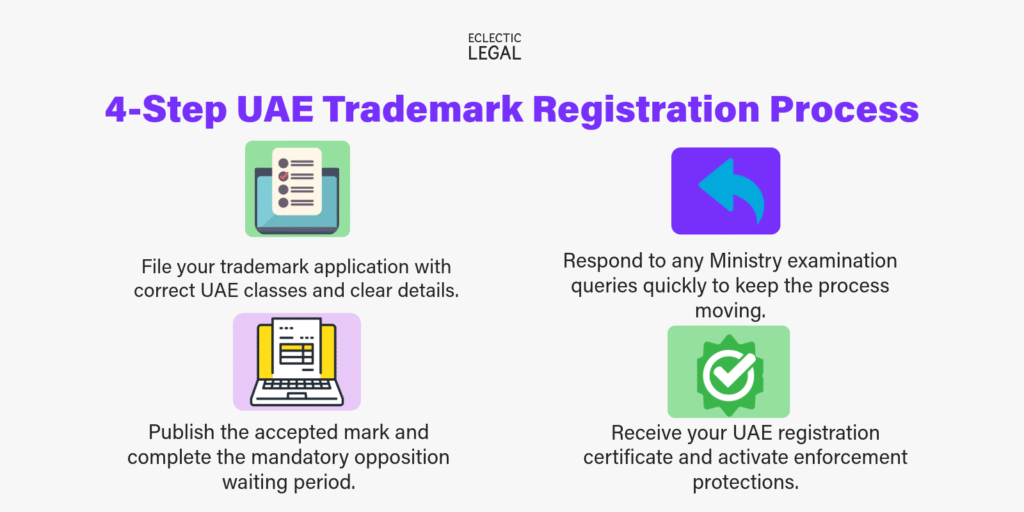
UAE trademark registration involves filing with the UAE Ministry of Economy, clearing classification, undergoing examination, publication, opposition and final registration. Indian businesses can file directly or through the Madrid Protocol. Protection is jurisdiction-specific, so securing UAE rights early is essential before market entry, distribution, or advertising.
After filing, the application undergoes a formal review by the Ministry to verify classification and documentation. Once accepted, it proceeds to publication in the UAE Trademark Journal and local newspapers, where third parties may oppose within 30 days. If no opposition is raised, or if resolved, the mark proceeds to registration and certificate issuance. Indian businesses expanding into Dubai, Abu Dhabi or the broader GCC should also secure domain names, Arabic transliteration protection, and distributor-related IP safeguards, as misuse in these areas is common.
Why UAE Should Be Your First International Filing Outside India
For Indian brands entering global markets, the UAE offers a unique combination of high purchasing power, significant Indian diaspora, and ease of doing business. But this visibility also makes you a target for copycats. Opportunistic filings by local traders are common, especially when Indian brands build traction online before formally entering the region.
This is exactly why early filings matter. A UAE registration protects you against distributor misuse, domain-name squatting, parallel imports, and trademark hijacking—risks that routinely derail Indian FMCG, restaurant, apparel and tech brands. Your filing strategy should ideally begin 3–6 months before commercialisation.
If your product also involves technology or innovations, it is wise to run a Freedom to Operate (FTO) check for the UAE and GCC region before finalising distribution contracts. See my earlier detailed breakdown on how FTO works in India and globally (linked here):
– Freedom to Operate (FTO): A Must-Know Framework for Indian Businesses
– How to Conduct an FTO Analysis
UAE Trademark Filing Options for Indian Businesses
1. Direct National Filing in the UAE
You file directly with the UAE Ministry of Economy through a local trademark agent. This route offers the most control and is useful when UAE is a priority market.
2. Filing Through the Madrid Protocol
UAE is a member of the Madrid System. Indian businesses can designate UAE while filing through WIPO. This works when you want a consolidated portfolio and centralised management. But objections, classification issues and translation errors are more common through Madrid, so monitoring is crucial.
Classification and Coverage Strategy for UAE
UAE follows the Nice Classification, but the Ministry is known to be strict with overly broad specifications. Indian businesses should:
- Align goods/services narrowly and precisely
- Include Arabic-transliterated word marks (common infringement vector)
- Cover packaging, logos, and sub-brands used in digital ads
- File early for domain-related protection and social-media facing marks
If you are licensing your brand to a UAE distributor or running franchise operations, ensure the contract mandates that all filings remain in your name, not the distributor’s—a common pitfall that leads to brand hijacking.
Timeline and Costs
Typical UAE trademark timeline: 5–7 months from filing to registration if uncontested.
Key stages include:
- Filing
- Formal Examination (30–45 days)
- Publication & Opposition (30 days)
- Registration & Certificate Issuance
Costs are significantly higher than India, and re-publication or re-examination can add to the total. Madrid filings may reduce procedural friction but often result in examiner queries that require additional time and attorney intervention.
Common Mistakes Indian Brands Make in UAE Filings
The most frequent risks I encounter in practice involve:
- Relying solely on Madrid without monitoring
- Failing to include Arabic transliteration
- Overly broad classification leading to refusals
- Not clearing earlier conflicting marks
- Ignoring distributor-related IP controls
- Delaying filing until after product launch
Many of these can be prevented with a simple pre-filing clearance review and a structured brand-protection plan.
If you want a deeper refresher on handling objections and refusals, my earlier guide on trademark objections offers relevant principles that apply internationally as well.
How should Indian businesses structure their UAE trademark strategy?
Prioritise early filing, precise classification, Arabic transliteration, clearance searches and strong distributor contracts. Use national filing for priority sectors and Madrid for portfolio management. Build a UAE-specific enforcement plan covering customs, online misuse, and franchise controls before launching in the Emirates.
A well-structured strategy starts with mapping your actual market touchpoints—retail, online ads, packaging, franchise or distribution channels. UAE examiners are particular about specification precision, so your filing should mirror your commercial footprint. Post-registration, you should record your mark with UAE Customs, monitor Arabic misuse, and track online marketplace listings. A coordinated approach significantly reduces infringement risk, especially during the first year of operations.
FAQs
1. Can an Indian business file a UAE trademark through the Madrid Protocol?
Yes, Indian businesses can designate UAE through the Madrid System. WIPO forwards the application to the UAE Ministry of Economy, which conducts its own examination. Madrid is useful for portfolio consolidation, but UAE often issues objections relating to classification, clarity, and translation accuracy. If the UAE office action is not addressed within the prescribed timeline, the designation may be considered abandoned, so docket management is critical.
Madrid also does not reduce the UAE government fee burden—those remain at national levels. Many Indian brands use Madrid for multi-country expansion but still prefer a direct national filing for the UAE when the market is strategically important. Businesses should weigh filing speed, enforcement needs and budget before choosing the route.
2. How strict is the UAE on trademark classification compared to India?
UAE is stricter. The Ministry of Economy expects clear, narrow, and commercially accurate descriptions. Broad terms like “software” or “services relating to…” often attract objections. Indian businesses accustomed to wider classifications under IP India should recalibrate their drafting when entering UAE.
In practice, UAE examiners prefer specific terms aligned with Nice Class definitions. A classification mismatch may result in refusal even when the mark is otherwise distinctive. Brands operating across digital, retail and manufacturing touchpoints often need separate multi-class filings rather than a single umbrella specification. Careful drafting helps reduce objections and accelerates registration.
3. Should Indian brands file trademarks before appointing a UAE distributor?
Absolutely. Filing before finalising a distributor is essential. Without prior registration, distributors may try to file your mark locally—a problem I see frequently with Indian FMCG, restaurant and apparel brands. In such cases, reclaiming rights through cancellation actions is expensive and slow.
A pre-filing strategy ensures your brand remains fully in your control. Once registered, the distributor agreement should explicitly state that all IP belongs to the Indian brand owner, and that the distributor cannot register the mark or any variation. Many enforcement challenges in the GCC stem from poor IP structuring during the initial market-entry stage.
4. What are the most common reasons for UAE trademark objections?
The Ministry commonly issues objections for descriptiveness, conflict with earlier marks, vague specifications, lack of distinctiveness, or improper class selection. This is similar to India’s examination approach under IP India, but the UAE is often more particular about wording and exactness.
Indian founders should conduct a clearance search in both English and Arabic before filing. If the business has a digital presence, social media handles and slogans should also be reviewed for conflict. Many objections arise because brands reuse India-focused specifications or assume that a WIPO filing protects them automatically—which it does not.
5. How fast can a UAE trademark be enforced once registered?
UAE enforcement is robust once the registration certificate is issued. Rights-holders can file complaints with the Ministry of Economy, Dubai Economy & Tourism (DET), local municipalities and customs authorities. UAE Customs enforcement is particularly effective for stopping counterfeit goods before they enter the market.
Online removal from marketplaces, domain takedowns and social media misuse can also be handled quickly with a valid UAE certificate. Unlike some jurisdictions, the UAE does not require proof of use for enforcement, making it easier for Indian brands to take action from day one.
About the Author
Prashant Kumar is a Company Secretary, Published Author and Partner at Eclectic Legal, where he advises Indian and global businesses on cross-border brand protection, international trademark portfolios, GCC market entry, and risk-based IP strategy. His team regularly assists Indian companies with UAE filings, Madrid designations, distributor-related IP structuring and enforcement actions across the Middle East.
For strategic guidance on UAE or global trademark protection, you can reach him at +91-9821008011 or prashant@eclecticlegal.com.


[…] If you’re entering the UAE as part of a broader international expansion, it helps to structure your filings in line with your global roadmap. Many Indian brands file in the UAE alongside their first set of international applications, especially when using the Madrid Protocol. For a deeper understanding of how UAE filings fit into a wider protection strategy, you can refer to my detailed UAE guide here:UAE Trademark Registration: A Complete Guide for Indian Businesses Expanding to the Middle East […]
[…] For broader UAE filing context, you can refer to my complete UAE guide here:UAE Trademark Registration Guide for Indian Businesses […]
[…] A detailed overview of UAE’s examination expectations is available in my full UAE guide here:https://csatwork.in/uae-trademark-registration-guide-indian-businesses/ […]
[…] If you want to revisit how UAE filings move from submission to registration before renewal considerations arise, my filing-process guide is a good starting point:https://csatwork.in/uae-trademark-filing-process/A more holistic understanding of the UAE trademark system is available here:https://csatwork.in/uae-trademark-registration-guide-indian-businesses/ […]
[…] how UAE filings work before examining the D2C angle, you can revisit the complete UAE guide here:https://csatwork.in/uae-trademark-registration-guide-indian-businesses/And if you want to see the procedural flow, the filing-process breakdown is […]
[…] What many Indian founders miss is that UAE law treats licensing, franchising and commercial use differently than India. A UAE trademark is not a mere formality — it determines who truly controls the brand in the region. Before exploring expansion models, it may help to revisit how UAE filings progress from application to registration here:https://csatwork.in/uae-trademark-filing-process/And for a comprehensive overview of the UAE system itself:https://csatwork.in/uae-trademark-registration-guide-indian-businesses/ […]
[…] UAE Trademark & Expansion Notes for Indian BusinessesHelpful for entities considering cross-border brand protection or regional expansion alongside IFSC operations.https://csatwork.in/uae-trademark-registration-guide-indian-businesses/ […]