By CS Prashant Kumar | Company Secretary & Compliance Officer | Global Horizons Capital Advisors (IFSC) Private Ltd
On 8 May 2026, the Ministry of Labour & Employment notified the Social Security (Central) Rules, 2026 — finally bringing the Code on Social Security, 2020 to life. Twelve old laws have been replaced. Gig workers are now formally inside the social security net. Crèche obligations have expanded. Gratuity rules have quietly changed for fixed-term staff. Here is everything in the new Rules, explained in plain English — with my notes on what each part actually means for your business.
First, the big picture: what just changed and why it matters
Think of it this way. For nearly a century, India’s labour welfare laws lived in twelve separate rulebooks — one for ESI, one for gratuity, one for the old Employee’s Compensation Act of 1923, one for the BOCW cess, and so on. Each had its own forms, its own registers, its own deadlines, and its own inspector. Anyone running a business knew the frustration: comply with one, you still had nine more to worry about.
The Code on Social Security, 2020 was Parliament’s attempt to fold all of that into one law. But a law needs operational rules to come alive, and those rules took six years to arrive. They have now arrived. The Social Security (Central) Rules, 2026, notified through Gazette S.O. 344(E), span 14 chapters, 67 rules and 30 prescribed forms.
My quick take: these Rules are better drafted than most of us in the profession expected. They are clearer than the Code itself in many places. And they are significantly more consequential than the press coverage has suggested. If you run a company in India — any size, any sector — at least three or four chapters here will require operational changes in the next ninety days.
Let me walk you through what each chapter says and what you should actually do about it.
Chapter I — How registration now works
Every establishment covered by the Code must register electronically on the Shram Suvidha Portal in Form-I. Your PAN and UAN are verified online at the point of submission. If the authority does not reject your application within seven days, registration is deemed granted — the certificate is issued automatically.
You must also keep your registration current. Any change in particulars — a new address, a change in directors, a switch in nature of business — must be updated within 30 days. Cancellation of registration is permitted only after all dues are paid and self-certified.
What this means in practice: the era of running between four different labour offices to get four different certificates is over. One portal, one form, one window. The seven-day deemed-approval clock is genuinely useful — keep evidence of submission carefully, because if the authority misses the deadline, you have a valid registration whether or not you receive a physical certificate. I would also recommend a monthly internal review of establishment data so the 30-day update obligation is never missed.
Chapter II — Who runs these social security organisations
This chapter governs the four main statutory bodies under the Code: the Central Board (which runs the EPF), the ESIC, the National Social Security Board, and the Building and Other Construction Workers’ Welfare Boards.
Trustees of the Central Board hold office for four years; Executive Committee members for two years. Members are capped at a maximum of two terms. Vacancies are filled through elections among employer and employee representatives.
Plain take: this is governance plumbing. For most employers, it does not directly affect day-to-day compliance. But it is useful to know that the people taking decisions on EPF investments, ESIC fund allocation and welfare board priorities have defined terms and are partly elected by industry — which means industry associations have a genuine seat at the table if they choose to use it.
📲 Stay updated in real-time
The labour codes are still rolling out. New clarifications, FAQs from the Ministry, state-level adaptations and procedural circulars will follow over the coming months. For real-time updates and practitioner notes on the Social Security (Central) Rules, 2026 — and on GIFT IFSC, SEBI, MCA and other regulatory developments — join my WhatsApp channel:
Chapter III — Appeals before the EPF Tribunal
If you are an employer and the EPFO determines you owe a sum under Section 125 of the Code, you can appeal — but the Rules now require:
- A filing fee of ₹2,000
- A 25% pre-deposit of the disputed amount before the appeal is admitted
My honest opinion: the 25% pre-deposit is the more important number. The government has, in effect, said: if you want to dispute an EPFO order, you must put some skin in the game. This is the same playbook used in GST and customs appeals, and the goal is to compress the volume of frivolous litigation that has historically clogged the tribunal. For a genuine dispute it is still worth appealing. For a borderline case it changes the calculus — the working-capital cost of the pre-deposit may push more matters into negotiated settlement, which is probably what the government wants.
Chapter IV — ESIC, simplified
The ESIC framework continues largely as before, with three meaningful modernisations:
- The Director General of ESIC has clearly defined powers over fund administration and benefit disbursement.
- ESIC investments are now aligned with Central Government investment guidelines — meaning the fund must follow the same prudential rules as other public welfare corpora.
- Most importantly for insured workers: a mandatory annual medical examination for insured persons aged 40 and above. This is preventive screening, free of cost, and is intended to catch lifestyle diseases — diabetes, hypertension, cardiac risk — early.
My take: the 40+ annual medical examination is a quiet but genuinely good policy. For a workforce that has historically only engaged with the ESIC system when something has already gone wrong, building in routine preventive care is overdue. HR teams should publicise this benefit internally; my experience is that most ESI-covered employees do not realise this entitlement exists.
Chapter V — Gratuity (read this one twice)
The gratuity chapter contains the single most under-discussed change in the entire Rules.
For regular employees, the rules are familiar:
- Form-III nomination, now requiring the Aadhaar of the nominee
- The employer must respond to a gratuity claim in 15 days and pay within 30 days
- Payment is permitted only by demand draft or direct bank credit (no cash, no cheques anymore)
- For minor nominees, the amount must be deposited in an SBI or nationalised bank term deposit until majority
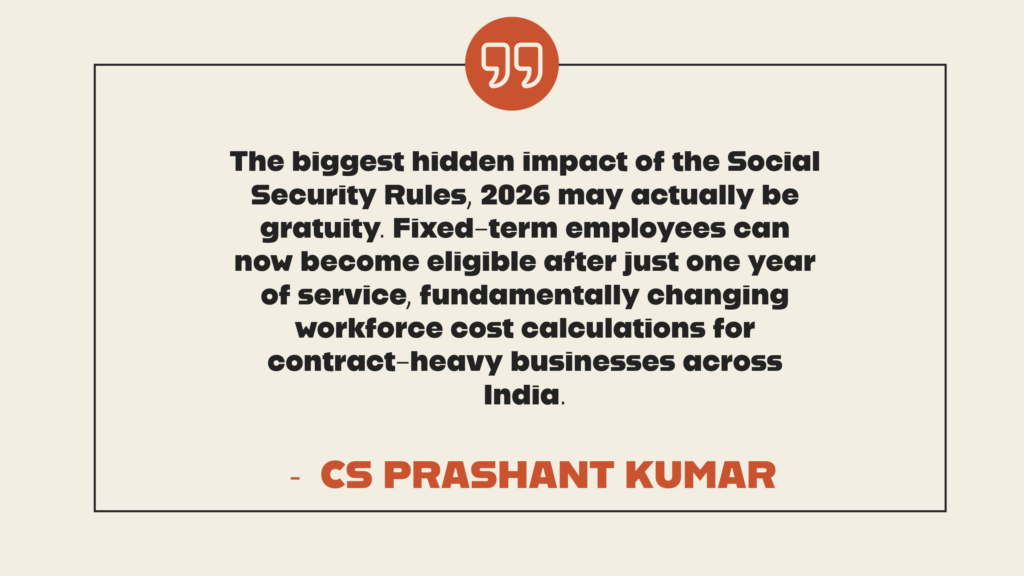
For fixed-term employees (FTEs), the change is significant: gratuity now accrues from the completion of one year of service, not five years. And in the year of separation, six or more months of service rounds up to a full year.
Why this matters — and what to do about it: for decades, the five-year continuous service threshold has been the unspoken reason why a great deal of Indian employment is structured on 11-month or 12-month renewable contracts. Companies that have built their workforces on FTE structures — IT services, ITeS, retail and quick-commerce, BFSI back-offices, electronics assembly, auto components — are now carrying a gratuity liability they have historically not provisioned for.
I would suggest three immediate steps for any company with a meaningful FTE base:
- Instruct your actuary to recompute the gratuity liability on the new year-one basis. This is not a wait-and-watch matter; your auditors will ask in the next quarter.
- Audit your contracts to identify which FTEs now trigger accrual. Some renewal patterns that were previously safe — repeated 11-month contracts — now compound against you because of the six-month rounding rule.
- Refresh your nomination database. Pull the Aadhaar of every nominee. The day you actually need a nomination — typically when an employee passes away in service — is the worst time to discover it is unenforceable.
Chapter VI — Maternity benefits, with the crèche rule that has expanded
This chapter standardises maternity certification, nursing breaks and crèche obligations across all sectors — not just factories.
Key thresholds:
- Crèche is now mandatory for any establishment with 50 or more employees (not 50 women employees — any 50 employees)
- Located within 1 km of the workplace (relaxable in industrial parks and clusters)
- Minimum 10 sq ft of floor area per child
- A trained woman-in-charge plus one ayah for every ten children
- Operating hours must match the workplace’s working hours, including shifts
- Nursing mothers are entitled to two breaks of 15 minutes each, plus up to 15 minutes of travel time per break
My take: the Maternity Benefit Act, 2017 already required this for “every establishment having fifty or more employees”, but the design specifications were vague and enforcement was patchy. The Rules now make every parameter explicit. Many service-sector employers — IT campuses, BPOs, financial services back-offices — have historically interpreted the obligation loosely. I expect inspections to begin testing these specifications during FY 2027.
If you are above the 50-employee threshold and do not currently provide a crèche, this is a Q3 priority, not a “we will get to it” item. The cleanest solutions I have seen are tie-ups with professional crèche operators (Klay, Founding Years, Little Elly are the main organised players); building in-house is rarely cost-effective unless you have multiple thousand employees on one campus.
Chapter VII — BOCW cess: how construction projects are now assessed
The Building and Other Construction Workers’ Welfare Cess regime has been restructured for clarity:
- Cess is self-assessed by a chartered engineer at the commencement of the project
- For government and public-sector projects, cess is deducted at source by the contracting authority
- Collected cess must be transferred to the relevant State Welfare Board within 30 days
Plain take: the self-assessment-by-chartered-engineer model is a workable improvement. It moves the cess determination away from a slow case-by-case authority review to a professional certification model, similar to how project costs are audited for income tax. Real-estate developers and infrastructure contractors should ensure their chartered engineer’s assessment certificates are properly maintained — that is the document the welfare board will ask for in any future scrutiny.
Chapter VIII — Gig workers and aggregators (the chapter that will reshape the platform economy)
This is the headline chapter, and it deserves to be understood properly.
For the first time, India has operational rules governing the relationship between platform aggregators — Ola, Uber, Zomato, Swiggy, Urban Company, Zepto, Blinkit, Rapido, Porter, and every comparable platform — and the gig and platform workers they engage.
What every aggregator must do:
- Within 45 days of these Rules coming into force, share gig and platform worker details with the designated portal via API for UAN generation
- New worker onboarding and exit reporting must be transmitted in real time (or at minimum, daily) via API
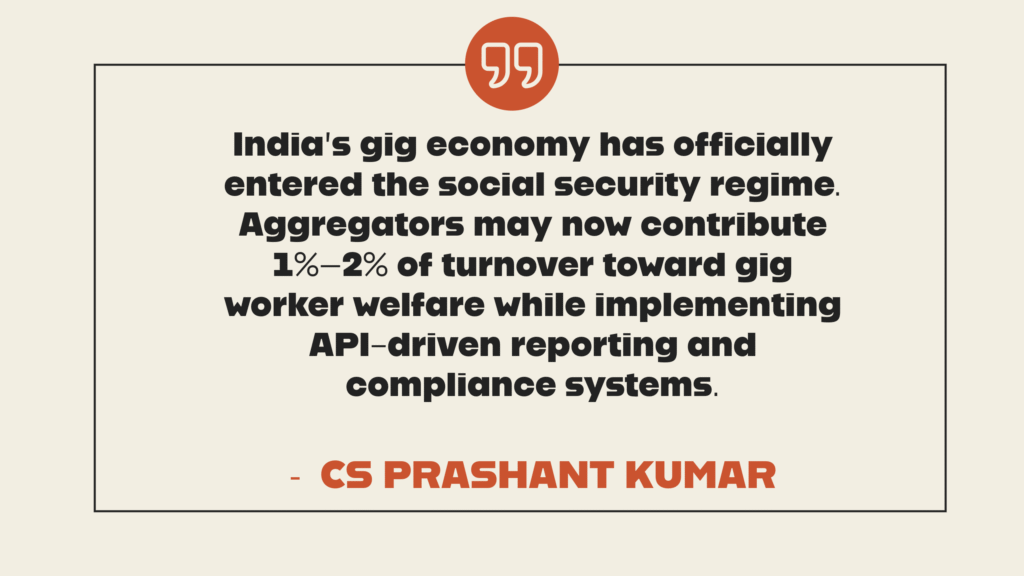
- Contribute between 1% and 2% of turnover to the Social Security Fund, capped at 5% of total payouts to gig and platform workers
- File the provisional contribution in Form-XX by 30 June
- File the final return in Form-XXI by 31 October, after statutory audit under the Income-Tax Act 2025, Companies Act 2013, or LLP Act 2008 as applicable
- Default in contribution attracts 1% interest per month
The captive structure trap is critical. Many platforms have, over the years, parked workers in associate companies, holding companies, subsidiaries, vendor LLPs and third-party manpower agencies — partly for tax efficiency, partly for labour-law cushioning. The new Rules expressly extend the 5% computation to workers engaged through any of these arrangements. The denominator is unified. Restructuring will not save you.
When does a gig worker become eligible for benefits?
The worker must have been engaged for:
- At least 90 days with a single aggregator, OR
- At least 120 days across multiple aggregators
…in the preceding financial year. A “day” is any calendar day on which the worker earned income from the aggregator, regardless of amount. Working with three aggregators on one calendar day counts as three engagement days. Benefits cease at age sixty.
My honest view: this chapter is a watershed. The 1-2% turnover contribution sounds small on paper but for unicorn-scale food delivery and ride-hailing platforms operating on thin or negative contribution margins, it is a real number that will need to be priced into unit economics. The captive-structure trap is well drafted and closes a loophole that several large platforms have quietly relied on. The 90/120 day eligibility threshold is, in my reading, deliberately calibrated to capture genuine platform-dependent workers — the full-time delivery executive, the full-time driver — while excluding genuinely casual side-income earners. It is a defensible policy line.
If you run a platform business, this is the chapter that should be on your CEO’s desk this week. The 45-day API integration window is tight. Most aggregators will need external technology support to build the data pipeline; that procurement decision needs to be made now.
Chapter IX — Finance, accounts and write-offs
This chapter governs how the various welfare funds are administered financially.
Two points worth knowing:
- Dues that are irrecoverable can be written off where the establishment has been closed for more than five years
- ESIC accounts are subject to CAG audit
Plain take: this is mostly internal financial-administration plumbing. For employers, the only practical implication is that you should not assume historical EPF or ESI dues will quietly disappear — the five-year-closure threshold for write-off is genuinely tight, and active or recently-active establishments will continue to face recovery action on legacy dues.
Chapter X — Records, registers and the unified annual return
This chapter is small in length but large in operational impact.
- All registers must now be maintained electronically, in a format consistent with the Wages (Central) Rules, 2026
- Five-year retention of all records and registers
- The legacy multiplicity of annual returns under EPF, ESI, Maternity Benefit and BOCW is replaced by a single unified annual return in Form-XXIII, due by 28 (or 29) February each year
My take: this is the chapter that genuinely simplifies life for compliance teams. One return, one deadline, one format. If your organisation is still running paper-based attendance, wage and contribution registers, this is the time to migrate. Several HR-tech platforms (Keka, Darwinbox, GreytHR) are already updating their compliance modules for Form-XXIII; the migration should not take more than a quarter for most mid-sized employers.
Chapter XI — Offences and compounding
Where a violation can be compounded, the compounding notice is now issued electronically in Form-XXIV, and the compounded amount must be deposited within 15 days.
Plain take: electronic compounding is faster and more transparent than the old paper-based regime. The 15-day deposit window is firm — missing it converts a compoundable matter back into a prosecutable one. Compliance officers should set up internal alerts for any compounding notice received, with escalation if the deposit is not actioned within seven days.
Chapter XII — Career Centres and vacancy reporting
The old Employment Exchanges framework has been replaced by Career Centres. The notable change: private establishments with 20 or more employees must now report vacancies, with unique vacancy reporting numbers issued in three working days (seven in the North-Eastern States).
My take: the 20-employee threshold is genuinely low and catches a wide swathe of mid-sized Indian companies that have previously had no employment-reporting obligation at all. This is not a heavy procedural burden, but it does mean that for the first time, mid-sized private employment data will flow systematically to the central authority. Over time, this data will feed into sectoral wage and employment analytics. Compliance teams should not dismiss this as a formality — set up an internal workflow that routes every new vacancy through the Career Centre reporting portal before posting it on job boards.
Chapter XIII — Employee’s Compensation
If you delay paying compensation due to an injured employee or their dependants beyond 30 days, you owe 12% per annum simple interest on the unpaid amount.
The chapter also provides a mechanism for the cross-border transfer of compensation to dependants residing outside India — a useful provision for organisations with expatriate workforces or for dependants of Indian workers in international postings.
Plain take: the 12% interest number is meaningful. For a company that delays a substantial compensation payout by a year, the interest cost alone can exceed the legal fee for handling the matter properly in the first place. Process discipline here directly protects the bottom line.
Chapter XIV — Miscellaneous: the Social Security Fund and exemptions
This final chapter governs the Social Security Fund (which receives aggregator contributions and other earmarked moneys) and the exemption mechanism under Section 143 of the Code.
The exemption bar is high. An establishment seeking exemption from EPF and other welfare obligations on the ground that it operates substantially similar or superior schemes must now demonstrate:
- A three-year compliance history
- At least 500 contributing members
- A corpus of ₹50 crore
- Positive net worth for the three preceding years
- Full Aadhaar seeding of all members
My take: these thresholds are deliberately stringent. They effectively close the exemption route for all but the largest legacy private-sector schemes — typically those of public-sector undertakings, large banks and a handful of conglomerates with their own provident fund trusts. The policy direction is unambiguous: the government wants money in the central Social Security Fund, not in fragmented private trusts. If you are presently operating under an exemption, expect renewed scrutiny on whether you continue to meet the new thresholds.
The cross-cutting themes (the patterns to internalise)
Stepping back from chapter-by-chapter detail, four patterns run through the Rules that define the texture of the new regime.
Digital-first is no longer optional. Almost every interaction with the regulator — registration, returns, nominations, compounding, appeals, vacancy reporting — is now mandatorily electronic, with the Shram Suvidha Portal as the central pipe. If your compliance workflow still depends on physical filings, plan the migration this quarter.
Aadhaar has become structural. Every welfare benefit nomination requires Aadhaar. Every exemption application requires Aadhaar seeding. Old debates about Aadhaar’s role in welfare have effectively been settled in favour of universal seeding.
Deemed approvals are a real procedural tool. Seven days for registration, sixty days for certain exemption decisions. If the authority does not act, the applicant gets the benefit. Use it — keep clean evidence of submission timestamps, because if a clock runs out in your favour, that document is your shield.
Inter-statute integration is accelerating. The aggregator audit linkage to the Income-Tax Act, 2025 is a small but telling detail. The era of treating labour, tax and corporate compliance as separate silos is closing. Expect the next round of rules — under the other three labour codes, which are also in pipeline — to push this integration further.
The compliance calendar in one place
| Trigger | Deadline | Action |
|---|---|---|
| Change in establishment particulars | 30 days | Update on Shram Suvidha Portal |
| Aggregator API onboarding (one-time) | 45 days from notification | Share worker data via API |
| Aggregator provisional contribution | 30 June | File Form-XX |
| Aggregator final return | 31 October | File Form-XXI |
| Unified annual return | 28 / 29 February | File Form-XXIII |
| Gratuity claim response | 15 days | Respond to claimant |
| Gratuity payment | 30 days | Pay via DD or bank credit |
| Compounding deposit | 15 days from notice | Pay compounded amount |
| Records retention | 5 years | Maintain electronically |
| Delayed employee’s compensation | Beyond 30 days | 12% p.a. simple interest |
| Aggregator contribution default | Per month | 1% interest per month |
Three questions every board should ask this quarter
For senior management and audit committees now reviewing the impact of these Rules, three questions cut to the heart of likely exposure.
On gratuity: have we recomputed our gratuity liability assuming year-one accrual for fixed-term employees? Is the increased actuarial provision reflected in the next financial statements? Have nomination records been refreshed with Aadhaar?
On platform exposure: if our business model depends on gig or platform workers — directly or through any group entity — are we ready in 45 days? Is the API integration scoped and resourced? Have we modelled the 1-2% turnover contribution against current EBITDA?
On operational readiness: are our registrations, returns and registers ready for migration to the unified electronic regime? Do our HR policies on crèche, maternity, nursing breaks and vacancy reporting reflect the new thresholds? Do we know which legacy filings disappear and which replace them?
The bottom line
The Social Security (Central) Rules, 2026 are the largest single consolidation of Indian labour welfare law since Independence. For most employers, the procedural changes are manageable — provided they are actioned in time. For employers with large fixed-term workforces, the gratuity exposure is real and largely unprovisioned. For aggregators, the 45-day clock has already started.
These Rules reward those who move first. The cost of inaction is now measurable — in interest, in actuarial provisions, in deferred audit qualifications, and in reputational risk.
The Code is no longer theoretical. The Rules are here. The compliance calendar has begun.
About the Author
Prashant Kumar is a Company Secretary, Published Author, and seasoned professional in corporate and financial services regulation. He currently serves as Company Secretary and Compliance Officer at Global Horizons Capital Advisors (IFSC) Private Limited, an IFSCA-licensed Investment Banker based in GIFT City, with direct, on-ground exposure to capital market transactions and regulatory structuring within the IFSC ecosystem.
He brings hands-on experience in IPOs, direct listings, and exchange listings, along with deep expertise in GIFT IFSC structuring, fund setup across FME and AIF frameworks, corporate governance, and regulatory compliance — including the labour, social security and HR compliance requirements that apply to financial services entities operating within the IFSC and the wider Indian regulatory environment.
His current role at an IFSCA-licensed entity in GIFT City gives him direct working familiarity with the intersection of corporate, securities and labour regulation as it affects financial services activity — including the workforce-structuring choices that platforms, fund managers, and operating companies need to make under the new Social Security (Central) Rules, 2026.
For professional discussions on the Social Security (Central) Rules, 2026 — whether it is a gratuity-exposure review for your fixed-term workforce, an aggregator readiness assessment under Chapter VIII, group-entity structuring under the new aggregation rule, or a broader compliance gap-check against the unified framework — Prashant Kumar and the team at Global Horizons Capital Advisors are positioned to provide structured, regulation-grounded advisory.
He also advises on GIFT IFSC leasing structures, fund setup, IPOs, listings, and regulatory strategy more broadly.
📞 +91 9821008011 | ✉️ prashant.kumar@global-horizons.in
This article reflects the author’s professional analysis and is intended for general guidance. It does not constitute legal advice. Readers should obtain specific advice on their particular circumstances before acting.