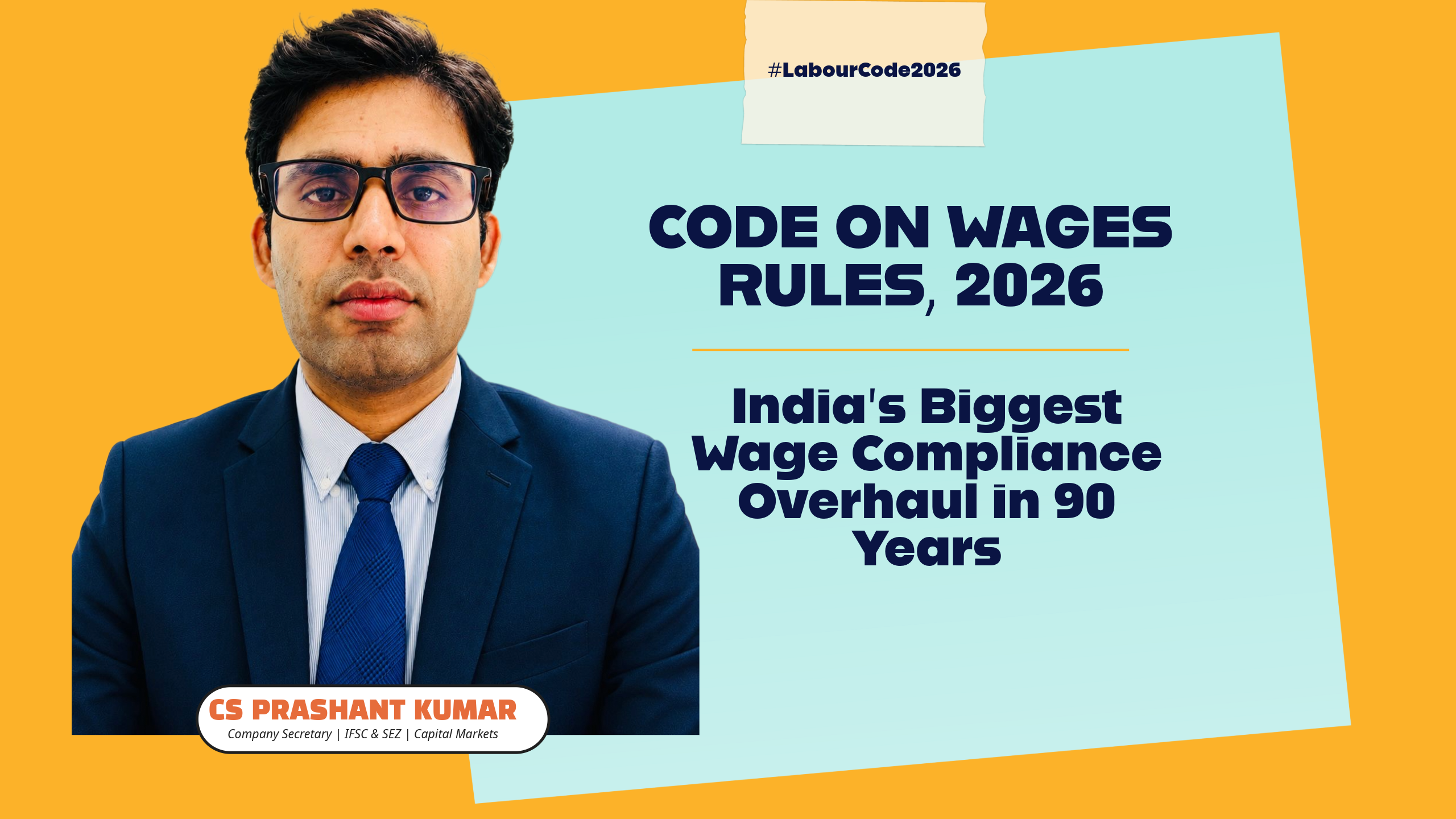
CS PRASHANT KUMAR | Company Secretary & Compliance Officer | Global Horizons Capital Advisors (IFSC) Private Ltd
On 8 May 2026, the Ministry of Labour & Employment notified the Code on Wages (Central) Rules, 2026 — finally bringing the Code on Wages, 2019 to life. Seventeen old laws have been replaced. Minimum wage calculation has been standardised. The bonus framework now applies across every covered establishment. Disciplinary deductions follow a strict 7-day / 15-day procedural code. And appeals against wage claims now require a 100% pre-deposit. Here is everything in the new Rules, explained in plain English — with my notes on what each part actually means for your business.
First, the big picture: what just changed and why it matters
For nearly ninety years, India’s wage administration sat across at least four separate statutes — the Payment of Wages Act of 1936, the Minimum Wages Act of 1948, the Payment of Bonus Act of 1965, and the Equal Remuneration Act of 1976 — each with its own rules, its own forms, its own registers, and its own inspector. Compliance was scattered. Litigation was fragmented. And the same wage dispute could move through multiple authorities depending on which Act it came under.
The Code on Wages, 2019 was Parliament’s first attempt at unifying all of this into a single statute. But a law needs operational rules to come alive, and those rules took seven years to arrive. They have now arrived. The Code on Wages (Central) Rules, 2026, notified through Gazette S.O. 343(E), span 8 chapters, 54 rules, 9 forms and 4 appendices.
This is the second labour code to come into force in 2026 (the Social Security Rules were notified the same day). The Industrial Relations Code and the Occupational Safety, Health & Working Conditions Code are next.
My quick take: these Rules do something the four parent Acts never managed in 90 years — they create a single, unified compliance framework for wage administration in India. The most consequential design choices are not in the headline-grabbing minimum wage chapter but in the procedural chapters: the 100% pre-deposit on employer wage-claim appeals, the 7-day / 15-day disciplinary framework, and the unified employee register that now sits across multiple labour codes. If you run a business in India, at least four chapters here will require operational changes in the next 90 days.
Let me walk you through what each chapter says and what you should actually do about it.
Chapter I — How the Rules define the playing field
The opening chapter establishes scope and definitions. Two things deserve attention.
First, the definition of “electronically” has been deliberately expanded. It now covers email, designated portals, mobile applications, websites, and any digital payment mode. This is not casual drafting — it is the statutory basis for the entire Code being administered through electronic compliance.
Second, the Rules introduce a four-tier skill classification — highly skilled, skilled, semi-skilled, and unskilled — that anchors minimum wage fixation throughout the Code. Each tier has a specific definition tied to training, experience, judgment, and supervisory requirements.
What this means in practice: every employee in your organisation now needs to be tagged into one of these four skill tiers in your HR records. This is not a nominal exercise — minimum wage notifications, bonus computations, and overtime calculations will reference these tiers going forward. If your job descriptions are still vague or your skill classifications are inconsistent across departments, this is a Q3 priority. I would also recommend documenting the basis on which each tier is assigned, because skill-classification disputes are likely to become a fresh head of wage litigation over the next two years.
Chapter II — How minimum wages are now calculated
This chapter is the operational heart of the Code on Wages. It standardises minimum wage computation across the country in a way no previous statute managed.
The basics:
- Minimum wages are fixed on a daily basis, with detailed criteria notified separately by the Central Government
- Daily rate ÷ 8 = hourly rate
- Daily rate × 26 = monthly rate
- Rounding works in the employee’s favour: halves and above round up, below half drops
- Central Government employees are expressly excluded — they continue under their existing pay scales
The variable dearness allowance (VDA):
- Revised twice every year — before 1 April and before 1 October
- Computed by reference to the Average Consumer Price Index for Industrial Workers, published by the Labour Bureau, Ministry of Labour & Employment
Working hours and rest:
- Normal working day = 8 hours
- Weekly cap = 48 hours, regardless of how many days are worked
- One weekly rest day mandatory — Sunday in a six-day week; Saturday + Sunday in shorter weeks
- The employer can substitute the rest day, but no more than 10 consecutive working days are permitted without a rest day
- Work performed on a rest day must be paid at overtime rate (minimum twice the normal wage) plus a substituted rest day at normal rate
- Night shifts that extend past midnight are treated specially — the rest day clock starts when the shift ends
My take: the 48-hour weekly cap is the headline number for HR teams to internalise. It is more permissive than the 40-hour cap that some states had been moving toward, and it formally enables traditional six-day workweeks at eight hours each — which still characterises most of India’s organised manufacturing, retail, BFSI back-office, and services sectors.
The 10-consecutive-days rule is the new compliance trap. Any shift roster that pushes an employee through more than ten working days without a rest day is now expressly non-compliant, even if the employee is paid overtime. For sectors that run continuous operations — IT/ITeS night shifts, manufacturing campaigns, retail festive seasons, hospitality, healthcare — this requires a roster audit. I have already seen draft rosters in client organisations that violate this rule without anyone realising it.
The twice-yearly VDA revision is also new. Most payroll systems are configured to update minimum wages annually on Central Government notification. From now, the April and October dates are hard. Build them into your payroll calendar as recurring events, not as discretionary updates.
Chapter III — The national floor wage
This chapter is short but politically significant. The Central Government will fix a national floor wage in consultation with the Central Advisory Board and State Governments, taking into account food, clothing, housing, and minimum living standard.
The floor wage is reviewed every five years, with periodic adjustments for cost-of-living variations.
Plain take: the floor wage sets a national baseline below which no State can fix its own minimum wage. For employers operating across multiple states, this introduces a measure of standardisation that has been politically debated since the Code was passed in 2019.
The actual floor wage number is not in these Rules — it will be notified separately. When it is announced, the impact will fall hardest on states that currently have minimum wages below the new floor. For multi-state employers — particularly retail chains, logistics, hospitality, and manufacturing with plants in lower-wage states — this could mean an immediate wage bill increase in select locations. Run a state-wise minimum wage gap analysis now, so that when the floor wage is notified you have your exposure quantified within 48 hours.
Chapter IV — Payment of wages and the new disciplinary framework
This is the chapter most HR practitioners will spend the most time with, because it governs the day-to-day mechanics of wage administration and disciplinary deductions.
For contractual employees:
Where workers are employed through a contractor, the principal employer (the company, firm, or association that owns the establishment) must pay the contractor the wage amount due, and the contractor pays the workers. If the contractor defaults, the principal employer steps in. The legal exposure does not vanish by routing employment through a vendor — a principle that has been reaffirmed across the new labour codes.
The 50% deduction cap:
Total authorised deductions cannot exceed 50% of an employee’s wages in any wage period. Where deductions exceed this cap, the excess is carried forward to the next wage period — but again subject to the same 50% cap on that month’s wages. In effect, no single month can ever see more than half of the wage absorbed by deductions.
The 7-day / 15-day disciplinary framework:
Whether the employer is imposing a fine, making a deduction for absence from duty, or deducting for damage or loss, the procedure is now identical:
- The employer must give electronic or written notice specifying the act or omission
- The employee has 7 days to respond with cause
- If charges are established, the fine or deduction is imposed
- The employee must be intimated within 15 days of imposition
The notice listing acts and omissions for which fines can be levied must be displayed in Hindi, English and the local language at a conspicuous place in the workplace, AND a copy sent to the Inspector-cum-Facilitator having jurisdiction.
The “approving authority” for fines under Section 19 of the Code is the Deputy Chief Labour Commissioner (Central)of the jurisdiction.
Recovery of advances and loans:
Recovery of any advance or loan in instalments cannot push total deductions in any wage period beyond the 50% cap. Recoverable interest on loans follows Central Government guidelines issued from time to time.
My take: the 7-day notice and 15-day intimation framework is non-negotiable due process. Every disciplinary deduction in your payroll system must now flow through this gate. Skipping the notice, missing the 7-day window, or failing to intimate within 15 days will make the deduction challengeable — and in my experience, employees who do challenge such deductions tend to recover not just the disputed amount but interest and procedural costs.
For HR teams, I would suggest three immediate steps:
- Build the 7-day / 15-day timeline into your HR information system as automated workflow gates. No fine or deduction should be capable of being processed in payroll without these checkpoints clearing.
- Audit your existing list of “acts and omissions” for which fines are imposed. It must be displayed in three languages and registered with the Inspector-cum-Facilitator. Most workplaces I have seen still display this only in English.
- Update employee contracts and HR policy manuals to reflect the new disciplinary procedure. The Code does not grandfather old procedures — every disciplinary action from notification date onward must follow the new framework.
Chapter V — Bonus, set-on, set-off, and the new universal application
The bonus chapter retains the substance of the Payment of Bonus Act, 1965, but extends it operationally to every covered establishment under the Code.
For contractual workers: if a contractor fails to pay bonus due under Section 26, the principal employer must pay the minimum bonus on written notice from the workers or their registered trade union.
The set-on / set-off mechanism:
If allocable surplus in any year exceeds the maximum bonus (20% of wages):
- The excess is set on — carried forward to the next year
- Capped at 20% of the total wage bill in the carrying year
- Available for the next 4 accounting years
If allocable surplus falls short of the minimum bonus (8.33%):
- The shortfall is set off — carried forward
- Same 4-year window
- Used to top up minimum bonus in deficit years
Appendix A illustrates this with a worked 10-year example. Appendix B and C set out the gross profit computation methodology — separately for banking companies (Appendix B) and all other establishments (Appendix C). Appendix D lists the prior charges to be deducted from gross profit before bonus computation, including preference dividends, 8.5% of paid-up capital, 6% of reserves, and so on, varying by employer category.
My take: the substantive bonus mechanism is unchanged — anyone who has computed bonus under the 1965 Act will find familiar territory in Appendices A through D. What is genuinely new is the scope of application. Under the old Act, the bonus obligation was largely confined to establishments with twenty or more employees. The Code on Wages broadens this materially.
For mid-sized employers who have historically been outside the bonus net, this is now a fresh annual compliance and a fresh financial liability. The 8.33% minimum bonus on the wage base of an excluded mid-sized workforce can run into significant rupee numbers. I would suggest two immediate steps:
- Run the Appendix C gross profit calculation on your last three years of financial statements to understand the baseline. If your allocable surplus has been negative or thin, set-off planning matters.
- Build the bonus computation into your annual financial close process. Several mid-sized employers historically computed bonus only when challenged. The new framework leaves no room for that approach.
Chapter VI — The Central Advisory Board, in brief
This chapter governs the constitution and functioning of the Central Advisory Board that advises the government on minimum wage and equal remuneration matters.
Key features worth knowing:
- 3-year terms for members, capped at two terms
- Quorum = one-third of members, with at least one representative each from employers and employees
- Meetings called with 15 days’ notice (7 days for emergencies)
- Decisions by majority; Chairperson holds the casting vote
- Decisions by circulation require two-thirds majority
- Disqualification grounds: unsound mind, undischarged insolvency, or conviction involving moral turpitude
Plain take: governance plumbing. Directly relevant only to industry associations and trade unions that nominate Board members or engage with its consultations. For most employers, the practical relevance is that the Board is the channel through which industry can shape minimum wage and floor wage decisions. If your industry association has a Board seat, use it.
Chapter VII — Nominations, undisbursed dues, and the death-in-service workflow
This chapter deals with what happens when an employee passes away or cannot be traced and wages remain undisbursed. It is administratively important and procedurally strict.
The nomination framework (Rule 45):
Every employee must file a Form-VII nomination designating who receives undisbursed dues on their death. The rules are clear:
- If the employee has a family, the nomination must be in favour of the spouse, or the spouse along with one or more family members — a nomination outside the family is invalid where a family exists
- A fresh nomination is required after marriage — any nomination made before marriage is deemed invalid once marriage occurs
- For minor nominees, the employee can appoint a guardian within the family
- Multiple nominees must have specified shares totalling 100% of the dues
If dues remain undisbursed:
- Unpaid for 3 months after death or because the employee’s whereabouts are unknown → the employer must deposit the amount with the Deputy Chief Labour Commissioner (Central) of jurisdiction
- The DCLC has 2 months to identify the nominee and disburse
- Unpaid for 6 months for any other reason → also deposited with the DCLC, within 15 days of the end of that 6-month period
- Deposits must be made by bank transfer or crossed demand draft
- The DCLC publishes notice in two local newspapers in the vernacular of the work area AND two local newspapers in the vernacular of the employee’s home area
- If the deposit remains unclaimed for 7 years, it is dealt with as the Central Government directs
My take: the nomination database is the under-recognised compliance risk in most Indian organisations. Two checkpoints HR teams must build in:
- A fresh-nomination workflow on marriage. Most HRMS platforms do not currently flag this. When an employee updates marital status, the system should automatically prompt for a refreshed Form-VII. This single workflow change closes the largest practical gap most employers have on this Rule.
- Automated tracking of the 3-month and 6-month deposit clocks. Once dues become payable after death, the clock starts running. The employer’s obligation to deposit with the DCLC is unconditional after 3 months for death cases and 6 months otherwise. Missing this is not a paperwork issue — it is a statutory default.
The vernacular-newspaper notification requirement is also worth flagging to clients with employees from multiple language regions. The DCLC handles the notification, but the employer’s deposit obligation includes furnishing accurate home-address information to enable it.
Chapter VIII — Forms, registers, wage slips, claims and compounding
This is the longest operational chapter and the one that defines daily compliance.
Registers every employer must maintain — electronically or in physical form:
- Form-I — Employee Register: 36 fields covering identity, family, UAN, PAN, Aadhaar, EPS/NPS membership, ESIC IP number, bank details, nominee, posting history, photo, specimen signature, mark of identification, date and reason for exit
- Form-IV — Register of Wages, Overtime, Advances, Fines & Deductions for Damage and Loss
- Form-IX — Attendance Register-cum-Muster Roll
Retention: all registers must be preserved for 5 years after the date of the last entry.
Wage slips must be issued on or before the wage payment date in Form-V, electronically or physically. Required fields cover basic, DA, allowances, attendance, overtime, gross wages, all deductions (PF, ESI, others), and net wages paid.
Returns are now filed electronically in the formats prescribed under the Occupational Safety, Health & Working Conditions Code, 2020 — so the wage return is unified with the OSH return. One filing covers both Codes.
Claims procedure (Rule 49):
- A single application can be filed on behalf of multiple employees with similar claims relating to the same wage period or the same incident of discrimination
- Filed in Form-II before the authority under Section 45
- Notice to employer in Form-VIII
- Authority can decide ex-parte if the employer fails to appear
- The application is dismissed if the applicant fails to appear without reasonable cause
Appeals procedure (Rule 50):
- Filed in Form-III before the appellate authority
- An employer’s appeal is not admitted unless the full claim amount is deposited at the time of filing
- Same ex-parte / dismissal logic applies
Compounding of offences (Rule 54):
- Application in Form-VI to the notified Gazetted Officer
- Composition amount = 50% of the maximum fine prescribed for that offence under the Code
- Payment within 30 days of the composition order
- Composition certificate issued within 10 days of receipt of payment
- If the accused fails to deposit within the specified time, prosecution proceeds before the competent court
My take: the 100% pre-deposit rule on employer wage-claim appeals is the single most consequential procedural design in these Rules, and it is not getting the attention it deserves.
In every other comparable Indian statute — GST, customs, EPF — the pre-deposit for an appeal sits somewhere between 7.5% and 25% of the disputed amount. The Code on Wages now requires the entire claim amount to be deposited before an appeal is even admitted. This will fundamentally change the economics of wage-claim litigation in India.
For employers, this means three things:
- Every wage claim should be defended seriously at the authority stage, because the cost of losing and then appealing is now the full disputed amount tied up upfront.
- Borderline claims should be settled rather than appealed, even where the employer believes the merits are on its side. The opportunity cost of capital is meaningful.
- Internal payroll and disciplinary processes need to be bulletproof — because procedural defects (missed 7-day notice, missed 15-day intimation, missing wage slip) are now the easiest routes to a successful employee claim.
I would also suggest that any organisation with open wage-claim litigation should re-evaluate its dispute strategy in light of this change. Cases that were worth taking up on appeal under the old 25%-style pre-deposit assumptions may not be worth it now.
The cross-cutting themes practitioners should internalise
Stepping back from the chapter-by-chapter detail, five patterns run through these Rules that define the new regime.
Digital-first by default. Almost every interaction — registration, returns, wage slips, nominations, claims, appeals, compounding — is now electronic. Physical alternatives are permitted but treated as the exception. The Shram Suvidha Portal is the central pipe.
Unified registers across the labour codes. Form-I (Employee Register), Form-IV (Wages Register), and Form-IX (Attendance Register) are now common across the Code on Wages, the Code on Social Security, and (when their rules come) the OSH and IR Codes. Payroll-software vendors are already updating their compliance modules. If your organisation maintains separate registers across statutes, consolidate now.
Skill-tier classification is now structural. Highly skilled / skilled / semi-skilled / unskilled is the basis for minimum wage fixation. Every employee record must be properly tagged. Inconsistent classification will become a fresh head of wage litigation over the next two years.
Twice-yearly VDA revision. April and October. Auto-update your payroll systems for these dates as recurring events, not as discretionary updates.
The 100% pre-deposit on employer wage appeals is a hard de-litigation tool. It will reshape how wage disputes are managed. Front-load your compliance discipline so disputes do not arise — because once a claim is filed and the authority rules against you, your appeal route is economically expensive.
The compliance calendar in one place
| Trigger | Deadline | Action |
|---|---|---|
| VDA revision | Before 1 April and 1 October each year | Recompute and update payroll |
| Show-cause notice for fine / deduction | 7 days | Employee response window |
| Intimation of fine / deduction imposed | 15 days from imposition | Notify employee electronically or in writing |
| Wage slip | On or before wage payment date | Issue in Form-V |
| Undisbursed dues on death of employee | 3 months from due date | Deposit with DCLC (Central) |
| Undisbursed dues for any other reason | 6 months from due date | Deposit with DCLC (Central) |
| Records retention | 5 years from last entry | Preserve all registers |
| Composition of offence | 30 days from order | Pay 50% of maximum fine |
| Composition certificate issued | 10 days from payment | Form-VI Part B |
| Employer wage-claim appeal | At time of filing | Deposit 100% of claim amount |
| Board meeting notice | 15 days (7 days emergency) | Circulate agenda |
| Maximum consecutive working days | 10 | Without a rest day |
📲 Stay updated in real-time
The labour codes are still rolling out. New clarifications, FAQs from the Ministry, state-level adaptations, and the upcoming Industrial Relations and OSH Code rules will follow over the coming months. For real-time updates and practitioner notes on the Code on Wages, the Social Security Rules, and the broader regulatory landscape, join my WhatsApp channel:
Three questions every board should ask this quarter
For senior management and audit committees reviewing the impact of these Rules, three questions go to the heart of likely exposure.
On payroll architecture: are our payroll systems configured to auto-update wages on the 1 April and 1 October VDA revision dates? Have we tagged every employee record in Form-I with the correct skill tier? Are wage slips being issued in Form-V on or before the payment date — electronically or physically?
On disciplinary procedure: are the 7-day notice and 15-day intimation timelines built into our HR information system as hard gates? Is our list of fineable acts and omissions displayed in Hindi, English, and the local language at the workplace, and registered with the Inspector-cum-Facilitator? Have we trained line managers on the new procedural requirements?
On dispute strategy: are we prepared for the 100% pre-deposit rule on wage-claim appeals? Does this change how we approach our existing open wage disputes? Have we evaluated whether borderline matters should be settled rather than litigated under the new economics?
The bottom line
The Code on Wages (Central) Rules, 2026 do something the four parent Acts never accomplished in 90 years: they create a single, unified compliance framework for wage administration in India. The headline change is consolidation, but the practical changes that will affect employers daily are procedural — the 7-day / 15-day disciplinary framework, the 100% pre-deposit on appeals, the twice-yearly VDA, the unified registers across labour codes, and the four-tier skill classification.
For most employers, the operational changes are manageable provided they are actioned in time. For employers running multi-state operations with complex shift rosters and fixed-term workforces, the scope of work is more substantial — and the deadlines are tight.
The Code on Wages is no longer a 2019 statute waiting for its rules. The Rules are here. The compliance calendar has begun.
These Rules, taken together with the Social Security (Central) Rules, 2026 notified the same day, represent the largest single consolidation of Indian labour and wage law in modern memory. The two codes that remain — Industrial Relations, and Occupational Safety, Health & Working Conditions — are next in the pipeline. The texture of the new regime, however, is already visible. It rewards employers who move first.
About the Author
Prashant Kumar is a Company Secretary, Published Author, and seasoned professional in corporate and financial services regulation. He currently serves as Company Secretary and Compliance Officer at Global Horizons Capital Advisors (IFSC) Private Limited, an IFSCA-licensed Investment Banker based in GIFT City, with direct, on-ground exposure to capital market transactions and regulatory structuring within the IFSC ecosystem.
He brings hands-on experience in IPOs, direct listings, and exchange listings, along with deep expertise in GIFT IFSC structuring, fund setup across FME and AIF frameworks, corporate governance, and regulatory compliance — including the labour, wage, and HR compliance requirements that apply to financial services entities operating within the IFSC and the wider Indian regulatory environment.
His current role at an IFSCA-licensed entity in GIFT City gives him direct working familiarity with the intersection of corporate, securities and labour regulation as it affects financial services activity — including the wage, bonus, and disciplinary compliance choices that platforms, fund managers, and operating companies need to make under the new Code on Wages (Central) Rules, 2026.
For professional discussions on the Code on Wages (Central) Rules, 2026 — whether it is a payroll architecture review, a disciplinary procedure audit, a bonus liability assessment, a wage-claim defence strategy, or a broader compliance gap-check against the unified framework — Prashant Kumar and the team at Global Horizons Capital Advisors are positioned to provide structured, regulation-grounded advisory.
He also advises on GIFT IFSC leasing structures, fund setup, IPOs, listings, and regulatory strategy more broadly.
📞 +91 9821008011 | ✉️ prashant.kumar@global-horizons.in
🔗 csatwork.in · 📲 WhatsApp Channel · LinkedIn: csprashantkumar · Instagram: @pkforchange
This article reflects the author’s professional analysis and is intended for general guidance. It does not constitute legal advice. Readers should obtain specific advice on their particular circumstances before acting.