Legal, tax and operational differences every promoter group should evaluate before choosing an FPO structure.
By Prashant Kumar
Introduction
When farmer groups come together to form an FPO, the first real decision is not about capital, business plan, or crop strategy—it is about choosing the right legal structure. In India, the two practical options are a Producer Company under the Companies Act, 2013 or a Cooperative Society under State Cooperative Laws. Both are farmer-owned, member-driven, and built for collective benefit. Yet the governance culture, compliance burden, tax treatment, and operational freedom differ significantly.
For promoters, NGOs, and implementation agencies, this choice shapes everything that follows—grant eligibility, bankability, voting rights, taxation, audit discipline, and even the perception of professionalism. If you have already gone through the basics of how to register an FPO (your pillar article), this piece will help you evaluate which structure best supports long-term growth and credit readiness.
What is the difference between a Producer Company and a Cooperative Society?
A Producer Company is a corporate structure governed by the Companies Act with professional governance, limited liability, and democratic voting. A Cooperative Society is regulated under state cooperative laws, often with government oversight, lower compliance costs, and community-driven decision-making. Producer Companies suit commercial FPOs; cooperatives suit purely welfare-oriented groups.
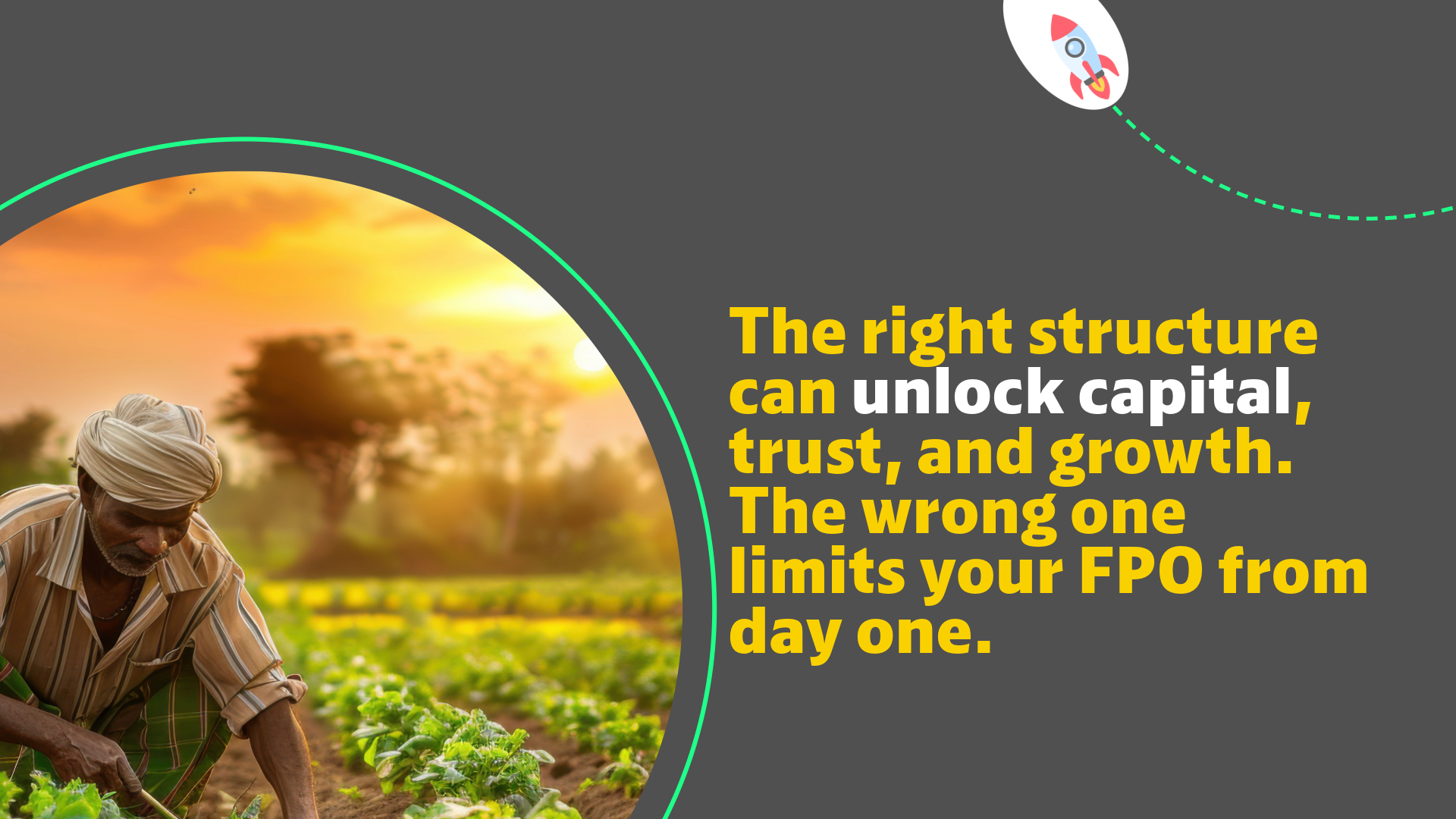
Producer Company: A Corporate Model Built for Commercial Scale
A Producer Company blends farmer ownership with corporate governance. Registered under the Companies Act, 2013 (Chapter on Producer Companies), it enjoys the credibility of a corporate entity while preserving cooperative principles like one-member-one-vote. For FPOs that plan to engage in aggregation, processing, value addition, and market linkages at scale, the Producer Company is often the natural choice.
Key advantages for growth-focused FPOs
The biggest strength is governance discipline. The Board must meet regularly, maintain registers, approve budgets, and follow transparent decision-making. This aligns well with requirements for SFAC equity grants, NABARD promotion assistance, NCDC infrastructure finance, and commercial bank credit. Most lenders and CSR partners also prefer the Producer Company model because accounts are audited annually and MCA filings create a transparent financial trail.
A Producer Company also offers limited liability, making it safer for directors. Farmers’ risks are capped to their shares, unlike traditional cooperatives where unlimited liability sometimes applies.
Tax treatment and accounting clarity
Producer Companies benefit from agricultural-income exemptions—when activities involve primary production, marketing, or processing. If your FPO expects a mix of agricultural and non-agricultural income, the tax planning complexities explained in your FPO taxation and accounting guide become crucial because corporate structures provide cleaner separation of revenue streams, depreciation, and grant accounting.
Best suited for:
- Market-linked FPOs
- Groups aiming for processing units, cold chains, packhouses
- FPOs targeting supermarkets, exporters, e-commerce
- Organisations planning to raise capital or seek NCDC finance
Cooperative Society: Community-Centric, Familiar, and State-Controlled
Cooperative Societies remain the oldest farmer-collective model in India. Registration is under state-specific Cooperative Acts, which vary widely across India. They are deeply rooted in community processes, with lower compliance requirements and simpler governance norms.
Strengths in grassroots, welfare-driven ecosystems
For NGOs working in remote areas or very small clusters, cooperatives offer flexibility. Their compliance load is lower, meeting formats are simpler, and farmers often feel more culturally aligned with the cooperative tradition. Many state-level welfare schemes and community projects still use cooperative structures because they fit into existing administrative frameworks.
Limitations for commercial expansion
However, cooperatives face inherent limitations:
- Government interference or registrar control in many states
- Slower governance because changes need registrar approval
- No concept of limited liability in several state laws
- Lower acceptance by banks for credit
- Difficulties attracting professional talent without corporate governance
If an FPO intends to scale beyond local mandi procurement, the cooperative format often becomes restrictive.
Best suited for:
- Welfare-oriented farmer collectives
- Small clusters with localised marketing
- NGOs focusing on social mobilization rather than enterprise development
Governance Differences That Change Everything
Decision-Making: Corporate Discipline vs Community Voting
Producer Companies follow structured governance—regular board meetings, resolutions, minutes, audited statements. Cooperatives rely on general body decisions and registrar oversight. If your FPO needs agility—approving bank loans, processing plant investments, or vendor partnerships—the Producer Company offers far greater operational flexibility.
Voting Rights: Same Principle, Different Outcomes
Both structures follow the one-member-one-vote rule. But in a Producer Company, this principle is reinforced with corporate controls—board authority, audit trails, and transparent registers. In cooperatives, the same rule can become politicised or influenced by local power dynamics unless the group is highly disciplined.
Compliance: Higher in Producer Companies, Lower in Cooperatives
Producer Companies must file annual returns, maintain statutory registers, conduct audits, and follow MCA norms. This higher compliance cost buys one important advantage: credibility. Banks, buyers, and agencies see a compliant corporate entity rather than a community body. Cooperatives face a lighter compliance load, but governance discipline varies widely depending on the state registrar.
Operational Differences: Which Structure Runs Better on the Ground?
Management and Staffing
Producer Companies can hire professional CEOs, accountants, procurement managers, and marketing teams. Cooperatives rely more on member participation and community-driven leadership, which works well for social initiatives but is less reliable for commercial expansion.
Raising Capital & Receiving Grants
Almost every national-level scheme—SFAC, NABARD, NCDC, state subsidies—prefers Producer Companies for funding due to their governance standards, transparent filings, and audited accounts. Cooperatives often get stuck at the verification stage because documentation varies across states.
Market Linkages & Buyer Confidence
Large buyers (retail chains, processors, exporters) generally prefer entering agreements with Producer Companies because contracts, invoicing, and dispute mechanisms align with corporate norms.

Legal and Tax Comparison (Practical View for Promoters)
Producer Company
- Governed by Companies Act, 2013
- Agricultural income exemption available
- Tax clarity for processing & trading
- Limited liability
- Easy to structure ESOP-like incentives for employees
- No government interference
Cooperative Society
- Governed by State Cooperative Act
- Tax exemption varies by state
- Registrar oversight (can slow decisions)
- Often unlimited liability
- Limited ability to raise capital
- Governance quality depends on local leadership
For promoters planning to claim agricultural exemption, the FPO tax exemption guide will help align the structure with the intended business model.
So Which is Better? A Clear Recommendation Based on Scale & Purpose
⭐ If the FPO aims for commercial scale → Choose a Producer Company.
Value addition, processing, institutional credit, and private sector partnerships align better with a corporate structure.
⭐ If the group is small, informal, or welfare-driven → A Cooperative may work.
This is suitable for micro-aggregation, local seed production, or community-level savings and credit.
⭐ For NGOs and CBBOs working under the 10,000 FPO scheme → Producer Company is the default.
It fits funding norms, banking requirements, and value-chain integration.
⭐ For donors (CSR, foundations) → Producer Company offers superior transparency.
Especially when monitoring utilisation of grants.
FAQs
1. Which structure is preferred by banks and government agencies?
Banks overwhelmingly prefer Producer Companies because audited MCA filings, board governance, and limited liability build confidence. Cooperative records vary by state, making risk assessment difficult.
2. Is compliance expensive for Producer Companies?
Compliance costs are higher (audit, MCA filings), but they unlock access to grants, credit, and buyers. For any FPO planning to scale, this cost is justified.
3. Can a Cooperative convert into a Producer Company later?
Yes, but the process is paperwork-heavy and requires member approvals, registrar consent, and fresh incorporation steps. It is better to choose the right model at the start.
4. Which structure gives better tax advantages?
Producer Companies receive agricultural-income exemption when engaged in primary production or marketing. Cooperatives have varying state-level concessions, but not all qualify.
5. Which structure is easier for NGOs to manage?
For commercial FPO development, NGOs prefer Producer Companies because of clarity in governance, reporting, and accountability frameworks.
6. Can government scholars and private investors support a Cooperative?
Most institutional funders avoid cooperatives due to governance risks. Producer Companies allow cleaner contracts and professional oversight.
Related Readings
Use these to help promoter groups make informed choices:
- How to Register an FPO in India
https://csatwork.in/how-to-register-fpo-in-india/ - FPO Taxation & Accounting in India
https://csatwork.in/fpo-taxation-accounting-india/ - FPO Tax Exemption for Agricultural Income
https://csatwork.in/fpo-tax-exemption-agriculture-india/ - Government Grants & Subsidies for FPOs in India
https://csatwork.in/fpo-government-grants-subsidies-india/ - SFAC FPO Funding Support in India
https://csatwork.in/sfac-fpo-funding-support-india/
About the Author
Prashant Kumar is a Company Secretary, Published Author, and Partner at Eclectic Legal, advising Farmer Producer Organisations, agri-startups, cooperatives, and rural enterprises on governance, taxation, funding strategy, and organisational design. He works closely with FPOs on SFAC, NABARD, NCDC, and state subsidy documentation, helping promoter groups build compliant and scalable institutions.
Reach him at prashant@eclecticlegal.com or +91-9821008011.