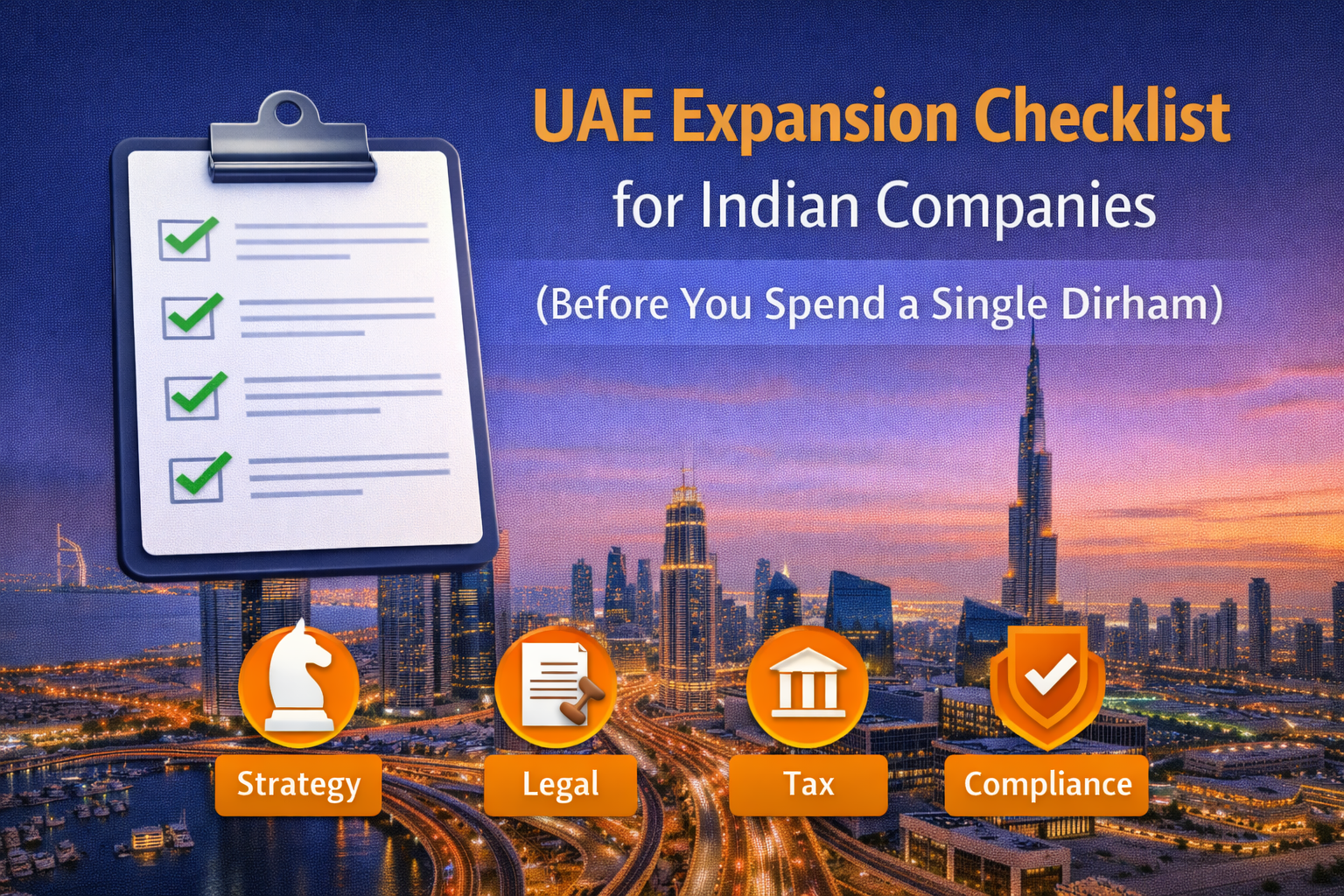
For many Indian companies, UAE expansion begins with incorporation discussions and cost comparisons. That is already too late. The success or failure of a UAE entity is usually determined before the first dirham is spent, at the stage where strategic intent, regulatory exposure, and operational substance are evaluated together. Businesses that skip this stage often end up restructuring within a few years, dealing with banking friction, or facing India-side compliance complications. This article sets out a practical UAE expansion checklist for Indian companies, designed to be completed before incorporation, licences, or visas are finalised. It builds naturally on the foundational framework explained in the Dubai company setup guide for Indian businesses and the analysis in why Indian businesses are expanding to the UAE (and when it actually makes sense).
What is a UAE expansion checklist and why does it matter?
A UAE expansion checklist helps Indian companies evaluate strategy, structure, tax, compliance, and substance requirements before incorporation, ensuring the UAE entity aligns with business reality, banking expectations, and Indian regulatory obligations.
Without this checklist, UAE setups are often reactive instead of intentional.
Step 1: Clarify the real business objective for UAE expansion
The first and most important question is why the UAE entity is being created. Indian companies expand to the UAE for different reasons—international trading, overseas services, holding structures, fundraising readiness, or regional headquarters functions. Each objective demands a different structure and compliance posture.
If the UAE entity exists only to “reduce tax” or “look international”, the structure will not survive regulatory or banking scrutiny. The objective must be commercially defensible and operationally achievable. This distinction is explored in depth in why Indian businesses are expanding to the UAE (and when it actually makes sense), which should be read alongside this checklist.
Step 2: Identify where customers and revenue will actually come from
Indian companies must identify whether UAE customers, international customers, or Indian customers will generate revenue, as this determines whether a Mainland, Free Zone, or Offshore structure is legally and commercially viable.
If revenue is expected from within the UAE, a Mainland structure is usually unavoidable. If customers are overseas, Free Zone structures may be appropriate. If the entity will only hold shares or assets, Offshore or holding structures may be considered. This decision logic is explained in detail in Mainland vs Free Zone vs Offshore: which UAE structure fits which Indian business model? and should be cross-checked at this stage.
Step 3: Map Indian regulatory exposure before choosing a UAE structure
UAE expansion is not just a foreign law decision. Indian regulations under FEMA continue to apply. Indian companies must determine whether the investment qualifies as ODI or LRS, how funds will be remitted, and what reporting obligations arise in India.
Ignoring this step often leads to improper remittance routing, delayed filings, or later reclassification issues. Control, ownership, and funding method should be evaluated together so that the UAE structure does not conflict with Indian compliance requirements.
Step 4: Decide the correct UAE structure only after Steps 1–3
The correct UAE structure should be chosen only after business objective, customer geography, and Indian compliance exposure are clear—not before.
Many Indian companies invert this sequence by choosing a Free Zone or licence first and adjusting the business model later. This is precisely the mistake analysed in common mistakes Indian businesses make while choosing UAE company structure, and it is the reason many UAE entities require restructuring within a short period.
At this stage, the business should be able to clearly justify why it needs a Mainland, Free Zone, or Offshore entity—and why alternative structures were rejected.
Step 5: Budget for real costs, not brochure prices
UAE expansion costs are not limited to incorporation fees. Indian companies must budget for licences, visas, office requirements, banking setup, accounting, audits, renewals, and compliance filings on an annual basis.
The decision should be based on total cost of ownership, not the lowest upfront quote. This cost logic becomes especially important when comparing Free Zone and Mainland options, where long-term flexibility and compliance obligations differ significantly.
Step 6: Assess banking feasibility early
Indian companies should assess UAE banking feasibility before incorporation, not after, as structure, activity, ownership, and substance directly impact account approval.
Banking is one of the most common silent failure points in UAE expansion. Certain activities, Free Zones, and ownership patterns attract enhanced scrutiny. If banking requirements are not considered upfront, companies may end up with a valid licence but no operational account.
At checklist stage, companies should already have clarity on expected transaction volumes, customer jurisdictions, source of funds, and operational substance.
Step 7: Plan for substance, not just registration
Substance requirements in the UAE are no longer theoretical. Indian companies must consider where decisions will be made, who will manage operations, and whether employees or directors will be present in the UAE.
Entities that earn income without matching people, premises, or decision-making capability face issues under Economic Substance Regulations, tax assessments, and banking reviews. Substance planning must align with both UAE expectations and Indian tax residency considerations.
Step 8: Validate tax assumptions before relying on them
Indian companies should validate UAE tax assumptions—corporate tax applicability, Free Zone benefits, and DTAA protection—before relying on “tax-free” narratives.
With the introduction of UAE corporate tax, assumptions made even two years ago may no longer hold. Companies must understand when tax applies, when Free Zone benefits are available, and what the India–UAE DTAA does and does not protect. This validation prevents aggressive structures that attract future scrutiny.
Step 9: Define governance and ongoing compliance ownership
UAE expansion is not a one-time event. Indian companies must define who will handle licence renewals, filings, audits, and regulatory correspondence on an ongoing basis.
Lack of clarity here leads to missed deadlines, penalties, and loss of good standing. A clear compliance ownership model—internal or external—should be part of the pre-incorporation checklist.
Step 10: Proceed with incorporation only after checklist sign-off
The final step is procedural, not strategic. Incorporation should begin only once the business objective, structure, compliance, tax, banking, and cost implications are documented and approved internally.
Companies that follow this sequence build UAE entities that scale cleanly. Those that skip it often revisit the same decisions under pressure later.
FAQs
Is this checklist relevant for small Indian companies as well?
Yes. In fact, smaller companies face higher relative risk because restructuring costs and compliance failures have a disproportionate impact on margins and management bandwidth.
Can Indian companies use this checklist even if expansion is only exploratory?
Absolutely. The checklist helps determine whether UAE expansion makes sense at all, saving cost and effort if the answer is no.
Does this checklist replace professional advice?
No. It helps businesses ask the right questions before engaging advisors, ensuring advice is applied to a clear commercial context.
What happens if a company skips this checklist and incorporates directly?
Most issues surface later—during banking, audits, or Indian regulatory reviews—when correction becomes more expensive and disruptive.
Wrapping Up
UAE expansion rewards preparation, not speed. Indian companies that complete this checklist before spending a single dirham build UAE structures that withstand regulatory scrutiny, banking review, and long-term growth demands. Those that skip it often pay the price quietly over time.
About the Author
Prashant Kumar is a Company Secretary, Published Author, and Partner at Eclectic Legal, a full-service Indian law firm advising on corporate, regulatory, and transactional matters. He advises Indian companies on UAE expansion strategy, cross-border structuring, FEMA compliance, and international governance frameworks, helping businesses design compliant and commercially sustainable overseas operations. He can be reached for discussions on UAE structuring, compliance, and governance excellence via LinkedIn, or directly at prashant@eclecticlegal.com or +91-9821008011.