Evaluating the right structure for Indian founders expanding into Singapore
By Prashant Kumar
Introduction
For Indian businesses looking to expand globally or create an overseas holding structure, Singapore has become the jurisdiction of choice. Its legal predictability, tax clarity, strong IP protection, and global investor confidence consistently position it ahead of many other hubs. But before any Indian business forms a presence in Singapore, it must choose the right legal structure — usually between a Private Limited Company (Pte Ltd) and a Limited Liability Partnership (LLP).
At first glance, this may appear as a simple administrative decision. In reality, it shapes the business’s governance, fundraising ability, FEMA and RBI compliance, banking experience, and long-term tax exposure in India and Singapore. Many Indian businesses discover this only after reading broader strategic pieces like my analysis on the Singapore holding company strategy or the comparison of Singapore Vs Dubai Vs Delaware. But selecting the correct structure is the foundation on which all other cross-border decisions rest.
This article breaks down the difference between a Pte Ltd and an LLP, explains how Indian FEMA rules apply to each, provides practical examples, and clarifies what other options non-residents can or cannot use. By the end, Indian businesses will know exactly which structure serves their long-term international goals.
What Is the Core Difference Between a Singapore Pte Ltd and LLP?
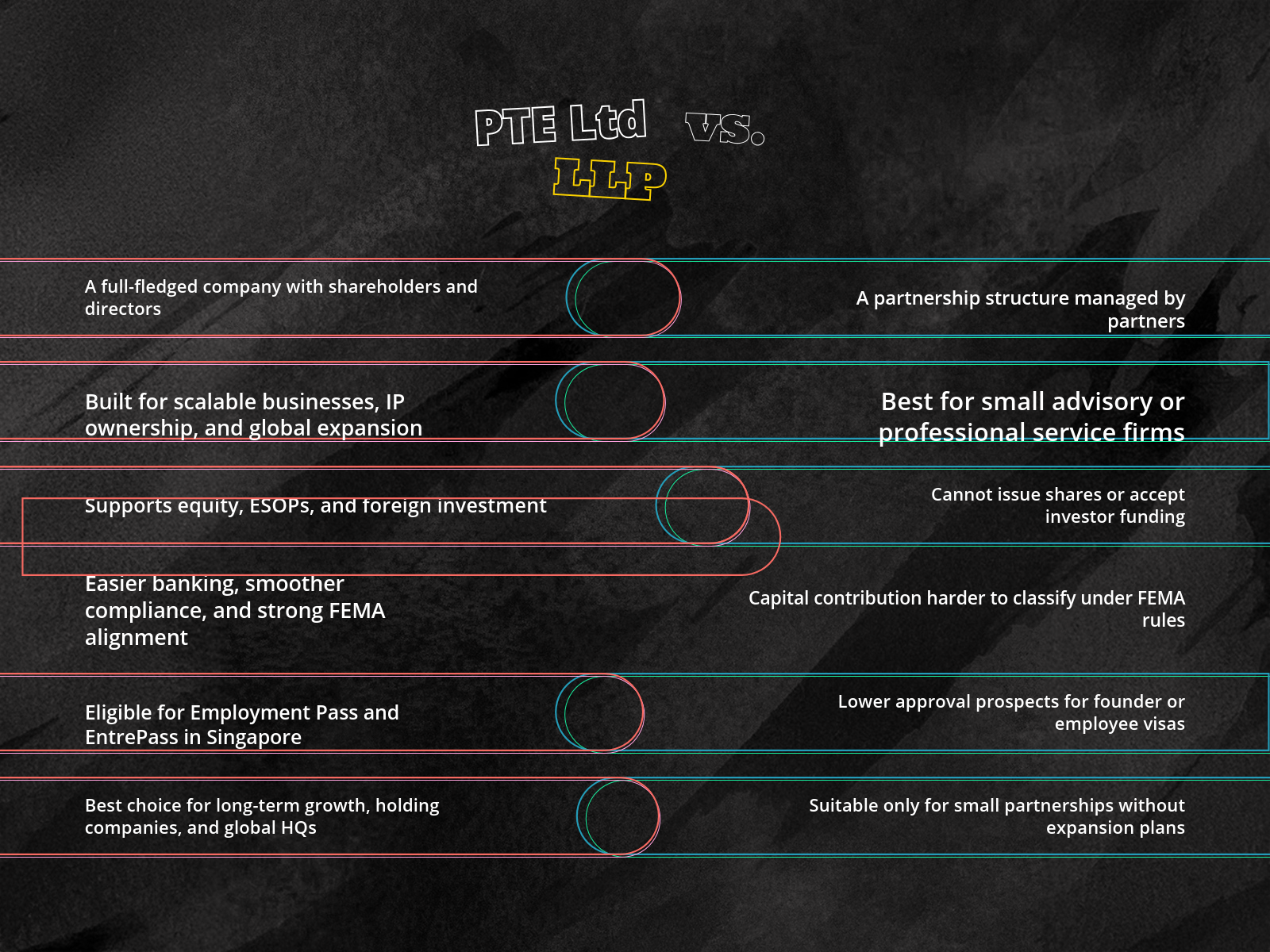
A Pte Ltd is a full-fledged company suited for ownership, IP, and global capital. An LLP is a partnership structure used for small professional services. For Indian businesses, the Pte Ltd is almost always the more practical and compliant structure.
A Singapore Pte Ltd mirrors the Indian private limited model. It is a separate legal entity, has shareholders and directors, and supports equity issuance, ESOPs, IP ownership, and external investment. It is the preferred structure for technology companies, trading companies, investment entities, and holding companies.
A Singapore LLP, on the other hand, functions like a professional partnership. It has partners instead of shareholders, profit distribution is flexible rather than based on share capital, and it typically serves accountants, consultants, architects, and law firms.
For a business intending to raise capital, own IP, enter international markets, or become the parent company of an Indian subsidiary, the LLP model simply does not provide the governance, credibility, or structural clarity required.
Why Almost Every Indian Business Chooses a Singapore Pte Ltd
Singapore Pte Ltd structures align naturally with what Indian businesses need when going global. Banks like DBS, UOB, and OCBC understand Pte Ltd structures well and onboard them more smoothly. Global investors and partners prefer companies rather than partnership vehicles.
Pte Ltd entities easily fit into Indian cross-border compliance frameworks such as ODI (Overseas Direct Investment) for Indian companies and LRS (Liberalised Remittance Scheme) for individuals. If you are unfamiliar with these investment routes, my earlier article breaks this down in detail: Should You Incorporate as an Individual or via Your Indian Company? (LRS vs ODI Explained).
Pte Ltd companies also benefit from:
• predictable corporate governance,
• Singapore’s startup tax exemptions,
• better IP protection,
• eligibility for Employment Pass or EntrePass visas, and
• alignment with India–Singapore DTAA when structuring royalties or management fees.
For Indian businesses establishing a regional or global headquarters, nothing replaces the robustness of a Pte Ltd.
Where LLP Makes Limited Sense — and Only in Specific Scenarios
While LLPs exist as an option, their use is extremely narrow for Indian businesses. They are suitable for:
— professional services firms (consulting, advisory, design),
— small, partnership-driven ventures,
— low-capital operations without investor involvement.
However, LLPs quickly fall short in areas most Indian businesses care about:
— they cannot issue shares or ESOPs,
— cannot easily take foreign investment,
— are often scrutinised more by banks,
— and do not work well as holding companies.
Imagine an Indian business wanting to shift IP to Singapore, attract US investors, and licence technology back to India. A Pte Ltd structure will support this seamlessly, while an LLP will raise questions from regulators and investors, often requiring restructuring later — which is far more expensive.
LLPs are practical only when the business wants flexibility, low compliance, and no long-term international ambitions.
How FEMA Treats Pte Ltd vs. LLP — The Reality Indian Businesses Must Know
The Indian compliance side is where the difference becomes stark.
For FEMA and RBI:
A Singapore Pte Ltd is classified clearly as a foreign company for ODI or LRS purposes.
This makes valuation, reporting, shareholding, and repatriation straightforward.
A Singapore LLP is treated as a foreign partnership, not a company.
This often confuses Indian banks because capital contribution and profit-sharing do not fit neatly into ODI or equity rules. Many Authorised Dealer banks hesitate or raise additional queries, slowing down the process significantly.
Businesses that are serious about compliance — especially after reading the risks explained in FEMA Compliance for Overseas Investments — naturally prefer Pte Ltd because it is fully compatible with RBI systems.
Examples: How Structure Choice Changes Outcomes
Example 1 — Technology Business Holding IP Abroad
A Bengaluru software company wants to relocate IP to Singapore for global licensing. A Pte Ltd allows for royalty licensing, transfer pricing alignment, and valuation compliance. An LLP would confuse investors and tax authorities.
Example 2 — Business Seeking Global Investment
An Indian SaaS business plans to onboard US and APAC funds. Those investors will insist on a Pte Ltd. An LLP is immediately a deal-breaker.
Example 3 — Consulting Firm Serving International Clients
A two-partner advisory firm may prefer an LLP because revenue flows directly to partners and governance remains simple. But if they want to create a holding entity later, LLP causes structural limitations.
Example 4 — Business Planning to Make Its Singapore Entity the Global HQ
As explained in my comparison of Singapore vs. Dubai vs. Delaware, Singapore Pte Ltd is ideal for headquarters. LLP cannot serve this purpose.
Are There Any Other Options for Non-Residents?
Realistically, no — not for meaningful business. But here’s the full picture:
Variable Capital Company (VCC)
A fund vehicle, not an operating structure. Only for regulated fund managers.
Sole Proprietorship
Not available to non-residents.
Representative Office
Cannot generate revenue. Only for research or liaison.
Branch Office
Requires a foreign parent company — not suitable for fresh expansion.
This leaves only two practical choices for non-residents:
Pte Ltd and LLP.
And as this article makes clear, Pte Ltd is the superior option for nearly all Indian businesses.
Summary Insight
Choosing the wrong Singapore structure can slow growth, complicate taxation, and create non-compliance under Indian law. For any Indian business building a holding company, raising international capital, owning IP, or operating globally, the Singapore Private Limited Company is the only structure that provides the governance, stability, and compliance compatibility required. LLPs remain niche options with limited long-term usefulness.
FAQs
1. Is an LLP allowed for Indian businesses under FEMA?
Yes, but FEMA compliance becomes far more complex. An LLP does not issue shares, so Indian banks often struggle to classify capital contributions. Many banks ask for additional clarifications regarding ownership, profit rights, and control — all of which slow down or complicate ODI or OPI filings. A Pte Ltd fits neatly into RBI’s reporting system, making compliance significantly easier.
2. Which structure is better for raising international investment?
A Pte Ltd is unquestionably better. Investors in Singapore, the US, or Europe rarely, if ever, fund LLPs in international jurisdictions because LLPs cannot issue equity. Without shares, there is no cap table, no ESOP pool, and no mechanism for preferred stock. A Pte Ltd, on the other hand, aligns perfectly with global funding norms.
3. Can a Singapore LLP own shares in an Indian company?
It is legally possible but practically discouraged. Indian regulators scrutinise LLP structures because profits are distributed directly to partners, making it harder to track valuations and capital movements. A Pte Ltd is far more standardised, clean, and acceptable when cross-border ownership is involved.
4. Does LLP provide better tax efficiency than Pte Ltd?
Not usually. LLPs are tax-transparent — meaning profits are taxed in the hands of partners — which may increase disclosure requirements in India. Pte Ltd companies benefit from Singapore’s corporate tax exemptions for startups, and corporate-level taxation is often cleaner when paired with the India–Singapore DTAA. For global businesses, Pte Ltd usually creates stronger tax predictability.
5. If I start with an LLP, can I convert to a Pte Ltd later?
Yes, conversion is possible, but it involves valuation, transfer of assets, reassigning agreements, redoing bank compliance, and updating RBI filings if Indians hold ownership. It is far simpler to start with a Pte Ltd rather than restructure later, especially when global partners or investors come into the picture.
6. Is Pte Ltd required to get visas like Employment Pass or EntrePass?
Yes, Singapore’s Ministry of Manpower strongly prefers Pte Ltd structures for EP and EntrePass applications. LLPs can theoretically apply, but the approval rate is much lower. For businesses planning regional headquarters, hiring, or relocation, Pte Ltd is the correct structure.
7. Is there any situation where LLP is better than Pte Ltd?
Only when the business is a small, low-capital, advisory or professional service that will never raise external investment, never hold IP, and never act as a holding company. Even then, many businesses choose Pte Ltd simply to maintain flexibility for the future.
About the Author
Prashant Kumar is a Company Secretary, Published Author, and Partner at Eclectic Legal, specialising in cross-border structuring, FEMA compliance, and overseas business setup. He advises Indian businesses on building globally credible structures across Singapore, Dubai, and other jurisdictions.
Reach him at prashant@eclecticlegal.com or +91-9821008011.