
Over the last few years, the UAE — particularly Dubai — has emerged as the most talked-about overseas destination for Indian founders. From YouTube videos promising “zero tax companies” to consultants pitching overnight global credibility, UAE expansion is often sold as a shortcut to scale. The reality is more layered. The UAE can be an exceptional base for international business, but only when the move is anchored in commercial logic, operational substance, and regulatory discipline. For many Indian businesses, the UAE is not a growth accelerator — it becomes an avoidable cost centre. Understanding the difference is where smart decision-making begins.
Why are Indian businesses expanding to the UAE?
Indian businesses expand to the UAE for international market access, stable commercial laws, efficient cross-border banking, predictable taxation, and proximity to Europe, Africa, and the Middle East. The UAE works best as a regional or international hub — not as a substitute for Indian operations.
The most successful UAE expansions are driven by business fundamentals, not optics.
UAE as a commercial bridge, not a tax shelter
The UAE’s real value lies in geography and market access. Positioned between Asia, Europe, and Africa, the UAE allows Indian companies to serve global clients without extreme time-zone friction. For exporters, distributors, logistics players, SaaS companies, and consulting firms, contracting through a UAE entity often makes commercial conversations smoother. Many overseas clients are simply more comfortable signing contracts governed by UAE law than Indian law.
Legal certainty and enforceable contracts
Unlike the perception-driven narrative, serious businesses are attracted by predictability. The UAE offers structured commercial courts, arbitration-friendly regimes, and consistent enforcement. For companies entering distributor agreements, franchise arrangements, or cross-border joint ventures, this legal certainty reduces risk and improves negotiating power.
International banking and cash-flow efficiency
While UAE banking is compliance-heavy, it provides better access to multi-currency accounts, faster international remittances, and smoother integration with global payment systems. For companies billing in USD, EUR, or AED, this simplifies treasury operations. Compared to many Indian SME banking arrangements, the operational ease can materially impact cash-flow cycles.
Tax efficiency — not tax avoidance
The UAE is no longer a “no tax” jurisdiction. Corporate tax, economic substance requirements, and reporting obligations now apply. The advantage is clarity and predictability. When structured correctly, businesses avoid double taxation, reduce uncertainty, and operate within transparent rules — a stark contrast to aggressive or artificial tax planning.
Global perception and investor signalling
A UAE holding or operating company often improves credibility with foreign investors, PE funds, and enterprise clients. It signals global ambition, governance maturity, and readiness for cross-border operations. This signalling effect matters in fundraising, partnerships, and large-ticket contracts.
When does expanding to the UAE actually make sense?
UAE expansion makes sense when a business has international customers, foreign currency revenue, overseas investors, or regional operations — and can maintain real substance, people, and compliance in the UAE.
The decision should be grounded in business reality.
For Indian companies already exporting goods or services, or planning to do so in the near term, a UAE entity can function as a natural international interface. It works particularly well when contracts, invoicing, and collections are offshore, while execution may still happen in India. In such cases, the UAE structure aligns with how the business actually operates.
It also makes strategic sense where founders are targeting Middle East, Africa, or Europe as growth markets. The UAE functions effectively as a regional headquarters, allowing centralised contracting, branding, and management oversight.
Businesses raising funds from foreign investors or entering global joint ventures often find that a UAE structure simplifies negotiations and documentation. Investors typically prefer familiar jurisdictions with predictable governance standards.
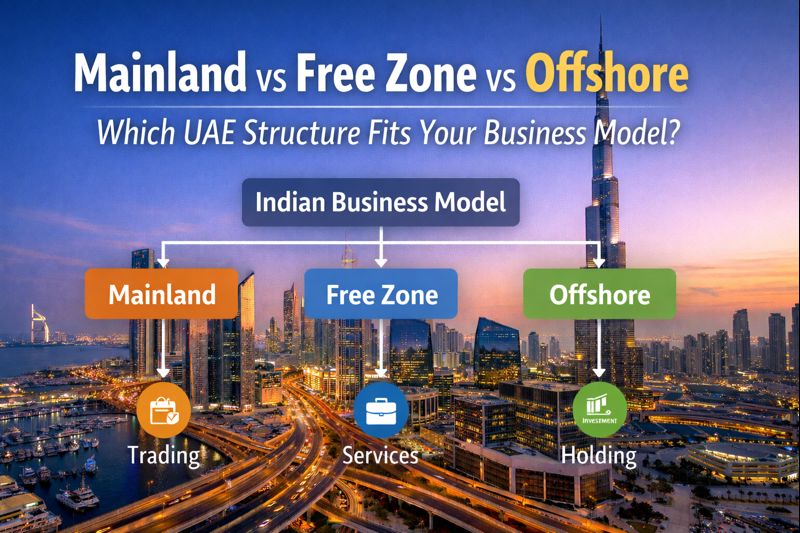
For a deeper understanding of structures, compliance layers, and decision points, this Dubai company setup guide for Indian businesses explains the practical differences between Mainland, Free Zone, and Offshore models, and when each works commercially.
The hype that creates bad decisions
UAE expansion is frequently oversold — and that is where trouble begins.
The most common misconception is that UAE incorporation automatically reduces tax liability. In reality, Indian tax residency rules, GAAR provisions, FEMA regulations, and transfer pricing norms continue to apply. Artificial arrangements without substance can attract scrutiny from both Indian and UAE authorities.
Another dangerous assumption is that a minimal setup — one visa, one desk, and a registered address — is sufficient. Banks, tax authorities, and investors now expect genuine economic presence. Token structures collapse under due diligence.
Finally, many founders underestimate the operational cost. UAE companies require annual renewals, accounting, audits, compliance filings, and professional support. The structure demands management attention, not passive maintenance.
Who should NOT go to the UAE?
Indian businesses should not expand to the UAE if they have India-only revenue, thin margins, no overseas clients, or expect UAE incorporation to deliver tax savings without real international operations.
This is where hard honesty saves money.
If a business sells exclusively in India, invoices only in INR, and has no near-term export or international client pipeline, UAE incorporation offers little strategic value. The annual cost — often ₹10–25 lakh when banking, compliance, and renewals are factored in — can strain margins without delivering commensurate benefits.
Similarly, promoter-driven tax motivations without operational substance are high-risk. Such structures often fail banking reviews, attract tax questions, and complicate FEMA compliance.
Another red flag is lack of leadership bandwidth. If promoters or senior executives cannot meaningfully engage with overseas operations, the structure becomes superficial and unsustainable.
In practice, many such companies quietly shut down UAE entities after a few years — absorbing sunk costs and compliance exposure.
India and UAE: structure, not substitution
The smartest founders do not “move” to the UAE. They design complementary structures.
India continues as the execution and operational base. The UAE becomes the international contracting, holding, or regional coordination hub. Transfer pricing is aligned. FEMA positions are documented. Substance is genuine. Compliance is proactive.
This is not glamorous, but it is durable.
FAQs
Is UAE company setup useful for Indian startups?
Yes, but only when startups have foreign clients, overseas investors, or global expansion plans. Early-stage startups with India-only traction usually gain more by strengthening domestic fundamentals first.
Does UAE incorporation automatically reduce Indian tax liability?
No. Indian tax laws, residency rules, and GAAR provisions still apply. Without real substance and arm’s-length structuring, UAE entities can increase scrutiny rather than reduce tax exposure.
How much does it realistically cost to maintain a UAE company annually?
Depending on structure and activity, annual costs can range from ₹8–25 lakh, including licence renewal, accounting, audit, compliance, and banking overheads.
Is Dubai better than Singapore or GIFT IFSC for Indian businesses?
There is no universal answer. Dubai works best for Middle East–Africa exposure, Singapore for Southeast Asia and VC ecosystems, and GIFT IFSC for regulated financial structures. The choice must match business geography and intent.
Can Indian promoters freely remit money to set up a UAE company?
Remittances must comply with FEMA, LRS or ODI frameworks, depending on structure. Improper routing of funds can create regulatory issues later.
Do UAE free zone companies really need physical offices and employees?
Yes. Economic substance and banking norms increasingly require demonstrable operational presence. Virtual setups are rarely sufficient today.
Wrap Up
UAE expansion is neither a shortcut nor a status symbol. Done with clarity, it can unlock markets, credibility, and capital. Done casually, it becomes an expensive lesson. The difference lies in intent, structure, and discipline — not geography.
About the Author
Prashant Kumar is a Company Secretary, Published Author, and Partner at Eclectic Legal, a full-service Indian law firm advising on corporate, regulatory, and transactional matters. He specialises in corporate governance, legal compliance, and brand protection, helping businesses build credible and sustainable legal foundations. He can be reached for discussions on brand strategy, compliance, and governance excellence via LinkedIn.

[…] UAE expansion has become a standard strategic discussion for many Indian businesses exploring overseas markets. Yet, a significant number of UAE entities set up by Indian companies struggle within the first two to three years—not because the UAE is complex, but because the initial structuring decisions were flawed. These mistakes are rarely dramatic at the beginning. They surface later as banking delays, regulatory questions, rising compliance costs, or forced restructuring. This article examines the most common mistakes Indian businesses make while choosing a UAE company structure, and explains how these errors can be avoided with clearer commercial and compliance thinking at the outset. It builds on the broader UAE structuring framework explained in this guide on Dubai company setup for Indian businesses and complements the analysis in why Indian businesses are expanding to the UAE (and when it actually makes sense). […]
[…] For many Indian companies, UAE expansion begins with incorporation discussions and cost comparisons. That is already too late. The success or failure of a UAE entity is usually determined before the first dirham is spent, at the stage where strategic intent, regulatory exposure, and operational substance are evaluated together. Businesses that skip this stage often end up restructuring within a few years, dealing with banking friction, or facing India-side compliance complications. This article sets out a practical UAE expansion checklist for Indian companies, designed to be completed before incorporation, licences, or visas are finalised. It builds naturally on the foundational framework explained in the Dubai company setup guide for Indian businesses and the analysis in why Indian businesses are expanding to the UAE (and when it actually makes sense). […]