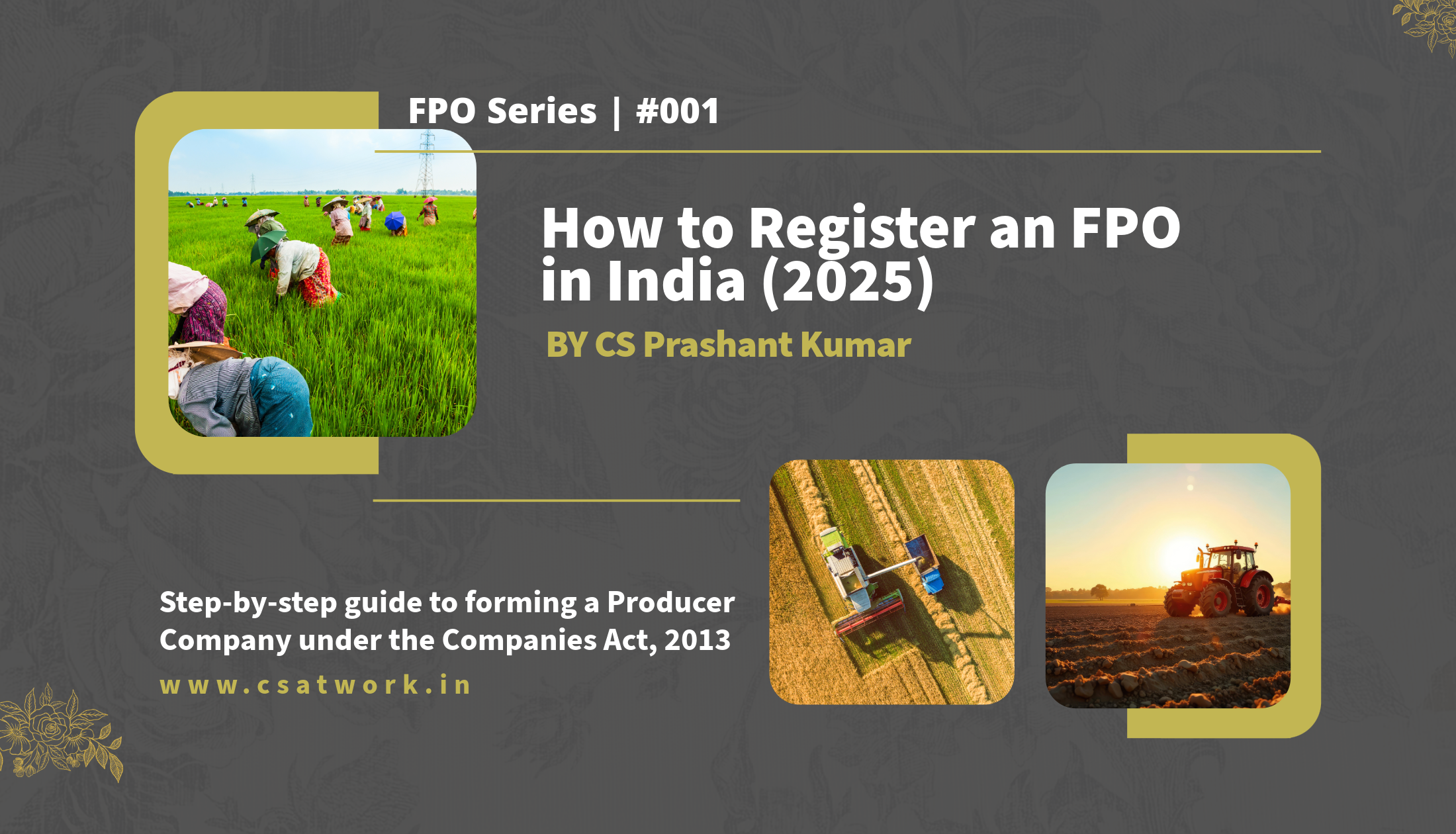
Introduction
In India’s agri-economy, the Farmer Producer Organisation (FPO) model is one of the most transformative interventions for small and marginal farmers. By coming together as a registered legal entity, farmers gain collective strength to buy inputs, access finance, and sell produce at better prices. Yet, most promising FPOs struggle at the first milestone — registration. Whether through a Producer Company under the Companies Act, 2013 or a Cooperative under state law, proper incorporation is crucial for legal validity, funding eligibility, and governance. This article provides a practical, step-by-step guide to registering an FPO in 2026 under Indian law, reflecting the latest procedural updates and compliance norms.
What is an FPO in India?
An FPO (Farmer Producer Organisation) is a collective of primary producers—farmers, dairy owners, fishers, or artisans—who form a registered entity like a Producer Company or Cooperative. The goal is to improve members’ incomes by aggregating production, marketing collectively, and gaining access to credit, inputs, and government schemes.
An FPO gives farmers a unified business identity. Instead of working individually, members operate as shareholders of a company. The FPO buys seeds, fertilizers, or machinery in bulk and sells members’ produce under one brand. It reduces dependence on middlemen, improves quality control, and allows direct linkage with large buyers, exporters, and agri-tech platforms.
Legal Structures for FPO Registration
Two main legal routes exist for FPO registration in India:
- Producer Company under the Companies Act, 2013 – A special corporate structure created exclusively for producers under Chapter XXIA (Sections 378A–378ZU).
- Cooperative Society under State or Multi-State Cooperative Acts – A traditional model governed by state-specific cooperative laws.
While cooperatives remain popular in states with strong cooperative movements, most new FPOs in 2026 prefer the Producer Company model. It offers limited liability, professional governance, and easier access to equity investment and bank finance. Unlike cooperatives, a Producer Company is regulated by the Ministry of Corporate Affairs (MCA) and operates with corporate transparency while retaining cooperative principles (like “one member, one vote”).
Step-by-Step Process to Register an FPO (Producer Company) in 2026
Step 1: Identify Promoter Members and Eligibility
An FPO requires at least ten individual primary producers or two registered producer institutions to form a Producer Company. At least five directors must be appointed from among these members. Each member must be engaged in similar or related activities such as farming, dairy, or fisheries.
Step 2: Obtain Digital Signature Certificates (DSC) and Director Identification Numbers (DIN)
Each proposed director must hold a Digital Signature Certificate (DSC) and a Director Identification Number (DIN)to sign and file documents electronically with the MCA. This is a mandatory pre-requisite for all incorporations. Supporting documents include PAN, Aadhaar, photograph, email ID, and phone number.
Step 3: Name Reservation
The company’s name must end with “Producer Company Limited.”
Name reservation is done online via SPICe+ (Part A) on the MCA portal. The proposed name should reflect the FPO’s activity or location (e.g., Satpura Agro Producer Company Limited). Names that resemble existing companies or trademarks are rejected.
Step 4: Drafting the MoA and AoA
The Memorandum of Association (MoA) defines the FPO’s objectives — like production, marketing, processing, and export of members’ produce.
The Articles of Association (AoA) set out governance rules — including shareholding, voting rights, distribution of patronage bonus, and director duties. Both must align with Section 378C and related provisions of the Companies Act, 2013. Drafting should be done carefully with professional assistance, as vague objects or non-producer activities can cause registration rejection.
Step 5: Filing Incorporation Application via SPICe+ (Part B)
The incorporation is filed through SPICe+ (Simplified Proforma for Incorporating Company Electronically) — a single integrated form available under MCA V3.
Key attachments include:
- Approved name (from SPICe+ Part A)
- MoA and AoA
- Address proof of registered office (utility bill or rent agreement with NOC)
- Proof of identity and address of members and directors
- Declaration by professionals (Form INC-9 and DIR-2)
Government fees depend on authorised capital, typically between ₹5,000–₹10,000 for small FPOs.
Upon verification, the Registrar of Companies (ROC) issues the Certificate of Incorporation (COI) — the legal birth certificate of the FPO.
Step 6: PAN, TAN and Bank Account
Unlike earlier practice, PAN and TAN are now applied through the SPICe+ system itself, integrated with MCA filings. However, if not done during incorporation, these can be separately applied through the NSDL or UTIITSL portals after receiving the COI.
Once obtained, open a current bank account in the company’s name using the COI, PAN, and board resolution. Deposit the paid-up capital — usually ₹1 lakh or more, depending on your business plan.
Step 7: Post-Incorporation Compliance
After incorporation, hold the first board meeting within 30 days. Appoint the first statutory auditor, issue share certificates, and adopt key registers (member, director, and share register).
If applicable, register under GST, obtain a Udyam registration (for MSME benefits), and register on e-NAM or SFAC FPO portals for government recognition and grants. Annual filings with the ROC (Form AOC-4 and MGT-7A) are mandatory.
For a detailed breakdown of all post-registration requirements, including MCA filings, board procedures, and annual compliance timelines, read our in-depth guide — Post-Incorporation Compliance Checklist for FPOs (2026).
Step 8: Develop Business and Governance Framework
Once legal formalities are done, focus on operations — expanding membership, building a brand, and establishing procurement and marketing systems.
Good governance practices — regular meetings, audited accounts, transparent decision-making — build credibility and attract institutional support. Many FPOs fail not due to poor market opportunity, but due to weak compliance and governance.
Key Documents Required
Each director and member must provide PAN, Aadhaar, and photograph. The FPO must provide registered office proof (utility bill, rent agreement, and landlord NOC if applicable). Additionally, proof of “producer status” — such as land records, crop certificates, or cooperative membership — must be maintained. Drafted and signed MoA, AoA, subscription sheet, and professional declarations are attached during incorporation.
Minimum Requirements at a Glance
- Members: Minimum 10 individual producers or 2 producer institutions
- Directors: Minimum 5 and maximum 15
- Authorised capital: Commonly ₹5 lakh (no prescribed minimum under law)
- Paid-up capital: Generally ₹1 lakh and above
- Name: Must end with “Producer Company Limited”
- Primary objective: Producer-related business — agriculture, horticulture, dairy, fisheries, or allied sectors
Benefits of Registering an FPO
A registered FPO gains a separate legal identity and limited liability, enabling it to access institutional finance, government subsidies, and training support. It can participate in central schemes such as SFAC’s 10,000 FPO Programme, NABARD’s credit support initiatives, and NAFED procurement tie-ups. For a deeper understanding of how to access SFAC grants, NABARD funding, and credit guarantees, read our detailed guide — SFAC Schemes and Funding Support for FPOs in India.
Legally, a Producer Company also enjoys tax benefits similar to cooperative societies in some states, depending on turnover and activity. Most importantly, collective marketing improves price realization, while pooling resources lowers input costs — ensuring real income growth for small producers.
Tax & Accounting of FPOs
Once your FPO is registered and compliant, the next step is understanding its taxation and accounting obligations. Every Producer Company in India must manage income tax, GST, and audit filings to remain compliant and funding-ready.
For a complete explanation of tax exemptions, GST rules, and accounting best practices, read our detailed guide — FPO Taxation and Accounting Rules in India (2026).
Common Challenges and How to Avoid Them
Many FPOs falter at early stages due to procedural errors: inconsistent member documents, unclear MoA objects, or late compliance filings. Delays in obtaining DSC/DIN also slow down incorporation. It’s essential to engage a professional Company Secretary early, maintain updated records, and build internal discipline from day one. Avoid inflating membership numbers — only genuine producers should be members to retain authenticity and eligibility for government support.
Frequently Asked Questions
1. How long does it take to register an FPO?
Usually 15–25 working days, depending on document accuracy and Registrar workload. Delays often arise due to name objections or incomplete digital signatures.
2. Can a non-farmer become a director or member of an FPO?
No. Only “primary producers” — such as farmers, dairy producers, fishermen, or artisans — can be shareholders. However, professionals like accountants or company secretaries can be appointed as CEO or consultant but not as producer-members.
3. Does the FPO need GST registration?
Yes, if annual turnover exceeds ₹40 lakh (for goods) or ₹20 lakh (for services). Even below that threshold, voluntary registration may help claim input tax credits or deal with institutional buyers.
4. What tax benefits do FPOs get?
Currently, there are no blanket exemptions. However, income from agricultural activities is tax-free under the Income Tax Act. NABARD and SFAC-supported FPOs may also enjoy grant-linked benefits or interest subvention on loans.
5. What funding or grants are available for FPOs in 2026?
Under the SFAC scheme, new FPOs receive equity grants up to ₹15 lakh and credit guarantees up to ₹1 crore. NABARD and NCDC also provide working capital and project-based assistance. Registration on the SFAC FPO Portal is mandatory for availing these benefits.
6. Can an existing cooperative convert into a Producer Company?
Yes. A cooperative society engaged in producer activities can convert into a Producer Company under Section 378J of the Companies Act, 2013, after approval from members and filing the required forms with ROC.
7. Can an FPO operate across India?
Yes. Unlike state-registered cooperatives, a Producer Company registered under the Companies Act can operate nationwide, open branches, and trade across states.
8. Is there any limit on profit distribution?
Profits are distributed as “patronage bonus,” based on the members’ participation, not shareholding. The company may also declare limited dividends on shares, as allowed under its Articles.
9. What records must an FPO maintain?
Mandatory registers include Member Register, Director Register, Share Transfer Register, and Minutes of Board and General Meetings. Financial statements must be audited annually and filed with ROC.
10. What happens if the FPO fails to file annual returns?
Failure to file returns under the Companies Act can lead to monetary penalties and disqualification of directors. Persistent non-compliance may result in striking off by the ROC.
Key Takeaway
A Farmer Producer Organisation is not just a legal structure—it’s a governance model for empowering rural producers. Registering it correctly under the Companies Act ensures credibility, financial inclusion, and policy benefits. The long-term success of an FPO depends on legal compliance, transparent accounting, and active member participation.
For founders or NGOs supporting FPO formation, consulting a Company Secretary early helps avoid procedural errors and ensures your organisation is eligible for SFAC or NABARD support from day one.
About the Author
Prashant Kumar is a Company Secretary, Published Author, and Partner at Eclectic Legal, a full-service Indian law firm advising on corporate, regulatory, and transactional matters. He specialises in FPO structuring, agricultural law, and corporate compliance, helping farmer groups, startups, and agri-businesses build legally sound and sustainable organisations. He can be reached at prashant@eclecticlegal.com or +91-9821008011 for professional consultations or collaborations.

[…] market linkages. If you’ve already completed your incorporation process (see our guide on how to register an FPO in India), this article explains how to unlock funding through SFAC equity and credit schemes, and why […]
[…] you’ve just completed registration (see our FPO Registration Guide), here’s your complete 12-month compliance roadmap for […]
[…] 📘 How to Register an FPO in India – Step-by-Step 2025 Guide📘 Post-Incorporation Compliance Checklist for FPOs (2025)📘 SFAC Schemes and Funding Support for FPOs in India (2025)📘 FPO Taxation and Accounting Rules in India (2025) […]
[…] How to Register an FPO in Indiahttps://csatwork.in/how-to-register-fpo-in-india/ […]
[…] 📘 How to Register an FPO in India – Step-by-Step 2026 Guide📘 Post-Incorporation Compliance Checklist for FPOs (2026)📘 SFAC Schemes and Funding Support for FPOs in India […]