UAE expansion has become a standard strategic discussion for many Indian businesses exploring overseas markets. Yet, a significant number of UAE entities set up by Indian companies struggle within the first two to three years—not because the UAE is complex, but because the initial structuring decisions were flawed. These mistakes are rarely dramatic at the beginning. They surface later as banking delays, regulatory questions, rising compliance costs, or forced restructuring. This article examines the most common mistakes Indian businesses make while choosing a UAE company structure, and explains how these errors can be avoided with clearer commercial and compliance thinking at the outset. It builds on the broader UAE structuring framework explained in this guide on Dubai company setup for Indian businesses and complements the analysis in why Indian businesses are expanding to the UAE (and when it actually makes sense).
Why do Indian businesses get UAE structuring wrong?
Indian businesses often choose UAE company structures based on speed, headline cost, or consultant advice rather than business model fit, banking perception, and India-side compliance, leading to wrong Free Zone selection, unnecessary licence expenses, and regulatory blind spots.
At the core, UAE structuring mistakes are not technical failures. They are decision failures made before the business model is fully mapped against regulatory reality.
Mistake 1: Choosing the wrong Free Zone without understanding activity fit
One of the most common errors is assuming that all UAE Free Zones are interchangeable. In practice, every Free Zone is designed with a specific commercial focus. Some are optimised for logistics and trading, others for technology and media, while a few are primarily suited for holding or back-office activities.
When an Indian business selects a Free Zone purely on pricing or speed of incorporation, without aligning it to its actual activity, problems emerge quickly. Banks question the mismatch between licence description and revenue model. Clients may struggle with credibility. Amendments to licences or migration to another jurisdiction later are far more expensive than choosing correctly at the start.
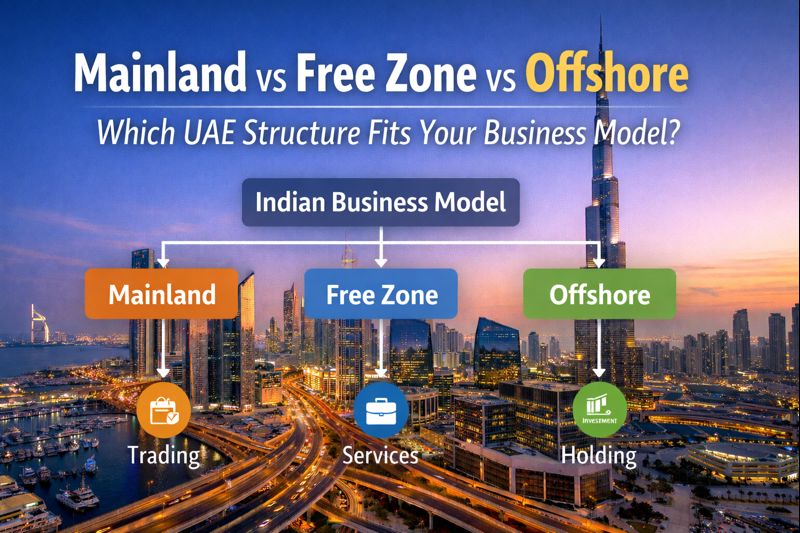
This mistake is closely linked to the broader misunderstanding around Mainland vs Free Zone vs Offshore structures, which is discussed in detail in this comparative guide.
Mistake 2: Assuming Free Zone companies can freely do business in the UAE market
Many Indian businesses wrongly assume that a Free Zone company can directly trade or provide services across the UAE, when in reality most Free Zones restrict onshore UAE activity without additional approvals or intermediaries.
Free Zone entities are primarily designed for international operations. While they are excellent for exports, overseas services, SaaS, and regional headquarters functions, they usually cannot invoice UAE mainland customers directly. When this limitation is discovered after incorporation, businesses resort to agent arrangements, distributor models, or rushed conversions to Mainland structures.
Each workaround increases compliance complexity and cost. This mistake often arises when businesses skip the basic question: Where will the customers actually be located? If UAE-based customers are part of the commercial plan, the structure must reflect that from day one.
Mistake 3: Overpaying for licences, visas, and bundled add-ons
UAE setup costs are rarely transparent in the first conversation. Indian businesses frequently overpay because licences are sold as bundled packages rather than as modular components aligned to actual needs.
Overpayment typically occurs through excess visa quotas, premium office packages with no operational relevance, overly broad activity descriptions, or bundled compliance services that are neither explained nor required. While the upfront difference may appear marginal, these costs compound annually through renewals, audits, and lease obligations.
A recurring theme across failed structures is that the UAE entity was designed as a one-time setup rather than as a recurring cost structure. A disciplined approach—starting with minimum viable licensing and expanding only when commercially necessary—prevents this problem.
Mistake 4: Using Offshore companies for operating businesses
Offshore UAE companies are meant only for holding or investment purposes, yet many Indian businesses mistakenly use them for trading or services, leading to banking restrictions and compliance failures.
Offshore entities cannot legally conduct business operations, hire employees, or invoice customers. Despite this, they are often marketed as “low-cost UAE companies”. The consequences appear later when banks decline operational accounts, auditors flag substance issues, and regulatory questions arise in India regarding commercial purpose and control.
Offshore structures work only when the intent is clearly limited to holding shares, owning assets, or making passive investments. Using them for active business is one of the most damaging structuring errors an Indian company can make.
Mistake 5: Ignoring Indian FEMA and tax implications while structuring in the UAE
This is the most serious blind spot.
UAE company structuring decisions cannot be evaluated in isolation. Indian regulations under FEMA, including ODI and LRS frameworks, continue to apply. Transfer pricing, tax residency, GAAR exposure, and control tests become relevant regardless of where the entity is incorporated.
Common issues include incorrect remittance routing, lack of arm’s-length documentation, promoter-level control triggering Indian tax residency, and income being earned offshore without matching substance. Many of these problems surface years later, often during audits or banking reviews.
A UAE entity that appears compliant locally can still be non-compliant from an Indian regulatory perspective if India-side implications are ignored at the design stage.
Mistake 6: Letting structure precede business clarity
The biggest mistake Indian businesses make is selecting a UAE structure before clearly mapping customers, revenue flows, operational substance, and compliance responsibilities.
No UAE structure—Mainland, Free Zone, or Offshore—is inherently good or bad. Each is suitable only when it mirrors commercial reality. Businesses that rush into incorporation without answering foundational questions about customer geography, decision-making control, and compliance ownership end up with cosmetic structures that do not survive scrutiny.
This mistake often overlaps with the broader hype-driven narrative discussed in why Indian businesses are expanding to the UAE (and when it actually makes sense).
How Indian businesses should approach UAE structuring instead
Successful UAE expansions follow a disciplined sequence. First, the business model is clearly articulated. Next, customer location and revenue flows are mapped. Then India-side FEMA and tax implications are evaluated. Only after this is the UAE structure selected.
This approach avoids restructuring, protects banking relationships, and ensures the UAE entity supports growth rather than becoming a compliance liability. A structured overview of this process is explained in Dubai company setup for Indian businesses: a simple guide to choosing the right structure, purpose, and cost.
FAQs
Can choosing the wrong Free Zone really affect banking outcomes?
Yes. Banks assess risk based on Free Zone jurisdiction, activity alignment, and historical misuse patterns. A mismatch between licence activity and business reality often leads to delays, enhanced due diligence, or outright account rejection.
Is the cheapest UAE licence usually the most cost-effective option?
Rarely. Low upfront pricing often hides higher renewal fees, restricted activities, or poor banking perception. Over a three-year horizon, such licences are frequently more expensive than properly structured alternatives.
Can Indian businesses change UAE structures later if needed?
Yes, but restructuring involves licence closures, new incorporations, migration costs, and compliance exposure. Choosing the correct structure at the beginning is significantly cheaper and cleaner.
Are compliance obligations lighter in certain Free Zones?
While requirements vary, audits, economic substance filings, and tax reporting are increasingly standard across the UAE. Claims of “no compliance” are outdated and risky.
Does UAE company structure influence Indian tax exposure?
Absolutely. Substance, control, and income characterisation matter more than the jurisdiction name. Poorly structured UAE entities can increase Indian tax scrutiny rather than reduce it.
Wrapping Up
Most UAE structuring failures are avoidable. They arise not from regulation, but from rushed decisions and incomplete analysis. Indian businesses that treat UAE structuring as a strategic design exercise—rather than a paperwork task—build entities that withstand banking scrutiny, regulatory review, and long-term growth demands.
About the Author
Prashant Kumar is a Company Secretary, Published Author, and Partner at Eclectic Legal, a full-service Indian law firm advising on corporate, regulatory, and transactional matters. He advises Indian businesses on UAE expansion, cross-border structuring, FEMA compliance, and international governance frameworks, helping companies design compliant and commercially sound overseas structures. He can be reached for discussions on UAE structuring, compliance, and governance excellence via LinkedIn, or directly at prashant@eclecticlegal.com or +91-9821008011.


[…] first and adjusting the business model later. This is precisely the mistake analysed in common mistakes Indian businesses make while choosing UAE company structure, and it is the reason many UAE entities require restructuring within a short […]