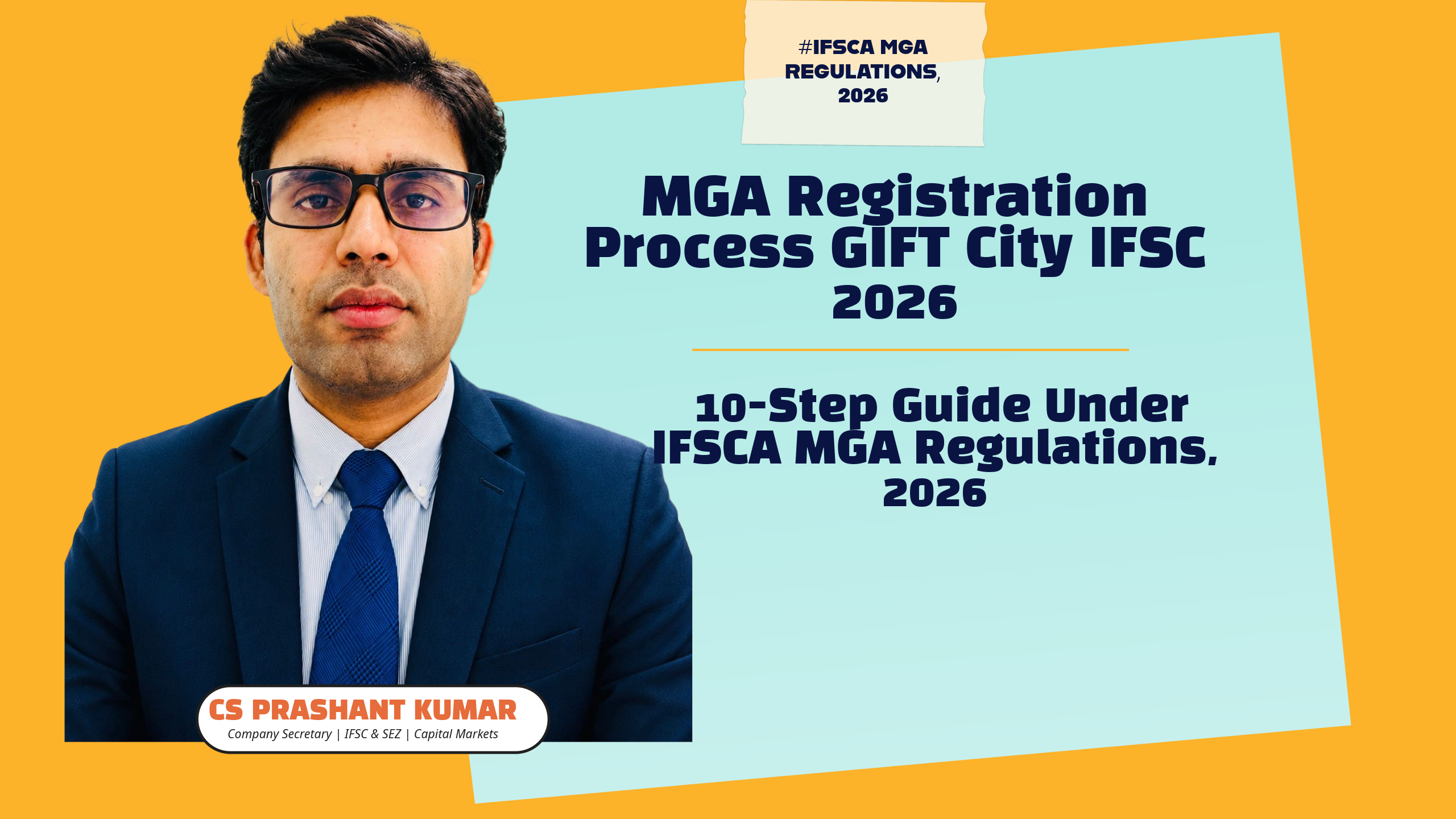
To register a Managing General Agent (MGA) in GIFT City IFSC under the IFSCA (Managing General Agents) Regulations, 2026, an applicant must (1) confirm eligibility and secure a written contract with a foreign insurer, (2) secure SEZ-compliant office space in GIFT IFSC, (3) incorporate a company under the Companies Act, 2013 in the IFSC — or establish a branch if already a licensed MGA abroad, (4) obtain SEZ approval (Letter of Approval) for unit setup, (5) arrange capital, net worth, and security deposit, (6) file an online application with IFSCA along with prescribed fees, (7) obtain in-principle approval, (8) execute a Binding Authority Agreement (BAA) with the foreign insurer, (9) complete compliance prerequisites and receive the Certificate of Registration, and (10) commence business within 180 days (extendable to a maximum of 18 months). The entire process typically runs 5-8 months from a standing start to writing the first policy.
This guide breaks down every step in the sequence you will actually experience it on the ground in GIFT City — not just the order the Regulations list it in.
What Is an MGA, and Why Is Everyone Suddenly Talking About It?
On 8 June 2026, the International Financial Services Centres Authority (IFSCA) notified the IFSCA (Managing General Agents) Regulations, 2026, creating — for the first time in India — a dedicated, stand-alone regulatory regime for Managing General Agents (MGAs) at GIFT IFSC.
An MGA is an insurance intermediary that holds delegated authority from a foreign insurer to underwrite direct insurance risks and/or settle claims on the insurer’s behalf. This is fundamentally different from what an Indian broker or corporate agent can do — a traditional intermediary distributes; it cannot price a risk, bind cover, or pay a claim. An MGA can do all three, within limits set by its Binding Authority Agreement.
This is the global “coverholder” model that powers the Lloyd’s and London specialty market. India never had a recognised home for it — the Regulations draw their power from Section 28(1) read with Sections 12 and 13 of the IFSCA Act, 2019, and Sections 42D, 42E, and 118A of the Insurance Act, 1938, and they carve MGAs entirely out of the earlier patchwork under the IFSCA (Registration of Insurance Business) Regulations, 2021 and the Insurance Intermediary Regulations, 2021.
If you’re an underwriter, insurtech founder, GCC insurance operation, or an existing overseas MGA/coverholder evaluating India as a base, this is the license that opportunity now sits under. GIFT City competes directly with Lloyd’s, DIFC, and Singapore for this business — at a materially lower cost of entry.
(For the full regulatory breakdown of what an MGA can and cannot do, see our companion piece: IFSCA MGA Regulations 2026 Explained.
Who Can Register as an MGA in GIFT City? (Eligibility Snapshot)
Before starting the process, confirm you meet the baseline eligibility bar. There are two entry routes under Regulation 4:
| Route | Who it’s for | Key condition |
|---|---|---|
| Branch route | An entity already registered/licensed to undertake MGA-type activities in a jurisdiction outside India | Must hold a valid home-country registration/licence, a track record of acting as an agent (solicitation, underwriting, claims settlement), be registered/certified in a DTAA jurisdiction, and obtain a No-Objection Certificate (NOC) from the home regulator to establish an IFSC branch |
| New company route | Anyone else — including India-based promoters, underwriting teams, or GCC-linked entities | Must incorporate a company under the Companies Act, 2013, inside the IFSC |
Note: LLPs cannot register as an MGA under either route. The Regulations define “Applicant” to mean a body corporate or a company incorporated under the Companies Act, 2013 — and expressly clarify that “body corporate” does not include a Limited Liability Company.
Gating condition (applies to both routes): At the time of filing the application, you must already hold at least one written contract with a foreign insurer authorising you to manage part of its direct insurance business, including solicitation, underwriting, and/or claims settlement. You cannot apply “in anticipation” of finding an insurer — the relationship has to already exist on paper before you file.
The foreign insurer itself must also clear a high bar (Regulation 4(4)):
| Foreign insurer eligibility | Requirement |
|---|---|
| Registration | Licensed for direct insurance in its home country, or country of incorporation/domicile |
| Net worth | Minimum USD 100 million |
| Credit rating | ‘A’ or equivalent from an internationally renowned agency, for the last 3 years |
| Jurisdiction | Registered/certified in a country with which India has a DTAA |
| FATF status | Not from a jurisdiction on FATF’s “high-risk, call for action” list |
| Track record | Satisfactory regulatory/supervisory compliance record, in its home country and any other country it operates in |
| Commitment | Board resolution undertaking to meet all liabilities arising from the applicant’s IFSC operations |
If you’re proposing to contract with more than one foreign insurer, Regulation 4(6) requires every one of them to independently satisfy these conditions.
Step-by-Step MGA Registration Process in GIFT City IFSC
Step 1: Confirm Foreign Insurer Eligibility Before You Apply
Your entire application stands or falls on whether your foreign insurer partner clears IFSCA’s bar. Verify this first — it’s the most common point of delay, because promoters often start office and entity setup before confirming the insurer side is fundable.
Run through the full checklist above — net worth, credit rating, DTAA jurisdiction, FATF status, and willingness to pass the Board resolution under Regulation 4(4)(f). This is also the point to confirm your insurer is comfortable with the disclosure and audit obligations it will owe you and IFSCA under Regulation 22 (independent annual audit, half-yearly on-site review, actuarial certification of loss reserves) — foreign insurers unfamiliar with the IFSC framework sometimes balk at these once they see them in writing, so surface them early.
Practical tip: Get this checked before you spend money on office space or incorporation. We run this eligibility check as a standalone service before clients commit to full registration.
Step 2: Secure SEZ-Compliant Office Space in GIFT IFSC
Before you can incorporate or apply for anything, you need a registered address inside the GIFT SEZ — and it has to be SEZ-compliant space, not any commercial address in Gandhinagar.
Most applicants don’t build out a dedicated office at this stage. Several developers and operators in GIFT City now offer SEZ-compliant co-working and serviced office space, built specifically to meet SEZ documentation requirements (proof of address, floor plan, lease/licence agreement) at a fraction of the cost of a dedicated built-out unit. This is the practical entry point for most MGA applicants, especially in year one — the Regulations require “adequate office space, IT systems, and data security protocols… commensurate with the proposed operations” (Regulation 6(2)(e)), not a specific size or ownership structure.
This space agreement becomes a supporting document for both your company incorporation and your SEZ unit application — so lock this in first.
Step 3: Incorporate the Applicant Entity (or Set Up the Branch)
- New company route: Incorporate a company under the Companies Act, 2013, using your GIFT SEZ office address as the registered office.
- Branch route: Establish an IFSC branch of your existing foreign MGA entity, supported by your home regulator’s NOC, using the same SEZ address.
At this stage, also identify your Principal Officer (or Branch Head, for a branch structure). Regulation 6(2)(d) requires this individual to be in the MGA’s direct employment and resident in India, and Schedule-II further requires the PO to demonstrate competence in insurance and satisfy “fit and proper” criteria. This appointment cannot be an afterthought — IFSCA scrutinises it as a distinct ground for approval, and a weak or last-minute PO appointment is a common reason applications stall at Step 6.
Step 4: Obtain SEZ Approval (Letter of Approval) for Unit Setup
With the entity incorporated and office space secured, apply for the Letter of Approval (LoA) to set up your unit in the GIFT SEZ under the Special Economic Zones Act, 2005.
This is a distinct approval from your MGA registration — it establishes you as an authorised SEZ unit, which is itself a continuing condition of your MGA registration, not just an entry formality. Regulation 8(7) requires every registered MGA to hold, “at all times,” a valid and subsisting Letter of Approval from the Administrator (IFSCA) under the SEZ Act, 2005. Lapse this at any point post-registration, and you’re in breach of your registration conditions under Regulation 8 — which is itself a ground for suspension or cancellation under Regulation 34(1)(a) and (m).
Get this sequencing right: no SEZ LoA means no valid registered unit, which means your IFSCA application has no operational base to point to.
Step 5: Arrange Capital, Net Worth, and Security Deposit
Before filing with IFSCA, ensure the promoter group can fund the following under Regulations 13 and 15 (all figures maintained through an IFSC Banking Unit — IBU):
| Requirement | Amount |
|---|---|
| Paid-up equity capital (company) / assigned capital (branch) | USD 500,000 |
| Minimum Net Worth (at all times) | Higher of USD 250,000 or 50% of paid-up/assigned capital |
| Security deposit | USD 10,000 + 10% of minimum capital, lien-marked to IFSCA (Competent Authority may cap the total deposit, but not beyond USD 100,000) |
Critical structuring points, both non-negotiable under Regulation 13(5):
- Promoter/shareholder investment must come from owned funds only — the Regulations expressly exclude funds “arranged by way of borrowings or loans” from qualifying as owned funds.
- Shares held by any shareholder cannot be pledged to secure any form of credit facility, and must remain unencumbered at all times (this is also a standing condition of registration under Regulation 8(15), so it isn’t just an entry-stage check — it’s audited annually).
Branches should note: net worth under Regulation 13(3) is maintained at the parent entity’s level, not locally, but the same 15-day rectification-and-reporting obligation applies if there’s ever a shortfall (Regulation 13(4)).
Step 6: File the Application with IFSCA
Submit the application to the IFSCA, in the prescribed form, with all specified documents — including your SEZ LoA and incorporation documents — and the USD 1,000 non-refundable application fee(Regulation 29(1)).
Under Regulation 5, IFSCA may seek additional information or clarification during examination, and you’re independently obligated to proactively disclose anything that could bear on your application, even if not asked. If IFSCA identifies deficiencies, you get 30 days to rectify them — and importantly, no refusal can be made without first giving you a written opportunity to make submissions on the grounds for refusal (Regulation 5(4)-(5)). Use this window seriously; a well-prepared response here often determines whether you proceed to in-principle approval or restart the process.
Step 7: Receive In-Principle Approval
Under Regulation 6(2), IFSCA examines whether you undertake to meet the capital/net worth requirements, whether your team has the requisite underwriting/claims processing competence and qualified personnel, whether your Principal Officer, promoters, directors, and controlling shareholders are “fit and proper,” whether your office space/IT/data security setup is adequate, and — ultimately — whether granting you registration would be in the interest of policyholders.
Once satisfied, IFSCA grants in-principle approval under Regulation 7(1), subject to payment of the USD 5,000 non-refundable registration fee (Regulation 29(2)). Note that IFSCA retains the power under Regulation 5(6) to impose additional conditions at this stage beyond what’s explicitly listed in the Regulations.
Step 8: Execute the Binding Authority Agreement (BAA) with Your Foreign Insurer
This is the operational heart of the license. Under Regulation 20(1), no MGA may solicit business, underwrite risk, or settle a single claim on behalf of a foreign insurer until a BAA containing the mandatory Schedule-IV clauses is executed with that insurer and filed with IFSCA.
Your BAA must explicitly address, at minimum (Regulation 20(2) and Schedule-IV):
- Classes of direct insurance business, territorial limits, and maximum per-risk liability
- Underwriting guidelines and the basis of rates to be charged
- Underwriting capacity allocated by the foreign insurer to your MGA
- The foreign insurer’s right to terminate or suspend the BAA (including who’s authorised to do so during a pending dispute, and on what grounds)
- A strict delineation between “Claims Processing” and “Claims Settlement” as separate, distinctly authorised activities
- Fiduciary account stewardship and the three-month loss fund rule
- Monthly bordereaux reporting of premium and claims data in an agreed template
- Data portability on contract termination — records must transfer seamlessly to the insurer
- Two-year audited financials and annual on-site inspection commitments
Three hard caps to design your business plan around from day one:
- A foreign insurer cannot delegate binding authority worth more than 10% of its previous financial year’s GWP to a single MGA (Regulation 22(3)(b)).
- Any claim above USD 10,000, or any claim involving a coverage dispute, must be referred to the foreign insurer for prior approval before settlement (Regulation 20(4) proviso).
- If your quarterly GWP production exceeds 5% of the foreign insurer’s policyholder surplus, you’re required to notify the insurer (Schedule-IV, clause 10) — build your growth projections with this trigger in mind, since exceeding it repeatedly without proper notification is a compliance red flag, not just an internal metric.
Also note the foreign insurer’s own restrictions here: it cannot appoint any officer, director, employee, or controlling shareholder of your MGA to its own Board (Regulation 22(3)(a)) — a governance separation worth flagging early if your structuring involves any shared personnel or cross-holdings.
Step 9: Complete Compliance Prerequisites and Receive the Certificate of Registration
Before IFSCA issues the final Certificate of Registration under Regulation 7(2), confirm you have:
- Purchased the mandatory Professional Indemnity insurance under Regulation 14 and Schedule-III — including cyber liability cover, “continuous cover” retroactive to your IFSC registration date, coverage for ombudsman/arbitration awards, and no unreasonable exclusions on core business lines. Note the tiered excess caps: MGAs not holding client money are capped at the higher of $2,500 or 1.5% of annual income; MGAs holding client money (i.e., operating a Fiduciary Account) are capped at the higher of $5,000 or 3% of annual income.
- Opened your Fiduciary Account structure with an IBU under Regulation 21, if you’ll be collecting premium or claims money — segregated per foreign insurer, bankruptcy-remote, with surplus beyond three months of estimated losses/loss-adjustment expenses remitted monthly.
- Adopted your Board-approved underwriting & claims policy (Regulation 17 — reviewed at least once every 3 years) and conflict-of-interest management policy (Regulation 24(4) — reviewed annually).
- Set up data localisation-compliant IT systems — policyholder data must be stored within India, including IFSCs (Schedule-I, clause 3(3)).
- Established a robust cyber security and cyber resilience framework in line with IFSCA’s specified requirements (Regulation 23(12)).
Registration granted at this stage remains in force indefinitely, subject to the conditions in Regulation 8, until suspended or cancelled (Regulation 7(3)) — it isn’t a fixed-term licence needing periodic renewal, but every one of those Regulation 8 conditions is a live, ongoing obligation, not a one-time checkbox.
Step 10: Commence Business Within 180 Days
Once registered, you must commence business within 180 days of the date the Certificate of Registration is granted (Regulation 9(1)). If you need more time, you must apply for an extension at least 30 days before the 180-day period expires — IFSCA can grant an extension, but never beyond 18 months from the original date of grant of the Certificate of Registration (Regulation 9(2), proviso).
Missing this deadline entirely — with no extension sought or granted — is itself an explicit ground for cancellation of your registration under Regulation 34(1)(q).
MGA Registration Timeline: What to Actually Expect
| Phase | Approximate Duration |
|---|---|
| Foreign insurer eligibility check | 1-2 weeks |
| SEZ office space + entity incorporation + SEZ LoA | 4-6 weeks |
| Application filing to in-principle approval | 8-12 weeks |
| BAA negotiation and execution | Runs in parallel — start early |
| In-principle approval to Certificate of Registration | 2-4 weeks (once all conditions are met) |
| Certificate of Registration to business commencement | Up to 180 days (extendable to 18 months) |
Total realistic runway: 5-8 months from a standing start to writing your first policy — faster if the BAA and foreign insurer relationship are already mature going into the application.
Total Cost of MGA Registration in GIFT City (Fee Summary)
| Fee Head | Amount |
|---|---|
| Application fee (non-refundable) | USD 1,000 |
| Registration fee (non-refundable) | USD 5,000 |
| Annual fee (recurring, higher of the two) | USD 12,500 OR 0.05% of the MGA’s total GWP in the preceding financial year |
| Minimum paid-up/assigned capital | USD 500,000 |
| Minimum Net Worth (ongoing) | Higher of USD 250,000 or 50% of capital |
| Security deposit | USD 10,000 + 10% of capital (capped at USD 100,000) |
| Duplicate Certificate of Registration (if ever needed) | USD 500 |
| SEZ-compliant co-working office space | Varies by developer/operator — budget separately, plan for it at Step 2 |
This is deliberately capital-light compared to setting up a full insurer or reinsurer branch in the IFSC — that’s the commercial point of the MGA route. The IFSC tax incentives under Section 80LA of the Income Tax Act can meaningfully improve the economics further, but that requires a separate, fact-specific tax structuring exercise — not something to assume from this article alone.
Frequently Asked Questions
Do I need office space before applying for MGA registration in GIFT City?
Yes. You need SEZ-compliant office space in GIFT IFSC before incorporating your entity and before applying for your SEZ Letter of Approval — both require a registered address inside the SEZ. Most applicants use SEZ-compliant co-working space offered by GIFT City developers rather than building out a dedicated office, especially in the first year.
How long does it take to register an MGA in GIFT City?
Realistically 5-8 months from initial eligibility assessment to commencing business, depending on how quickly office space, SEZ approval, and the BAA are secured, and how prepared the applicant is at filing.
What is the minimum capital required to register an MGA in GIFT IFSC?
USD 500,000 in paid-up equity capital (for a company) or assigned capital (for a branch), maintained with an IFSC Banking Unit.
Can I apply for MGA registration without an existing foreign insurer relationship?
No. IFSCA requires at least one written contract with a foreign insurer authorising you to manage part of its direct insurance business, in place at the time of filing the application.
Can an LLP register as an MGA in GIFT City?
No. The Regulations exclude Limited Liability Companies from the definition of “body corporate.” You must register as a company under the Companies Act, 2013, or as a branch of an existing foreign MGA.
Can a GIFT City MGA sell insurance to customers in mainland India?
No. MGAs cannot solicit direct insurance business from India’s Domestic Tariff Area, except as permitted under Section 2CB of the Insurance Act, 1938. All business must be IFSC or offshore.
What happens if an MGA fails to start business within 180 days?
It can apply for an extension at least 30 days before the deadline. IFSCA may grant additional time, but never beyond a total of 18 months from the date of the original Certificate of Registration. Failing to commence business within this window is itself a ground for cancellation of registration.
Is a Binding Authority Agreement mandatory before starting operations?
Yes. No MGA may solicit business, underwrite risk, or settle claims until a BAA containing the Schedule-IV mandatory clauses is executed with the foreign insurer and filed with IFSCA.
Does the SEZ Letter of Approval need to be renewed or maintained after registration?
Yes. Holding a valid and subsisting SEZ Letter of Approval is an ongoing condition of MGA registration under Regulation 8(7), not just an entry requirement — letting it lapse can itself trigger regulatory action.
Who regulates MGAs in GIFT City?
The International Financial Services Centres Authority (IFSCA), under powers derived from Section 28(1) read with Sections 12 and 13 of the IFSCA Act, 2019, and Sections 42D, 42E, and 118A of the Insurance Act, 1938.
Thinking of Registering an MGA in GIFT City?
This process rewards preparation — the applications that move fastest through IFSCA are the ones where office space, SEZ approval, foreign insurer eligibility, capital structuring, and BAA drafting are handled in parallel, not sequentially.
I work on GIFT IFSC entity setup, licensing, and regulatory structuring on the ground at GIFT City, including MGA registration, SEZ unit approvals, BAA structuring, and Fiduciary Account compliance frameworks. If you’re evaluating an MGA setup — as a founder, an existing overseas coverholder, or a GCC looking to move up the value chain — I can walk you through a fit assessment before you commit capital.
📞 +91 98210 08011 | ✉️ prashant.kumar@global-horizons.in
🔗 LinkedIn: csprashantkumar
This article is for general information and does not constitute legal advice. Specific structuring, tax, and licensing decisions should be taken on a fact-specific basis in consultation with a qualified advisor.
About the Author: CS Prashant Kumar is a Company Secretary and corporate & financial-services regulation specialist with direct, on-ground experience in the GIFT IFSC ecosystem, currently serving as Company Secretary and Compliance Officer at Global Horizons Capital Advisors (IFSC) Private Limited, an IFSCA-licensed Investment Banker at GIFT City.