Introduction
For Fund Management Entities (FMEs) operating in GIFT IFSC, regulatory compliance does not end with obtaining registration. Under the IFSCA (Fund Management) Regulations, 2025, the Authority has adopted a continuous supervision model that expects FMEs to maintain robust governance frameworks, periodic disclosures, and demonstrable internal controls throughout the life of the entity and its schemes. In practical terms, registration is only the entry point — ongoing regulatory defensibility depends on how effectively compliance is embedded into day-to-day operations.
A careful reading of Chapters II and III, read together with the Third Schedule (Code of Conduct and fiduciary obligations) and the Sixth Schedule (valuation and NAV framework), makes the regulatory expectation clear. IFSCA does not evaluate FMEs merely on whether statutory filings are completed; it examines whether compliance is institutionalised, properly documented, and actively supervised at the board and senior management level. This distinction is critical for entities seeking to operate smoothly within the IFSC ecosystem.
This Guidance Note is therefore designed to translate the regulatory framework into a practical compliance roadmap for Fund Management Entities in India’s IFSC, including an operational calendar, key regulatory touchpoints, and an inspection-ready checklist. The objective is to help FMEs move beyond form-based compliance and build governance systems that withstand supervisory scrutiny and support long-term regulatory confidence.
Part I — Foundational Compliance Requirements
Registration and Eligibility Obligations
Before commencing any fund management activity in GIFT IFSC, an entity must obtain a valid certificate of registration from the International Financial Services Centres Authority (IFSCA). Regulation 3 of the IFSCA (Fund Management) Regulations, 2025 makes this an absolute threshold condition — no person can act as a Fund Management Entity in the IFSC without prior registration. In regulatory practice, this is treated not merely as a licensing formality but as the legal foundation of the entity’s right to operate.
Once registered, the FME is required to continuously satisfy key eligibility and governance conditions prescribed under the Regulations. These include maintaining the prescribed minimum net worth on an ongoing basis in terms of Regulation 8, designating a qualified Principal Officer responsible for the overall conduct of fund management activities under Regulation 7(1), and appointing a dedicated Compliance Officer to monitor regulatory adherence under Regulation 7(2). Further, Regulation 7(5) requires that key managerial personnel be suitably qualified and appropriately based in the IFSC, reinforcing the Authority’s emphasis on genuine operational presence.
IFSCA supervisory reviews increasingly focus on demonstrating real “substance in IFSC” rather than merely paper-based compliance. FMEs should therefore maintain clear employment documentation, reporting hierarchies, and physical presence evidence for principal personnel. Entities that treat these requirements as structural governance obligations — rather than one-time appointment formalities — are typically better positioned during inspections and ongoing supervisory engagement.
Infrastructure and Fit & Proper Requirements
Beyond registration, the regulatory framework places continuing emphasis on operational readiness and governance credibility. Regulation 10 of the IFSCA (Fund Management) Regulations, 2025 requires every Fund Management Entity to maintain adequate infrastructure — including secured office premises in IFSC, reliable communication systems, and manpower commensurate with the scale and nature of its activities. Importantly, this is not a one-time setup requirement; it is an ongoing obligation that must be demonstrable at all times.
In parallel, Regulation 9 imposes the well-known fit and proper person test on promoters, directors, key managerial personnel, and controlling shareholders. The Authority expects these individuals to meet standards of integrity, financial soundness, competence, and reputation on a continuous basis. The test is dynamic, not static — meaning the entity must remain vigilant to any developments that could affect the eligibility status of its leadership or ownership.
In IFSC supervisory practice, “fit and proper” operates as a continuing suitability filter rather than a one-time screening exercise. Any adverse regulatory action, insolvency development, enforcement proceeding, or integrity concern involving key persons can trigger closer scrutiny by IFSCA. FMEs should therefore institute periodic internal checks and board-level oversight to ensure that the fit and proper status of relevant persons remains clean, documented, and defensible at all times.
Part II — Ongoing Governance and Control Obligations
Internal Policy Architecture
While the IFSCA (Fund Management) Regulations, 2025 do not prescribe a single consolidated “policy schedule,” the combined reading of Regulation 7 (governance and compliance responsibility), Chapter VIII (general obligations and internal controls), and the Third Schedule (code of conduct and fiduciary duties) leaves little ambiguity about the Authority’s expectations. Fund Management Entities are required to function through documented, board-approved policy frameworks that institutionalise core control functions across the organisation.
In practical terms, an FME is expected to maintain formal written frameworks covering compliance monitoring, risk management, conflict of interest management, AML/CFT controls, cyber security and resilience, business continuity planning, valuation and NAV methodology, and books and records retention. These are not viewed by the Authority as optional governance enhancements; rather, they operate as structural compliance instruments through which the entity demonstrates that regulatory obligations are embedded into its operating model. Industry guidance consistently emphasises that FMEs must maintain strong internal controls, risk management, and governance systems to ensure investor protection and regulatory confidence.
For a detailed breakdown of the specific policy suite typically expected for IFSC fund managers, readers may also refer to this companion guide on Mandatory Internal Policies for IFSC Fund Management Entities, which elaborates the practical policy architecture in depth.
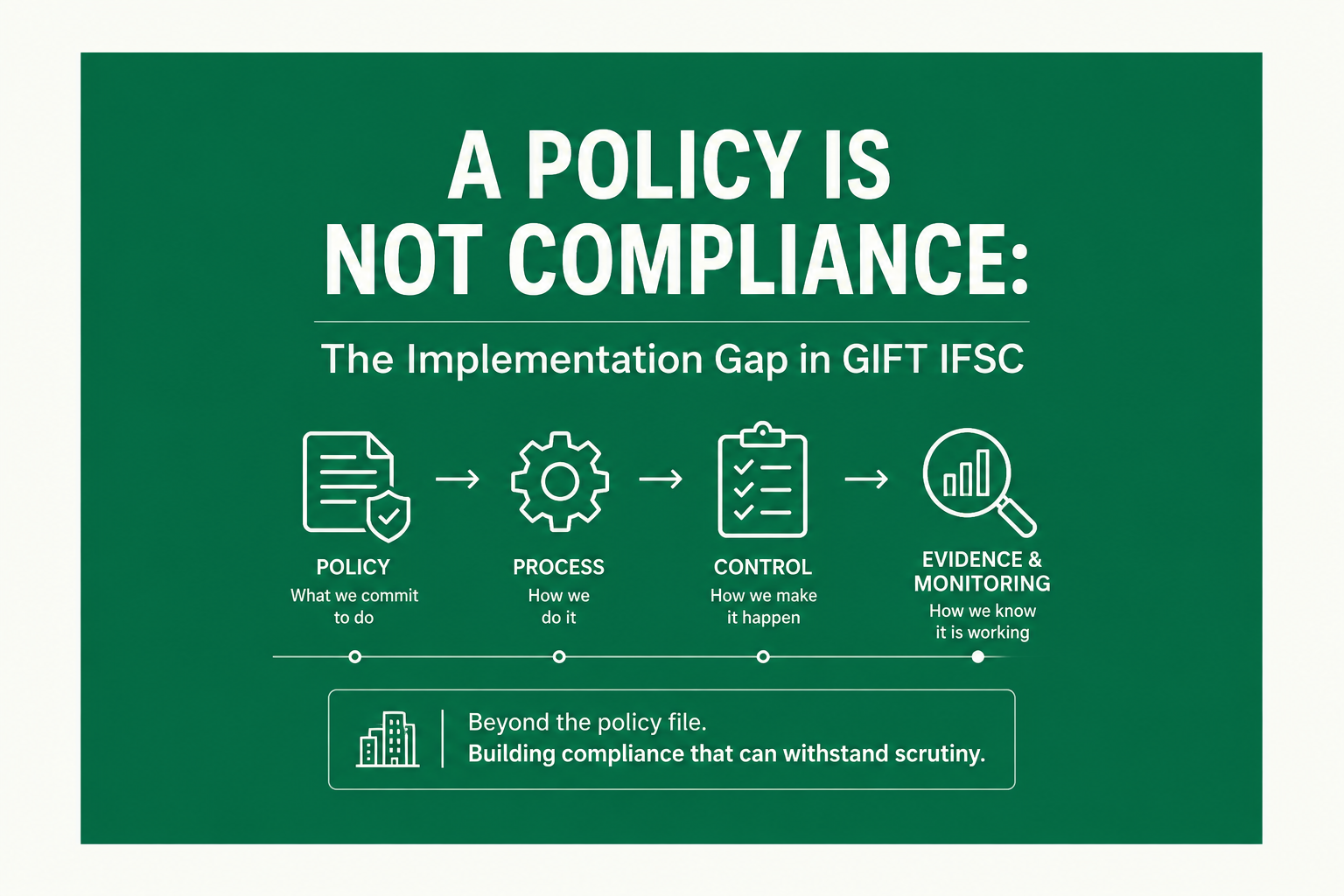
From a supervisory perspective, the focus is not merely on whether policies exist, but on whether they are approved, implemented, periodically reviewed, and supported by evidence trails. Policies that remain static documents — without board oversight, version control, or operational linkage — rarely satisfy regulatory expectations.
My View: In GIFT IFSC inspections, the absence of a properly documented and board-approved policy suite is frequently viewed as a governance weakness, even where no specific transactional breach is identified. FMEs that maintain a living policy architecture — regularly reviewed, updated, and operationalised — are significantly better positioned to demonstrate regulatory defensibility and institutional maturity.
Scheme Governance and Disclosure Discipline
Once a scheme is launched, the regulatory lens of IFSCA shifts decisively toward investor protection, valuation integrity, and disclosure discipline. At this stage, the Authority’s primary concern is whether the Fund Management Entity has established robust, repeatable processes that ensure investors receive timely, accurate, and transparent information throughout the life of the scheme.
The IFSCA (Fund Management) Regulations, 2025 impose a structured disclosure and valuation framework across different scheme categories. Broadly, the regulatory architecture requires that a placement memorandum or offer document be filed prior to launch (Regulations 19, 31 and 43), followed by ongoing disclosure of NAV and portfolio information at prescribed intervals (Regulations 24, 36 and 48). In parallel, the regulations mandate independent and fair valuation of scheme assets (Regulations 26, 38 and 50), supported by a clearly documented and consistently applied NAV computation methodology (Regulations 27, 39 and 51).
From a supervisory standpoint, IFSCA’s focus is not limited to whether disclosures are made; it examines whether the valuation and NAV ecosystem is process-driven, independently verifiable, and supported by audit trails. FMEs are therefore expected to maintain clear valuation policies, documented calculation workflows, maker-checker controls, and where appropriate, independent validation through fund administrators or valuers.
In current IFSC supervisory practice, NAV and valuation controls that rely heavily on manual spreadsheets without adequate controls, version discipline, or independent checks are increasingly viewed as high-risk. FMEs should design valuation frameworks that are system-backed, review-enabled, and capable of withstanding detailed regulatory scrutiny.
Part III — Compliance Calendar for FMEs
Daily / Ongoing Compliance
With the foundational framework in place, the regulatory lens for Fund Management Entities moves firmly toward continuous, always-on compliance discipline. Under the IFSCA (Fund Management) Regulations, 2025, several obligations are not tied to filing dates or periodic submissions. Instead, they are expected to function seamlessly within the day-to-day operating environment of the FME.
From a supervisory perspective in GIFT IFSC, these areas often receive heightened scrutiny because they reveal the entity’s real-time governance culture, not merely its ability to meet calendar-based filings. Accordingly, FMEs should treat these controls as system-driven processes supported by logs, review notes, and board visibility where appropriate.
The table below captures the core ongoing compliance expectations that should be continuously monitored and evidenced.
| Compliance Item | Applicability | Regulation Reference | Reporting Line | Practical Remarks |
| Continuous net worth maintenance | All FMEs | Regulation 8 | Internal monitoring; reported to Board periodically | Quarterly internal review is advisable despite continuous requirement |
| Quarterly net worth computation and internal certification | All FMEs | Regulation 8 read with Regulation 119 | Internal; available to Authority on request | Maintain working papers and Board visibility where material movement occurs. |
| AML / KYC monitoring | All schemes | Third Schedule (Code of Conduct) | Internal surveillance; regulatory reporting if suspicious activity | Maintain ongoing monitoring and STR/SAR readiness |
| Risk monitoring framework | All FMEs | Regulation 7 read with Chapter VIII | Internal risk oversight; Board visibility expected | Documented periodic reviews strengthen defensibility |
| Investor grievance handling | All FMEs | Regulation 7 (Compliance Officer duties) | Investor-facing; internal records; report to Authority if escalated | Maintain updated complaint register with closure timelines |
| Cyber security controls | All FMEs | Regulation 122 | Primarily internal; report incidents as required | Maintain incident logs and periodic vulnerability assessments |
| Segregation of scheme assets | Scheme level | Third Schedule fiduciary duties | Internal control; subject to inspection | Strictly enforced; separate bank and securities accounts expected |
In IFSCA inspections, gaps in continuous controls — particularly AML surveillance, asset segregation, and grievance redressal — are often viewed more seriously than minor delays in periodic filings. FMEs should therefore ensure these controls are embedded in systems, periodically reviewed by management, and supported by retrievable evidence at all times. Entities that operationalise these controls effectively tend to face significantly smoother supervisory interactions within the IFSC framework.
Daily / Weekly NAV Compliance
Once schemes are operational, NAV computation and disclosure become one of the most closely supervised areas under the IFSCA (Fund Management) Regulations, 2025. The regulatory emphasis is not only on calculation accuracy but also on timely disclosure to the correct stakeholders. FMEs should clearly distinguish between NAV that must be disclosed to investors or exchanges and documentation that must be retained internally for inspection.
The applicable framework is summarised below.
| Scheme Type | Frequency | Regulation Reference | Reporting Line | Practical Note |
| Retail open-ended scheme NAV | Daily | Regulations 48 & 51 | Disclosed to investors / exchange (if listed); records maintained internally | Automation strongly recommended |
| Retail close-ended scheme NAV | Weekly | Regulations 48 & 51 | Disclosed to investors / exchange (if listed); internal records retained | Maintain disclosure evidence |
| Restricted scheme NAV | Monthly / Half-yearly (as applicable) | Regulation 39 | Primarily investor reporting; internal working papers mandatory | Follow PPM commitments carefully |
| Venture capital scheme NAV | At least annually | Regulation 27 | Investor reporting; internal valuation records | Independent valuation advisable |
IFSCA typically examines two parallel aspects during inspections — whether the NAV was disclosed to the appropriate stakeholders on time, and whether the underlying valuation working papers are internally verifiable. FMEs should therefore maintain clear maker–checker controls, disclosure logs, and archival evidence of investor communications.
Quarterly Compliance
Beyond continuous controls, the quarterly compliance cycle is where the Fund Management Entity demonstrates structured governance oversight and investor transparency. While not every quarterly action is expressly date-driven in the regulations, supervisory practice in GIFT IFSC clearly expects FMEs to maintain periodic review discipline, board visibility, and investor-level disclosures where applicable.
Quarterly reviews are particularly important because they bridge the gap between daily controls and annual certifications. In inspections, IFSCA often evaluates whether FMEs have an established rhythm of internal review rather than relying solely on year-end compliance.
The key quarterly expectations are summarised below.
| Compliance Item | Timeline | Regulation Reference | Reporting Line | Practical Guidance |
| Portfolio disclosure to investors | Within 1 month of quarter end | Regulations 36 & 48 | Investors (and exchange if applicable) | Automate reporting and maintain dissemination evidence |
| Related-party / associate transaction review | Quarterly (good governance practice) | Third Schedule fiduciary duties | Internal review; Board visibility advisable | Maintain conflict and related-party register |
| Internal compliance report to Board | Quarterly (strongly recommended) | Regulation 7 governance intent | Board / senior management | Enhances supervisory defensibility |
IFSCA increasingly looks for evidence that the Compliance Officer and senior management maintain periodic situational awareness of the entity’s risk and compliance posture. FMEs that institutionalise quarterly reviews — particularly portfolio transparency and conflict monitoring — are generally better positioned to demonstrate proactive governance rather than reactive compliance.
Annual Compliance
The annual compliance cycle is where the Fund Management Entity consolidates its governance posture and demonstrates formal board oversight under the IFSCA (Fund Management) Regulations, 2025. While many controls operate continuously or quarterly, the Authority expects certain critical reviews, validations, and certifications to be completed at least once every financial year.
From a supervisory standpoint, annual compliance is not merely a ritual exercise. IFSCA increasingly examines whether year-end processes — particularly audits, policy reviews, and resilience testing — result in meaningful validation and documented management action, rather than routine sign-offs. FMEs should therefore ensure that annual items are properly scheduled, minuted, and supported by working papers.
The key annual compliance expectations are summarised below.
| Compliance Item | Timeline | Regulation Reference | Reporting Line | Practical Remarks |
| Statutory audit of accounts | Annual | Regulation 119 (Books and Records) | Auditor report to FME; available for Authority review | Ensure independence and timely completion |
| Policy review and board re-approval | Annual | Chapter VIII governance intent | Board approval | Maintain strict version control and change log |
| Business Continuity Plan (BCP) review and testing | Annual | Regulation 121 | Internal review; Board visibility advisable | Mock drill evidence strengthens defensibility |
| Cyber security audit / review | Annual | Regulation 122 | Internal / external audit; available to Authority | Increasing supervisory focus area |
| Net worth certification to Board | Annual | Regulation 8 | Board / senior management | Maintain computation working papers |
| Employee certification and training | Periodic (at least annual cycle advisable) | Regulation 7(6) | Internal HR / compliance oversight | Track completion and maintain training records |
| Scheme Annual Report submission to IFSCA | Within 4 months from end of financial year | Regulation 134 | IFSCA | Include audited financials and ensure investor abridged summary is circulated. |
| Payment of annual regulatory fees | As specified by IFSCA from time to time | Regulation 126 | IFSCA | Track fee circulars issued by the Authority. |
In recent IFSC supervisory interactions, regulators have shown heightened interest in whether annual reviews — particularly policy updates, cyber audits, and BCP testing — lead to documented remediation actions where gaps are identified. FMEs that treat the annual cycle as a substantive governance review, rather than a checklist exercise, typically demonstrate stronger regulatory maturity and inspection readiness.
Part IV — Event-Based Compliance Triggers
In addition to continuous and calendar-driven obligations, the IFSCA (Fund Management) Regulations, 2025 impose several event-triggered compliance requirements. These obligations arise upon the occurrence of specified developments and typically attract heightened regulatory sensitivity because they relate to changes that may impact investors, governance stability, or operational resilience.
From a supervisory standpoint, IFSCA expects FMEs to maintain clear internal escalation protocols so that reportable events are identified early, assessed promptly, and communicated to the appropriate stakeholder — whether the Authority, investors, or the Board. In practice, delays in event-based reporting are frequently viewed as control weaknesses even where the underlying event itself is not adverse.
The key trigger-based compliance requirements are set out below.
| Trigger Event | Compliance Action | Regulation Basis | Reporting Line | Practical Note |
| Change in Principal Officer / Compliance Officer | Inform the Authority promptly | Regulation 7 | IFSCA | Maintain board approval and updated filings |
| Material change in information previously submitted | Immediate intimation | Regulation 13(1)(b) | IFSCA | Assess materiality through compliance function |
| Material change in placement memorandum / offer document | Notify Authority and investors as applicable | Regulations 19 & 31 | IFSCA and Investors | Maintain version control and disclosure records |
| Deviation from stated investment strategy | Obtain investor consent where required | Regulations 36 & 48 | Investors (and Authority if applicable) | Document voting thresholds and communications |
| Cyber incident or material cyber event | Activate incident response and report as required | Regulation 122 | Internal escalation; report to IFSCA if material | Maintain incident log and root-cause review |
| Major operational disruption | Activate Business Continuity Plan | Regulation 121 | Internal / Board; inform Authority if significant | Preserve BCP activation evidence |
| Direct or indirect change in control of the FME | Prior approval of IFSCA required | Regulation 125 | IFSCA | Transaction should not be consummated prior to regulatory approval. |
| Opening branch or representative office outside IFSC | Prior intimation to IFSCA with details | Regulation 137 | IFSCA | Particularly relevant for marketing and client servicing presence. |
In GIFT IFSC supervisory reviews, delays or gaps in event-based reporting are among the most common observations raised by the Authority. FMEs should therefore implement clear trigger identification matrices, maker–checker escalation, and compliance officer oversight to ensure that reportable events are captured and communicated without regulatory lag.
Part V — Record Maintenance and Retention
Robust documentation is the backbone of regulatory defensibility for Fund Management Entities operating in GIFT IFSC. The IFSCA (Fund Management) Regulations, 2025 place explicit emphasis on the maintenance of books, records, and supporting documents in a manner that allows the Authority to conduct effective inspection and supervisory review. This obligation flows primarily from the record-keeping framework under Chapter VIII, particularly Regulation 119, read together with the Third and Sixth Schedules.
From a practical standpoint, IFSCA does not assess compliance based solely on whether processes exist; it evaluates whether the FME can produce contemporaneous, retrievable, and properly preserved records supporting its actions. Accordingly, FMEs should maintain structured retention policies covering financial, operational, investor, and valuation documentation, with clear ownership and archival protocols.
The indicative retention expectations are set out below.
| Record Type | Retention Expectation | Regulatory Basis | Reporting Line | Practical Guidance |
| Financial and operational records | Generally 8 years | Regulation 119 | Internal; subject to IFSCA inspection | Maintain both digital and secure backup archives |
| Scheme records post winding-up | Approximately 5 years | Regulation 119 | Internal; subject to inspection | Often overlooked — ensure archival discipline |
| KYC / AML records | As per AML norms | Third Schedule (Code of Conduct) | Internal monitoring; regulatory access when required | Maintain secure, access-controlled storage |
| Valuation and NAV working papers | Long-term retention advisable | Sixth Schedule | Internal; subject to Authority review | Preserve independent valuation trail |
| Investor communications | Recommended ~8 years | Governance best practice | Internal; producible to Authority | Maintain email and disclosure archives |
In IFSC inspections, inability to promptly retrieve historical records is frequently treated as a control weakness, even where the underlying transaction was compliant. FMEs should therefore ensure that record retention is system-driven, indexed, and periodically tested for retrieval readiness, particularly for valuation files, investor communications, and AML documentation.
Part VI — Board-Level Compliance Checklist
Always-On Oversight
At the apex of the governance framework, the Board and senior management of a Fund Management Entity are expected to maintain continuous supervisory visibility over the entity’s financial soundness, control environment, and investor protection mechanisms. While the IFSCA (Fund Management) Regulations, 2025 place primary operational responsibility on the Principal Officer and Compliance Officer, the regulatory architecture — particularly Regulation 7 read with the Third Schedule fiduciary obligations — clearly envisages active board oversight rather than passive reliance on management.
In practical supervisory reviews within GIFT IFSC, the Authority often evaluates whether the Board receives periodic dashboards, exception reports, and escalation notes on key risk areas. Where material deviations arise, appropriate reporting to IFSCA may also be triggered under the relevant provisions.
Accordingly, the Board should ensure continuous monitoring of the following critical areas:
- Net worth adequacy: Ongoing compliance with Regulation 8 should be tracked through periodic management certification. While routine reporting to IFSCA is not required in the absence of a breach, any material erosion below prescribed thresholds must be promptly escalated and, where applicable, reported to the Authority.
- AML / CFT surveillance effectiveness: Oversight of the AML monitoring framework under the Third Schedule is essential. Suspicious transactions, if identified, must be reported to the competent AML authority as per applicable law, and any material compliance concerns may warrant regulatory visibility.
- Risk management reviews: The Board should periodically review risk dashboards prepared under the governance framework flowing from Regulation 7 and Chapter VIII. Significant risk events or control failures may require internal escalation and potential regulatory intimation depending on materiality.
- Cyber resilience posture: Under Regulation 122, FMEs must maintain robust cyber security controls. The Board should receive periodic cyber risk reports and ensure that any material cyber incident is escalated in line with incident reporting protocols and, where required, notified to IFSCA.
- Investor grievance status: Regulation 7 places responsibility on the Compliance Officer to maintain an effective grievance redressal mechanism. The Board should review complaint trends, ageing, and systemic issues. Escalated or unresolved investor matters may attract regulatory attention.
- Asset segregation compliance: Fiduciary duties under the Third Schedule require strict segregation of scheme assets. Any breach or near-miss in segregation controls is considered highly sensitive and, if material, may require prompt regulatory engagement.
IFSCA increasingly evaluates whether boards of IFSC entities exercise active oversight supported by documented management information systems (MIS). FMEs that maintain structured board dashboards, exception-based reporting, and clear escalation protocols — including where regulatory intimation becomes necessary — are typically better positioned to demonstrate governance maturity and supervisory readiness.
Periodic Governance Actions
In addition to continuous oversight, the Board of a Fund Management Entity is expected to conduct structured periodic governance reviews to demonstrate active supervision under the IFSCA framework. While the IFSCA (Fund Management) Regulations, 2025 do not prescribe a single consolidated “board calendar,” the combined reading of Regulation 7, Chapter VIII, and the Third Schedule makes it clear that boards must exercise documented, review-based oversight over key control functions.
From a supervisory standpoint in GIFT IFSC, regulators increasingly assess whether boards are engaging with compliance and risk matters through formal review cycles supported by minutes, action notes, and follow-ups, rather than treating these as routine agenda items.
At a minimum, the Board should periodically ensure the following:
- Annual policy review and re-approval: All core internal policies — including compliance, risk management, AML/CFT, cyber security, BCP, and valuation — should be reviewed and formally re-approved by the Board at least annually. Version control and change logs are critical for inspection readiness.
- Review of Compliance Officer reports: Periodic reports submitted under the governance framework of Regulation 7 should be examined for exceptions, regulatory developments, and control gaps. Material non-compliances, if any, should be evaluated for potential regulatory reporting implications.
- Oversight of valuation and NAV controls: Given the emphasis under Regulations 27, 39, and 51 and the Sixth Schedule, the Board should obtain comfort that NAV computation and valuation processes remain independently verifiable, consistently applied, and supported by adequate maker–checker controls.
- Review of BCP testing results: In line with Regulation 121, the Board should review outcomes of Business Continuity Plan testing, including any gaps identified and remediation timelines. Evidence of mock drills materially strengthens supervisory confidence.
- Cyber security audit observations: Under Regulation 122, cyber resilience remains an area of increasing regulatory focus. The Board should review audit findings, vulnerability assessments, and incident reports, and ensure that significant cyber events are escalated appropriately.
- Related-party and conflict exposure review: Consistent with the fiduciary obligations in the Third Schedule, the Board should periodically review related-party transactions and conflict registers to ensure arm’s-length conduct and adequate disclosure controls.
IFSCA supervisory teams increasingly look for evidence that boards are not merely receiving information but are interrogating, minuting, and following up on risk and compliance matters. FMEs that maintain structured board calendars, exception-based reporting, and documented action tracking are far better positioned to demonstrate governance depth and regulatory maturity.
Inspection Readiness Checklist
In the current supervisory environment within GIFT IFSC, inspection preparedness is no longer viewed as a reactive exercise. The IFSCA (Fund Management) Regulations, 2025, read with the Authority’s inspection and information-seeking powers, effectively require Fund Management Entities to maintain continuous documentary readiness. During supervisory reviews, the Authority typically evaluates not only whether controls exist but whether the FME can promptly produce verifiable evidence supporting its governance framework.
Accordingly, an FME should be in a position to immediately retrieve and furnish the following core records upon regulatory request:
- Certificate of registration: Valid and current approval under the IFSCA framework.
- Net worth computation: Latest working papers demonstrating compliance with Regulation 8.
- KMP and key personnel appointment records: Including Principal Officer and Compliance Officer documentation under Regulation 7.
- Board-approved policy suite: Current versions of compliance, risk, AML/CFT, cyber security, BCP, valuation, and record-retention policies.
- Latest NAV computation workings: Supporting calculations aligned with the Sixth Schedule.
- Independent valuation reports: Where applicable under the scheme framework.
- Investor disclosure samples: Evidence of timely dissemination under Regulations 24, 36, and 48.
- AML / KYC files: Properly indexed and retrievable client due-diligence records.
- Cyber security and BCP test reports: Including vulnerability assessments and mock drill outcomes under Regulations 121 and 122.
- Investor grievance register: Updated complaint log with closure status under Regulation 7 duties.
IFSCA inspections are increasingly evidence-driven and turnaround-sensitive. Inability to promptly retrieve key records is often interpreted as a control weakness even where the underlying compliance position is sound. FMEs should therefore maintain a centralised, indexed compliance repository — preferably system-based — to ensure that regulatory queries can be addressed swiftly and with documentary confidence.
Concluding Perspective
The IFSCA (Fund Management) Regulations, 2025 intentionally avoid a rigid, checklist-style rulebook. However, when Regulations 3, 7, 8, 13, 24, 36, 48, 51, 121 and 122 are read alongside the Third and Sixth Schedules, the regulatory direction becomes unequivocal. For Fund Management Entities operating in GIFT IFSC, compliance is expected to be continuous, systems-driven, and demonstrably supervised at the board and senior management level. The Authority’s supervisory approach increasingly focuses on whether governance is institutionalised through policies, controls, and evidence trails — not merely whether filings have been completed.
In practical terms, FMEs that embed compliance into their operating architecture — through automated controls, periodic board visibility, and inspection-ready documentation — tend to experience materially smoother regulatory engagement. They are also better positioned to build investor trust, withstand supervisory scrutiny, and scale within the IFSC ecosystem with confidence. Conversely, entities that treat compliance as a periodic or form-driven exercise often face avoidable regulatory friction.
The strategic takeaway is clear: in the IFSC environment, regulatory success is less about meeting minimum filing requirements and more about demonstrating a living compliance culture that is documented, reviewable, and defensible at all times.
About the Author
Prashant Kumar is a Company Secretary and Published Author advising financial services businesses, investment platforms, and cross-border entities on corporate governance, IFSCA compliances, and regulatory architecture. He regularly works with IFSC-based institutions, fund managers, startups, and advisory firms on designing defensible compliance frameworks and board-approved governance structures.
He can assist Fund Management Entities and investment platforms in the preparation, review, and implementation of key mandatory internal policies under the IFSCA regulatory framework — including compliance manuals, risk management systems, AML/CFT frameworks, cyber resilience structures, valuation policies, and governance documentation — with the objective of ensuring regulatory defensibility, inspection readiness, and minimisation of enforcement risk.
Contact: +91 9821008011