Dubai has quietly become the easiest global base for Indian businesses — faster than Europe or the US, more tax-efficient than Singapore, and deeply connected to India in trade and culture. Yet many Indian founders remain confused: Do we choose Free Zone, Mainland or Offshore? What does each one allow? What’s the smartest fit for my business? This guide answers those questions in the simplest possible way. If you’re evaluating UAE expansion, this article will give you clear direction without legal jargon or complicated decision trees.
What are the three business setup options for Indians in Dubai/UAE?
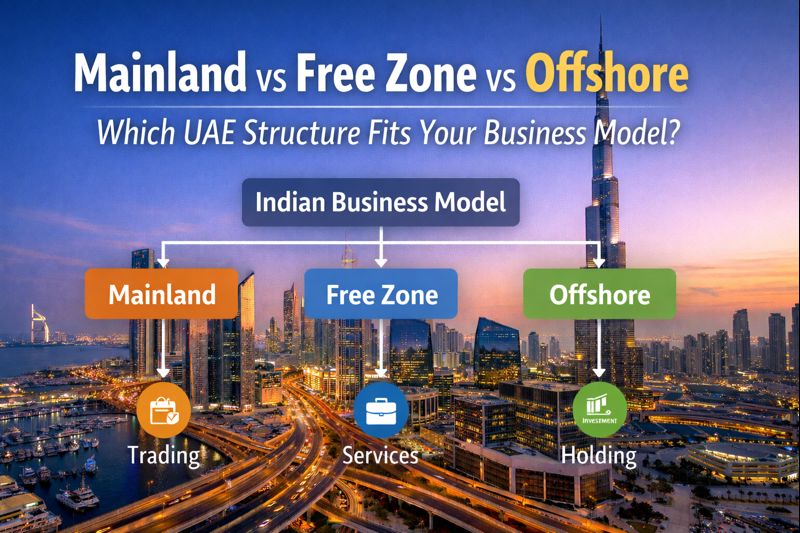
Indian businesses can choose between Free Zone, Mainland, and Offshore companies. Once you understand the core logic of each model, your choice becomes obvious.
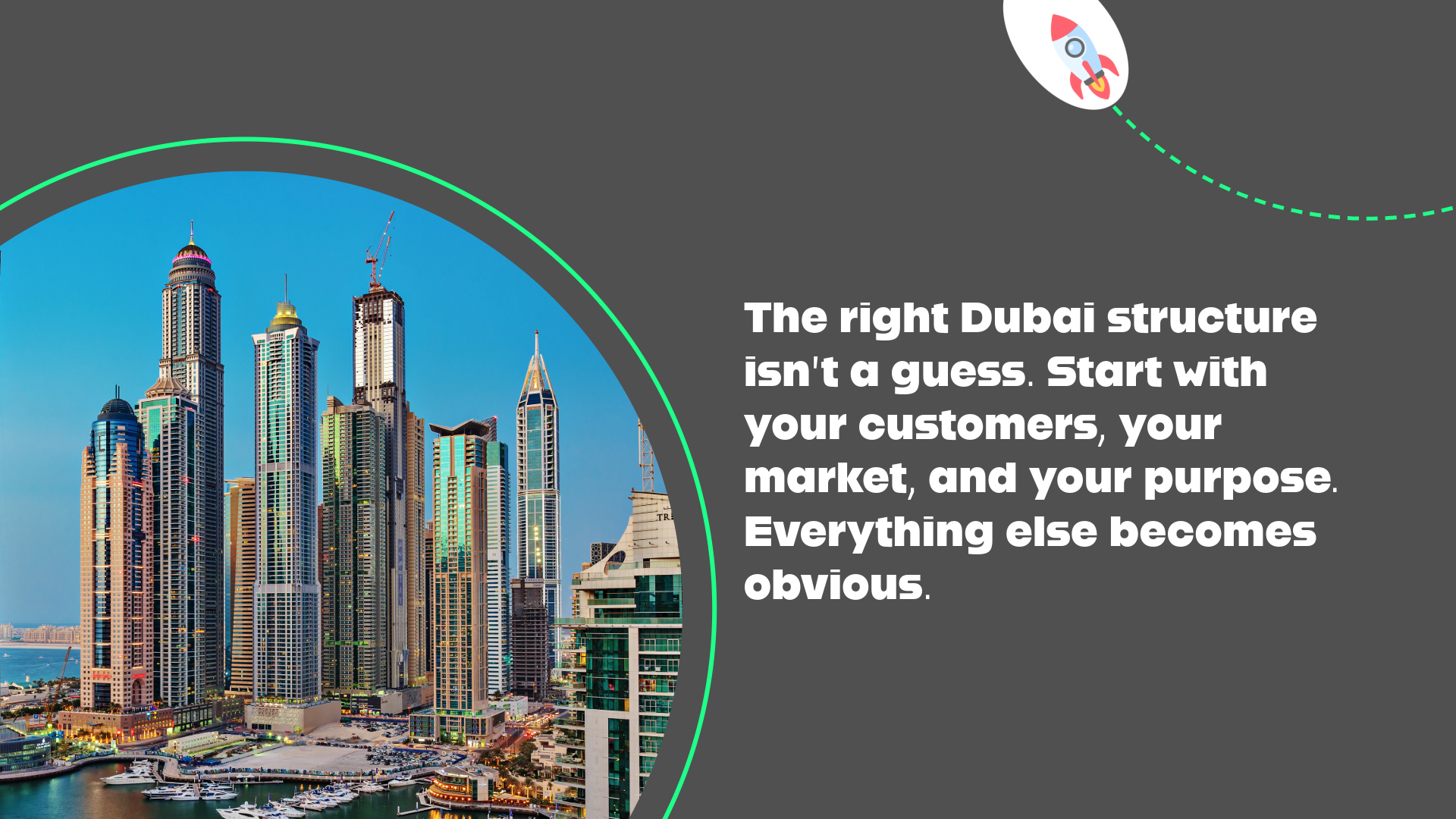
Which Dubai structure is best for which purpose?
Free Zone is best for global business, exports, consulting, online operations, and holding companies. Mainland is best when your customers are inside the UAE and you want full access to the local market. Offshore is best when you don’t need UAE business at all — just a holding or investment structure.
Free Zone Companies — the simplest and most popular option for Indians
Free Zones are designed to make life easy for international entrepreneurs. You get 100% ownership, quick digital setup, and lower costs. These zones allow you to run consulting, IT, SaaS, trading, e-commerce, and export businesses without needing a UAE partner.
A free zone company can invoice global clients, import from India and sell outside UAE, register intellectual property, own your global brand, hire employees, and even act as your international headquarters. Many Indian startups, exporters, D2C founders, and service companies choose this route.
What free zones don’t allow is direct selling inside the UAE local market. To sell locally, you either need a distributor or a mainland licence. This is the only major limitation. Free zone costs usually fall between AED 12,000–50,000, depending on the activity and visa needs.
Mainland Companies — when your customers are in the UAE
If you want to serve UAE customers directly — walk-in, retail, B2B, corporate, or government — you need a Mainland company. This structure gives full access to the entire UAE market. You can open your office anywhere, hire freely, participate in tenders, and operate in regulated sectors.
Most activities now allow 100% ownership, but a few sensitive categories still require a UAE national partner. Mainland is generally chosen by Indian restaurants, salons, logistics companies, construction firms, retail stores, coaching centres and healthcare units. It costs more because physical office space is mandatory. Expect AED 25,000–60,000+ depending on your business.
Offshore Companies — for holding, structuring and investments
Offshore companies are non-operational entities used for global structuring. They cannot trade in the UAE, hire staff or lease office space. They are mainly used to hold shares, own intellectual property, manage global investments, or act as SPVs.
Indian promoters use offshore companies for private investments, family wealth protection, international trading structures, or startup holding entities — especially when they don’t need UAE operations. Offshore is low-cost and clean for pure structuring.
How should Indian businesses decide the right structure?
Here’s the simplest way to decide:
If your customers are inside the UAE → choose Mainland.
If your business is global, digital, export-driven or consulting-led → choose Free Zone.
If you need only a holding or investment entity → choose Offshore.
If you need warehousing or logistics, choose a free zone with strong infrastructure like DMCC, JAFZA, RAKEZ or KIZAD.
If you want the lowest setup cost, zones like IFZA or SPC are ideal.
For 90% of Indian founders, the answer becomes clear once they think about customers, cost and purpose.
Common questions Indian founders ask
Yes, you can run your international operations from a Dubai entity. Many Indian entrepreneurs use Dubai as a global HQ, invoice clients abroad, hire talent globally and hold their intellectual property there.
Yes, a Dubai company can own shares in an Indian entity — subject to India’s FDI rules, sector caps, valuation norms and FEMA filings (FC-GPR, FLA etc.).
Yes, profits can be fully repatriated. UAE has no personal income tax and no tax on capital repatriation. Indian tax depends on residency and DTAA rules.
Most free zones allow remote incorporation. Mainland setups may require Emirates ID at a later stage. Free zones need no local partner. Mainland needs one only for specific regulated activities.
What documents are usually required?
Documentation is intentionally simple. You generally need passport copies, photos, address proof, and basic business details. Mainland may require additional verification. If an Indian company is the shareholder, corporate documents like MoA, AoA and board resolutions may be required. Free zones keep compliance extremely light.
Practical realities: understanding office, banking, tax and visas
Free zones offer flexible desk options and warehouses; mainland requires a physical office; offshore requires no space. Banking has become smoother, with many accounts opening in 5–10 days after due diligence. Corporate tax applies in the UAE, but free zones provide exemptions for compliant businesses. There is no personal income tax. Visa quotas vary — free zones usually give 1–6, mainland allows more, offshore provides none.
So which structure is best for most Indian businesses?
If your goal is international business and low friction: Free Zone.
If your goal is UAE customers: Mainland.
If your goal is structuring, SPVs or investments: Offshore.
For the majority of Indian entrepreneurs — exporters, consultants, SaaS firms, D2C brands, trading companies — free zones offer the best combination of ownership, cost, speed and global reach.
Why Dubai is a powerful strategic base for Indian companies
Dubai gives Indian businesses zero personal tax, fast banking, strong trading routes, high global credibility, easy fundraising, excellent logistics, strong IP protection and easier international hiring than India. It acts as a gateway to GCC, Africa, Europe and Southeast Asia. When planned properly, your Dubai structure can complement your Indian private limited or FPO seamlessly.
Final Takeaway
Indian businesses don’t need to drown in “Free Zone vs Mainland vs Offshore” confusion. The choice becomes clear once you know where your customers are, how global your operations are, and what cost structure you prefer. Dubai rewards clarity with speed, ease and opportunity — and Indian entrepreneurs are uniquely positioned to benefit from it.
About the Author
Prashant Kumar is a Company Secretary, Published Author, and Partner at Eclectic Legal, a full-service Indian law firm advising on cross-border structuring, FPOs, FEMA compliance, and international expansion. He works closely with Indian founders, family businesses, agribusiness groups and startups to design practical Dubai/UAE setup strategies — choosing the right structure, aligning India-side FEMA/FDI requirements, and ensuring long-term regulatory clarity.
For consultations or collaboration, he can be reached at prashant@eclecticlegal.com or +91-9821008011.