How Producer Companies Can Stay Tax-Efficient and Fully Compliant
By Prashant Kumar
Introduction
After registering and completing initial compliance, every Farmer Producer Organisation (FPO) faces its next challenge — taxation and accounting.
Many farmer groups assume that FPOs are completely tax-exempt, but in reality, the exemption applies only to agricultural income. Non-agricultural activities like trading, processing, or branded sales attract tax and GST obligations.
For an FPO to thrive, it must understand how to correctly classify income, meet statutory filing requirements, and maintain accurate books. This article explains the tax obligations, exemptions, GST applicability, and accounting best practices for FPOs under Indian law in 2026 — so that you can stay compliant while minimising your tax burden.
If your FPO has recently been incorporated, first complete the Post-Incorporation Compliance Checklist for FPOs (2026), then move on to this taxation framework.
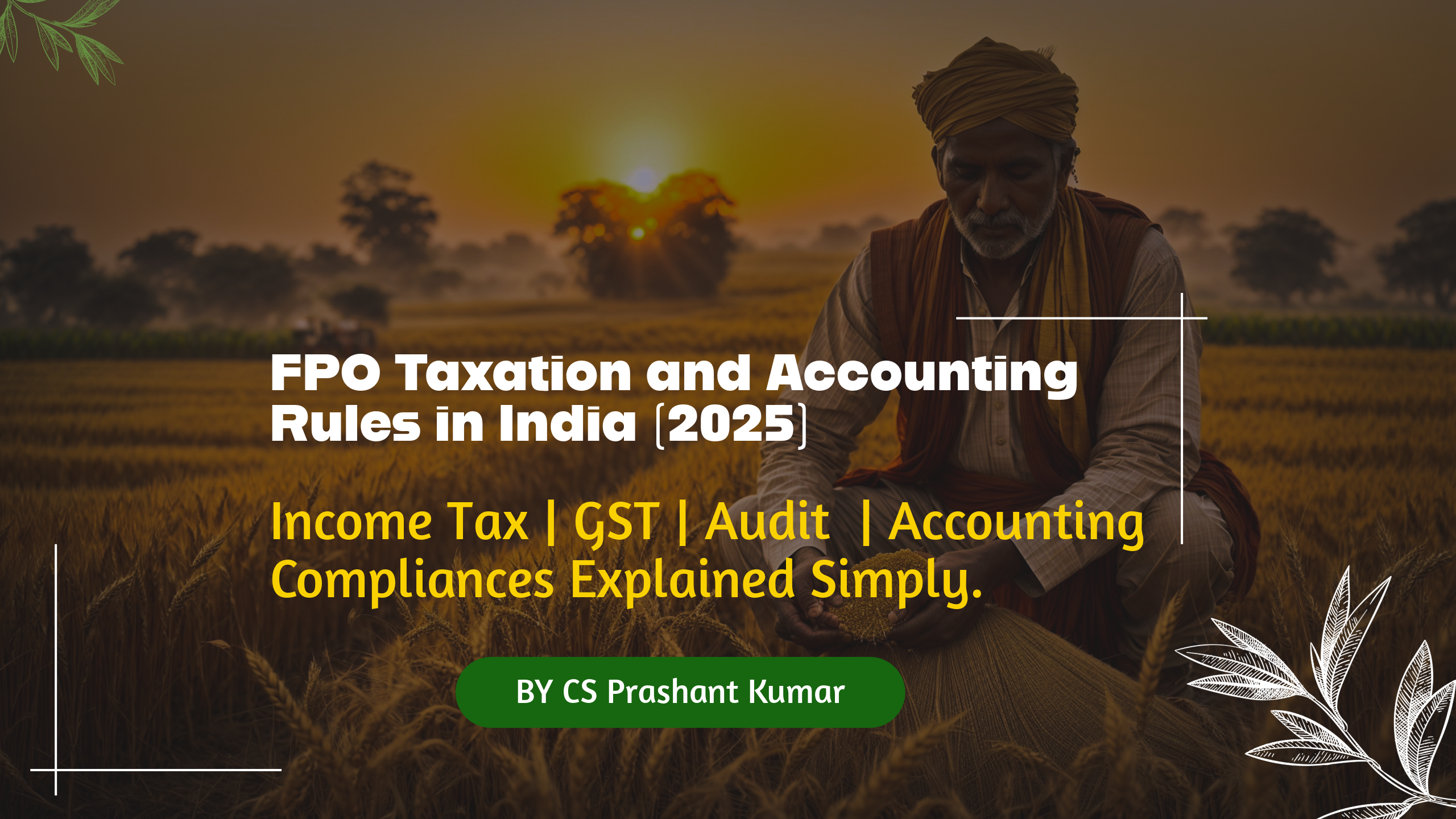
What Are the Tax Obligations of an FPO?
An FPO registered as a Producer Company is taxed like a domestic company under the Income Tax Act, 1961. Agricultural income is generally exempt, but profits from trading, processing, or non-member transactions are taxable. FPOs must also comply with GST and TDS obligations.
Main Tax Components Applicable to FPOs
- Income Tax – on business or trading profits.
- TDS (Tax Deducted at Source) – on payments to contractors or professionals.
- GST – on taxable supplies of goods and services.
- Tax Audit – mandatory if turnover crosses prescribed limits.
Income Tax Rules for FPOs (Producer Companies)
01. Tax Rate and Exemption
Under Section 115BAA of the Income Tax Act, 1961, a Producer Company is taxed as a domestic company:
- 22% corporate tax rate (plus surcharge and cess).
- Agricultural income (grown and sold by members) is fully exempt.
- Income from non-member activities or processing beyond primary level is taxable.
Example:
If an FPO buys paddy from non-members and sells under its brand, that income is taxable. If it sells its members’ produce in raw form, it’s exempt.
02. Relevant Exemptions
- Section 10(1): Agricultural income exemption.
- Section 10(37): Exemption on compensation from compulsory land acquisition.
- Section 80P (analogous reference): While cooperatives get deductions, Producer Companies don’t automatically qualify — so caution is needed.
Key Tip: Maintain member-wise records to prove agricultural income during assessments or funding audits.
GST Applicability on FPOs
When FPOs Must Register for GST
- Threshold: ₹40 lakh (goods) / ₹20 lakh (services).
- FPOs selling only members’ unprocessed produce are exempt.
- GST becomes applicable when:
- Selling inputs (fertilizers, seeds, pesticides).
- Trading goods bought from non-members.
- Processing or packaging beyond basic cleaning and grading.
Benefits of Voluntary Registration
Even if exempt, voluntary registration allows an FPO to claim input tax credit (ITC) on purchases and appear more credible for institutional transactions.
TDS Compliance for FPOs
Every FPO making specified payments must deduct TDS under the Income Tax Act:
- Section 194C: Contractors – 1% (individual) / 2% (company).
- Section 194J: Professional fees – 10%.
- Section 192: Salary TDS as per applicable slab.
TDS must be deposited monthly and reported quarterly via Form 24Q/26Q on the TRACES portal.
Failure to deduct or deposit attracts interest (1–1.5% per month) and penalties under Section 271C.
Accounting Standards and Audit Requirements
01. Books of Accounts
Under Section 128 of the Companies Act, 2013, every FPO must maintain:
- Cash and bank books.
- Journal and general ledger.
- Member-wise transaction register.
- Stock and sales registers.
02. Statutory and Tax Audit
- Tax Audit (Section 44AB): Required if turnover exceeds ₹1 crore (₹10 crore for digital).
- Producer Company Audit (Section 581S): Covers both financials and patronage distribution.
- Auditor appointment and filing (Form ADT-1) are mandatory under MCA V3.
03. Audit Synchronisation
Ensure your statutory and tax audits reconcile — discrepancies often delay SFAC or NABARD funding.
Refer to our SFAC Funding Guide for grant eligibility linked with audited accounts.
Filing Calendar and Compliance Summary
| Filing Type | Form | Due Date |
|---|---|---|
| Income Tax Return | ITR-6 | 31 October |
| Tax Audit Report | 3CA/3CB + 3CD | 30 September |
| GST Returns | GSTR-1 & GSTR-3B | Monthly/Quarterly |
| TDS Returns | Form 24Q/26Q | Quarterly |
| ROC Filings | AOC-4 & MGT-7A | 60 days post-AGM |
Synchronising ROC and tax filings keeps your FPO in good standing and eligible for institutional finance.
How to Stay Tax-Efficient
- Maintain separate ledgers for member and non-member income.
- Avoid mixing exempt agricultural receipts with taxable business income.
- Register under GST early to claim input credit.
- Digitise accounting using basic ERP or Tally FPO modules.
- Conduct quarterly financial reviews with your accountant or CS.
Efficient accounting reduces errors, simplifies audits, and builds trust with lenders and investors.
Common Mistakes That Lead to Notices
- Filing ITR late or without audit reports.
- Claiming agricultural exemptions without documentation.
- Ignoring TDS or GST compliance.
- Using personal bank accounts for FPO transactions.
- Not maintaining proper ledgers under MCA V3.
A proactive approach to tax and accounting ensures credibility — and unlocks faster access to funding and government incentives.
Related Reading
📘 How to Register an FPO in India – Step-by-Step 2026 Guide
📘 Post-Incorporation Compliance Checklist for FPOs (2026)
📘 SFAC Schemes and Funding Support for FPOs in India
Together, these articles form the FPO Legal Series — a comprehensive resource on registration, compliance, funding, and taxation for Farmer Producer Organisations in India.
About the Author
Prashant Kumar is a Company Secretary, Published Author, and Partner at Eclectic Legal, a full-service Indian law firm advising on corporate, regulatory, and transactional matters. He specialises in FPO structuring, agricultural law, and corporate compliance, helping farmer groups, startups, and agri-businesses build legally sound and sustainable organisations.
📩 prashant@eclecticlegal.com | ☎️ +91-9821008011