For Indian promoters evaluating a UAE entry, the real risk is not whether to set up in the UAE — it is choosing the wrong structure for the right business. Mainland, Free Zone, and Offshore companies in the United Arab Emirates are built for fundamentally different objectives. They differ in who you can sell to, where you can operate, how banks treat you, and how Indian tax and FEMA rules apply. Treating them as interchangeable options leads to blocked bank accounts, restructuring costs, and compliance exposure. This article expands the decision-tree logic and maps each structure clearly to Indian business models such as trading, services, holding, IP, and investments.
What are the three UAE company structures?
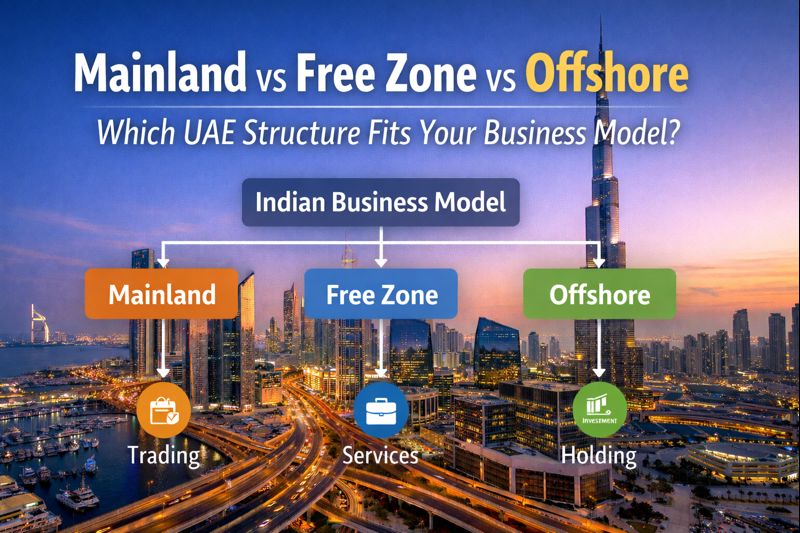
UAE companies can be set up as Mainland, Free Zone, or Offshore entities. Mainland companies serve the UAE domestic market, Free Zone companies support international or zone-based operations, and Offshore companies are non-operating vehicles used only for holding or investment purposes.
Everything that follows flows from this distinction.
Decision Tree – Step 1: Will you sell or deliver services inside the UAE?
This single question eliminates most confusion.
If your business intends to sell goods or provide services directly to UAE customers — whether B2B or B2C — a Mainland structure is almost always mandatory. This includes retail, wholesale distribution, logistics, construction, healthcare, professional services delivered onshore, and government or semi-government contracts. Mainland licences issued by the local Department of Economy allow unrestricted trading across the UAE, office location flexibility, and direct hiring without Free Zone constraints.
For Indian businesses targeting the UAE market itself, choosing anything other than Mainland typically results in workaround arrangements, agent dependencies, or compliance friction.
If the answer is no, and your customers are primarily outside the UAE, the analysis moves to the next layer.
Decision Tree – Step 2: Is this an operating business or a structuring entity?
This distinction separates Free Zone from Offshore.
If the company will have employees, issue invoices, earn operating revenue, or perform active business functions, it must be an operating entity. Offshore companies are not designed for this and should be excluded immediately.
If the entity will only hold shares, own IP, or act as an investment vehicle, Offshore or specialised Free Zone holding structures may be considered — but only with clarity on purpose and compliance.
Free Zone companies: Built for international operations, not local trading
Free Zone companies are best suited for Indian businesses with international clients, export-oriented trading, SaaS, consulting, or regional headquarters functions where UAE presence supports global operations rather than domestic UAE sales.
Free Zones were created to attract foreign businesses that need infrastructure, credibility, and banking access without entering the UAE domestic market. For Indian SaaS companies billing US or European clients, exporters routing goods through the UAE, or consulting firms serving global customers, Free Zones offer cost efficiency and speed of setup.
However, the limitation is critical: most Free Zone companies cannot trade directly with UAE mainland customerswithout appointing a local distributor or obtaining special permissions. Ignoring this constraint is one of the most common structuring errors.
From an Indian compliance perspective, Free Zone entities often align well with FEMA ODI or LRS frameworks when substance, pricing, and control are documented properly. For a practical breakdown of Free Zone versus Mainland choices, this Dubai company setup guide for Indian businesses explains the compliance and cost logic in detail.
Mainland companies: Necessary when UAE is the target market
Mainland companies are required when Indian businesses want unrestricted access to UAE customers, local contracts, government tenders, or regulated onshore activities.
Mainland entities are not about prestige — they are about permission. If your revenue will be generated from within the UAE, a Mainland licence provides legal clarity and operational freedom. Indian businesses entering UAE distribution, opening clinics, running restaurants, executing construction contracts, or providing onshore professional services typically have no viable alternative.
While Mainland structures are costlier and involve greater compliance, they eliminate artificial workarounds and future restructuring.
Offshore companies: For holding and investment — nothing else
Offshore companies in the UAE are suitable only for holding shares, owning assets or IP, and making investments. They cannot operate businesses, hire staff, or invoice customers.
Offshore jurisdictions such as JAFZA Offshore or RAK ICC exist to facilitate ownership and asset structuring, not commercial activity. They are often used as parent companies, family investment vehicles, or fund-level entities.
Indian promoters frequently misuse Offshore companies as “low-cost UAE setups.” This almost always backfires. Banks restrict accounts, auditors flag substance issues, and Indian tax authorities question control and residency. Offshore works only when the intent is purely holding or investment.
Matching UAE structures to Indian business models
For trading businesses, the deciding factor is geography of sales. International import-export and re-export activities typically fit well within a Free Zone. The moment sales shift to UAE customers, Mainland becomes mandatory.
For services, IT, consulting, and SaaS, Free Zone structures work when services are delivered to overseas clients. If services are performed onshore in the UAE or fall under regulated activities, a Mainland licence is required.
For holding companies, Offshore or Free Zone holding entities may be used depending on banking needs, treaty access, and substance expectations. Increasingly, Free Zone holding companies with real presence are preferred over pure Offshore vehicles.
For IP ownership and licensing, substance matters more than the label. While Offshore entities are sometimes used, IP income without people, decision-making, and licensing activity increasingly attracts scrutiny. Free Zone entities with operational substance are usually safer.
For investment and family office structures, Offshore vehicles work for passive investments. Where investment management, advisory, or fund operations are involved, regulated Free Zone or Mainland structures may be necessary.
Why structure mistakes become expensive
The most frequent failure pattern is choosing Free Zone when Mainland is needed, or Offshore when an operating entity is required. Another common issue is assuming all Free Zones are equal — banking perception, permitted activities, and regulatory oversight vary significantly.
Layered on top are Indian obligations: FEMA routing, ODI vs LRS classification, transfer pricing, GAAR exposure, and tax residency analysis. UAE structure selection without Indian compliance mapping is incomplete.
FAQs
Is Free Zone cheaper than Mainland for Indian businesses?
Generally yes, but only if the business model fits. A cheaper Free Zone structure becomes expensive if it later requires restructuring into Mainland due to local trading needs.
Can a Free Zone company legally serve UAE clients at all?
Only in limited circumstances, usually through authorised distributors or special approvals. Direct onshore trading is restricted in most Free Zones.
Are Offshore companies tax-free and anonymous?
No. Offshore companies are subject to transparency, beneficial ownership disclosures, and increasing scrutiny. They are not tax shelters and should not be treated as such.
Which UAE structure is safest from Indian tax scrutiny?
No structure is “safe” by default. Substance, control, pricing, and documentation matter far more than whether the entity is Mainland, Free Zone, or Offshore.
Can one Indian group use multiple UAE structures?
Yes, and many do. A common model is a Mainland operating company, a Free Zone regional HQ, and an Offshore holding entity — each with a clear role.
Does choosing the wrong structure create FEMA issues?
Yes. Improper remittance routing, incorrect ODI classification, or lack of commercial justification can trigger FEMA non-compliance.
Strategic takeaway
UAE structures are instruments, not shortcuts. Mainland enables market access. Free Zones enable international efficiency. Offshore enables ownership and investment structuring. The right choice depends on what the business does, where revenue is earned, and how compliance is maintained. Indian businesses that design structures deliberately — rather than chasing convenience — are the ones that extract real, lasting value from the UAE.
About the Author
Prashant Kumar is a Company Secretary, Published Author, and Partner at Eclectic Legal, a full-service Indian law firm advising on corporate, regulatory, and transactional matters. He specialises in corporate governance, legal compliance, and brand protection, helping businesses build credible and sustainable legal foundations. He can be reached for discussions on brand strategy, compliance, and governance excellence via LinkedIn.