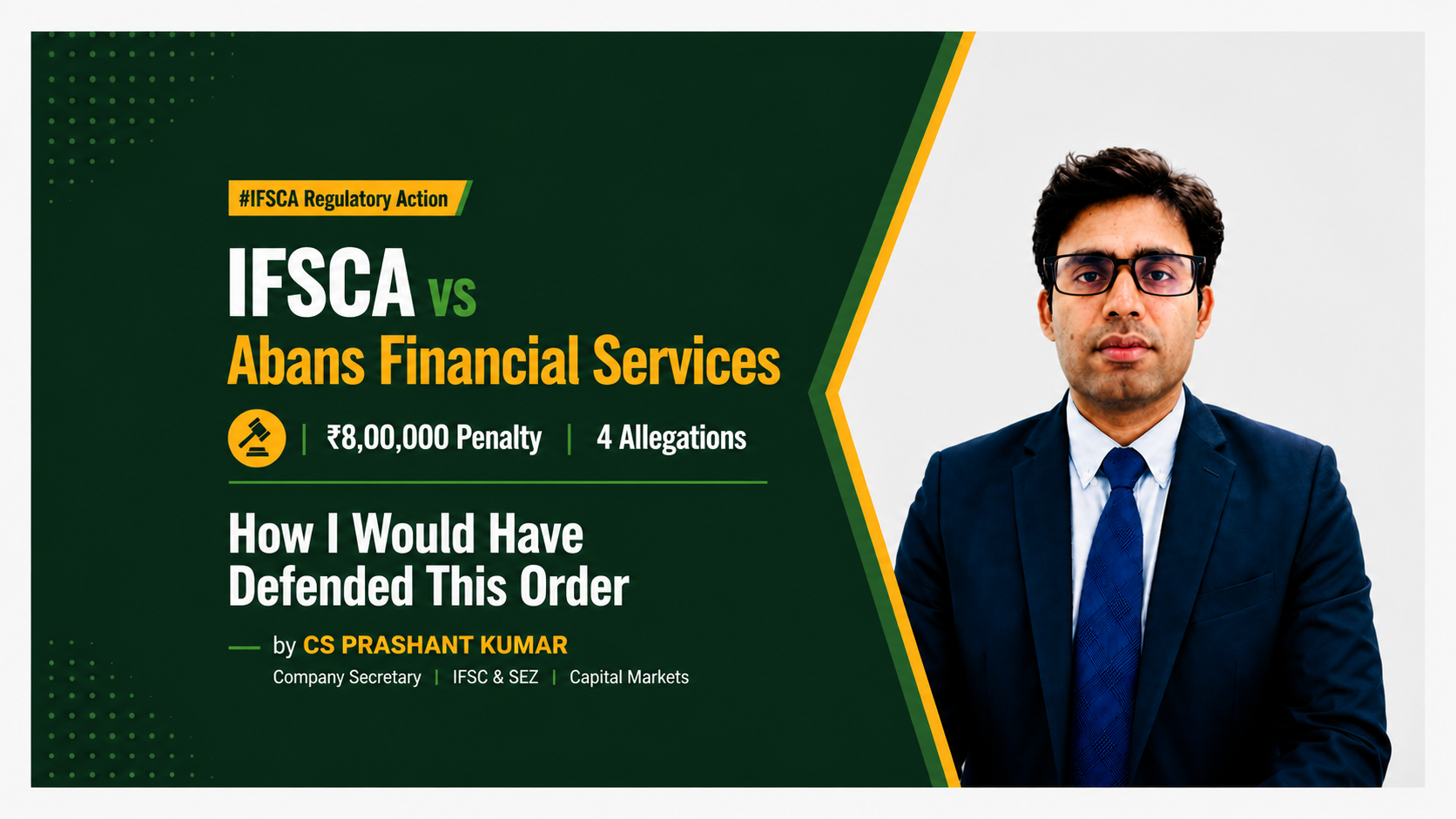
In June 2026, IFSCA imposed a penalty of ₹8,00,000 on Abans Financial Services Limited (IFSC Branch), upholding four separate allegations ranging from a fourteen-month Compliance Officer vacancy to delayed investor disclosures and inaccurate regulatory reporting. The order is now public, and most commentary on it has stopped at the obvious takeaway: here is what went wrong, do not repeat it.
This article goes further. Working from the Show Cause Notice and the specific facts it raised, here is exactly how I would have approached the defence of this matter — allegation by allegation, from the day the notice landed through the personal hearing and the submissions on penalty. The aim is not to argue that Abans should have escaped liability it genuinely had. It is to show where a sharper, more evidence-led defence could have closed the gaps the entity’s own submissions left open, protected the individuals named in the proceeding, and given the adjudicating authority a stronger basis to moderate the eventual penalty.
The Background, Briefly
Abans Alternative Fund Managers LLP was granted its Fund Management Entity licence in August 2022. In July 2024, following an internal restructuring within the group, the licence was transferred to Abans Financial Services Limited, with no change in ultimate control. IFSCA conducted an on-site inspection in September 2024, shared its findings in April 2025, and issued a Show Cause Notice in January 2026 covering four allegations. A personal hearing took place in March 2026, and the order followed in June 2026.
The four allegations were: a delay in appointing a Compliance Officer, a shortfall in the sponsor’s contribution to the scheme, inadequate internal procedures and controls, failure to disclose portfolio information and annual accounts to investors on time, and inaccurate information in periodic regulatory reports. I will take each in turn.
Allegation One: The Compliance Officer Vacancy
The facts here are not particularly flattering. The original Compliance Officer resigned, and for fourteen months no replacement was appointed. In the interim, the Principal Officer was given additional charge of the role, despite the regulation requiring a separate Key Managerial Person for that function. Candidate CVs were shared with IFSCA during this period, but none met the eligibility criteria, and the vacancy persisted.
If I were running this defence, I would not lead with the argument that the delay was unintentional. Intent is the wrong frame entirely — a fourteen-month vacancy is a problem regardless of why it happened, and arguing intent invites the regulator to focus on motive rather than on what was actually done about the gap. I would instead want, on file before the reply was even drafted, a complete record of every candidate considered, the date each was shared with IFSCA, and any response received.
What I would want most, though, is something that does not appear to exist in this matter: a written record of the entity proactively asking IFSCA for clarification on borderline candidates, rather than submitting names and waiting passively for rejection. If candidates kept falling short of the eligibility bar, the stronger move at the time would have been a direct query — here is a candidate’s profile, here is where they may not meet the stated criteria, can you confirm whether this would be acceptable. That kind of correspondence converts a pattern of failed submissions into a documented, good-faith effort to get the appointment right under genuinely difficult market conditions. Without it, the entity is left arguing good faith in the abstract, which is a weaker position than demonstrating it through a paper trail.
On the question of the Principal Officer holding additional charge, I would also want this decision documented, in writing, as a deliberate board-level or senior management decision taken as an interim stopgap — not something that happened by default. If that record does not exist from the time the decision was made, it needs to be created immediately for any ongoing situation, because reconstructing it later, after a notice has already been issued, carries far less weight.
Allegation Two: The Sponsor Contribution Shortfall
This allegation involves a genuinely strong underlying argument that, in my view, was not pushed hard enough. The scheme received authorisation in January 2022, before the Fund Management Regulations, 2022 came into force in May 2022. Those regulations later introduced a waiver mechanism allowing the sponsor’s contribution requirement to be waived if investors holding two-thirds of the scheme’s value consented. But investors in this scheme had already been onboarded before the regulation existed, meaning that consent could not realistically have been built into the original onboarding documents.
That much is a fair and sympathetic point about a regulation changing mid-stream. The problem is what happened next: the fund began investing in July 2022, and investor consent was only obtained in October 2022. That three-month gap, where investment activity proceeded without either the sponsor’s contribution or investor consent in place, was left without a specific explanation in the submissions made.
If I were handling this allegation, I would treat that gap as the single most important thing to address directly, not as a detail to be glossed over within the broader regulatory-transition argument. I would want a clear, specific explanation of why the fund could not have waited those three months — what the commercial cost of delay would have been, whether there were contractual deadlines or market conditions that made an immediate start commercially necessary, and why proceeding before consent was a reasonable judgment call given that the regulatory framework itself was still settling. Leaving that gap unaddressed, as appears to have happened, allows the regulator to conclude on its own that the entity should simply have waited — and that is exactly the conclusion drawn in this matter.
Allegation Three: Inadequate Internal Procedures and Controls
Here, the entity’s submissions leaned heavily on a legal argument: that the allegation rested on mere inference and surmise, supported by a citation to a Supreme Court decision on the standard required to establish a contravention. That is a real legal principle, but it was the wrong primary defence for this particular allegation, because the underlying ask from IFSCA was specific and factual — provide a detailed note on your internal procedures and controls — and that note was never furnished.
If I were defending this allegation, I would treat the absence of that document as the central problem to solve, not a technicality to argue around. Whatever legal principles apply to evidentiary standards, they do not substitute for producing the actual document the regulator asked for. By the time of the hearing, the entity did point to a valuation policy and a gift-and-entertainment policy adopted in September 2025, but this was raised only in passing, through an annexure, with no real detail on what the policies actually covered or how they were being implemented.
My approach would have been to treat the adoption of those policies, from the moment they existed, as something to document fully and proactively — the policy text itself, the date and authority of internal approval, and a specific note mapping each policy clause to the actual regulatory requirement it was meant to satisfy. If the regulation requires controls that protect investor interests and manage risk, the submission needs to say plainly which part of which policy does that. A passing reference in an annexure, introduced eleven months after adoption and discussed only briefly at the hearing, was never going to carry the weight this allegation needed.
Allegation Four: Investor Disclosure Delays
This is, in my view, the allegation where the entity’s defence was weakest, and where a different approach was most needed. Quarterly portfolio statements for seven consecutive quarters, covering June 2022 through December 2023, were not sent to investors on time — they were all sent together, in one batch, in April 2024. The annual report for FY 2023-24 reached investors three months late and reached IFSCA nine months late.
The submission made was that this delay was technical, venial, and procedural in nature, and did not affect the core activity of managing investor funds. I think this framing was always going to struggle, because the facts simply do not support it. A single missed quarter might reasonably be called technical. Seven consecutive missed quarters, corrected only when the regulator’s inspection forced the issue, is a pattern, not a slip — and IFSCA was right to treat it that way.
If I were running this defence, I would not have tried to characterise seven quarters of silence as a technical lapse. I would have conceded the lapse plainly and put the entire weight of the submission into two things: a clear, factual explanation of the operational cause behind the delay — whatever it genuinely was, whether a staffing gap, a systems issue, or something else specific to this entity’s early-stage operations — and a detailed account of the process now in place to prevent recurrence, including a named owner for each periodic filing and a clear internal deadline with an escalation step if that deadline is at risk. Owning the lapse honestly, paired with a credible and specific fix, would have done more for this allegation than insisting on a characterisation the facts could not support.
Allegation on Reporting: Table 3.3
A related point, raised in the proceedings, concerned a specific field in the quarterly reporting template — Table 3.3, covering investment in debt securities on a look-through basis — which was left blank. The entity’s explanation was that this was an inadvertent omission by an official, caused by a mistaken understanding, and that the relevant portfolio information had already been disclosed elsewhere in the report.
This defence had a structural problem that should have been caught before it was made: the same field was left blank in every quarterly report the entity ever filed, not just once. An explanation of a one-time mistaken understanding cannot survive that fact, because it implies a single momentary lapse, not a consistent gap across every filing.
Before offering any explanation on this point, I would have reviewed the entity’s own filing history first. Having done so, the honest and more defensible position would have been to acknowledge that the requirement for this specific field was consistently misunderstood, explain clearly what that misunderstanding was, confirm the date the correct understanding was applied, and describe the steps taken to ensure the gap does not recur going forward. That is a more credible account than one the entity’s own records contradict.
The Personal Hearing
The hearing was attended by the Principal Officer, the Vice President, and two representatives from external counsel — a reasonable composition. But composition is not the same as strategy. What matters most at a hearing like this is what gets placed on record about individual conduct, separate from the entity’s failures, because the regulatory framework allows for penalties on individual officers in default, separately from the entity itself.
The clearest example in this matter is the Principal Officer being given additional charge as Compliance Officer. I would have wanted that decision documented, well before the hearing, as a considered organisational decision made under genuine resourcing constraints — not something left to be explained orally for the first time in the hearing room. The same applies to the broader remediation steps mentioned at the hearing: rather than a general reference to policies having been adopted, I would have wanted a specific roadmap on record, naming who owns each corrective step, when it was implemented, and how it continues to be monitored.
Submissions on Penalty
The entity’s submissions on quantum relied on a list of eight precedents from the Securities Appellate Tribunal and SEBI adjudicating officers, all supporting the general principle that technical or venial breaches should not attract maximum penalties. IFSCA’s response to this was direct: the observations in those cases turned on their own specific facts, and could not be automatically applied to this matter.
This outcome was, in my view, foreseeable, because citing a long list of precedents for a shared general principle, without tying each one to the specific allegation it is meant to mitigate, makes it easy for any adjudicating authority to acknowledge the principle while still imposing close to the full penalty. A stronger approach would have built a separate, specific submission for each of the four allegations — addressing, for each one, whether there was any disproportionate gain to the entity, whether investors suffered quantifiable financial loss as distinct from inconvenience, whether the conduct was isolated or repeated, and the specific corrective step taken for that particular allegation. Tied to precedent in that structured way, the citations would have supported an actual proposed figure for each allegation, rather than floating as general arguments disconnected from this case’s specific facts.
The Decision on Appeal
The order leaves Abans with the option to appeal to the Securities Appellate Tribunal under Section 15T of the SEBI Act. Whether that option should be exercised deserves a genuine, unemotional assessment rather than an automatic decision in either direction.
Against the appeal: ₹8 lakh is not a large sum relative to the cost, time, and visibility of a contested SAT proceeding, and Abans Financial Services is still relatively early in its operating history under its current corporate form. A public, contested appeal over a comparatively modest penalty could do more damage to its relationship with IFSCA than the penalty itself, particularly if the entity intends to seek further authorisations or launch additional schemes in GIFT City.
In favour of a narrow appeal: the order’s treatment of the independent valuer requirement, where IFSCA gave the entity the benefit of the doubt because the wording of the relevant regulation genuinely changed from “may” to “shall” between the 2022 and 2025 versions, suggests that arguments rooted in precise textual changes between regulatory regimes do carry real weight with this authority. If there is a similarly strong, narrow point of law buried elsewhere in the order, it would be worth pursuing specifically and on its own terms — not as a challenge to the entire order, but as a targeted point where the regulations-in-transition argument has genuine legal substance.
On balance, my recommendation in a matter like this would usually be to pay the penalty within the prescribed window and direct the entity’s energy toward the compliance directions issued alongside it, because that is where the regulator’s attention will be focused at the next inspection. An appeal would only be worth pursuing if a specific point, on closer review, genuinely stands on its own legal merits independent of the other three allegations.
Conclusion
Across all four allegations in this matter, the same pattern repeats. Where the entity’s submissions offered specific, document-backed detail — as with the textual change in the valuer requirement — the regulator engaged with the argument and, in that instance, gave partial benefit of the doubt. Where the submissions relied on general characterisation — calling something technical, venial, or inadvertent without the evidence to support it — the argument did not hold, because the underlying facts, once examined closely, told a different story.
That is the central lesson this matter offers, not as a general principle for any FME facing any notice, but as a specific observation about how this particular file was run. A stronger defence would have closed the gaps in the sponsor contribution timeline, replaced the legal argument on internal controls with the actual document requested, abandoned the technical-and-venial framing on disclosure delays in favour of an honest account paired with a credible fix, and built the penalty submission around the specific facts of each allegation rather than a general list of precedents. None of this would have changed the underlying facts. It would, however, have given the adjudicating authority considerably more to work with in moderating both the finding and the eventual penalty.
About Me
Prashant Kumar is a Company Secretary, Published Author, and seasoned professional in corporate and financial services regulation. He currently serves as Company Secretary and Compliance Officer at Global Horizons Capital Advisors (IFSC) Private Limited, an IFSCA-licensed Investment Banker based in GIFT City, giving him direct, on-ground exposure to capital market transactions and regulatory structuring within the IFSC ecosystem.
He brings hands-on experience across GIFT IFSC fund structuring — including FME registration across the Authorised, Non-Retail and Retail tiers and scheme setup under the AIF framework (Venture Capital, Restricted, Retail and Special Situation Funds) — alongside IPOs, direct listings, exchange listings, corporate governance, and end-to-end regulatory compliance for financial services entities operating in the IFSC and the wider Indian regulatory environment.
His current role at an IFSCA-licensed entity in GIFT City gives him working familiarity with the practical decisions GPs and platforms actually face: selecting the right scheme vehicle, sizing FME net worth and sponsor commitment, navigating the green-channel versus offer-document filing routes, and aligning fund structure with investor profile, strategy and launch timelines under the IFSCA (Fund Management) Regulations, 2025 and their evolving amendments.
For professional discussions on GIFT IFSC fund setup and structuring — whether it is choosing between a VCS, Restricted, Retail or Special Situation Fund, an FME registration and net-worth strategy, a placement-memorandum or offer-document filing review, a sponsor-commitment and skin-in-the-game assessment, or a broader compliance gap-check against the Fund Management Regulations — Prashant Kumar and the team at Global Horizons Capital Advisors are positioned to provide structured, regulation-grounded advisory.
He also advises on GIFT IFSC leasing structures, IPOs, listings, and regulatory strategy more broadly.
📞 +91 9821008011 | ✉️ prashant.kumar@global-horizons.in WhatsApp Channel · LinkedIn: csprashantkumar · Instagram: @pkforchange
This article is a legal and regulatory analysis based on the publicly available IFSCA order dated June 3, 2026, in the matter of Abans Financial Services Limited (IFSC Branch). It reflects the author’s independent assessment of how the matter could have been defended, and does not represent the views of Abans Financial Services Limited, its officers, or IFSCA. It is intended for general informational and educational purposes and does not constitute legal advice.