By CS Prashant Kumar | Company Secretary & Compliance Officer | Global Horizons Capital Advisors (IFSC) Private Limited
A practitioner’s deep-dive into enforcement realities, deal structuring, tax economics, and why GIFT City is no longer just a policy experiment — it is becoming a genuine leasing jurisdiction.
Why Are Leasing Companies Moving to GIFT City?
If someone asks you — “Why are aircraft and ship leasing companies setting up in GIFT City?” — the honest, direct answer is this:
Because, for the first time, India offers the combination that global lessors actually need: enforceable asset recovery, tax-neutral structuring, full USD operability, and a single regulatory authority — all within the same jurisdiction.
That may sound like a policy brochure. But the shift is real, and it is being driven by commercial logic, not patriotism.
Let me walk you through exactly why — drawing on both the legal framework and the deal economics.
What Is GIFT City, and Why Does It Matter for Leasing?
GIFT City — Gujarat International Finance Tec-City — is India’s first operational International Financial Services Centre (IFSC), located near Gandhinagar in Gujarat. It operates under the International Financial Services Centres Authority (IFSCA), a unified regulator that governs banking, insurance, capital markets, and leasing activity within the zone.
What makes GIFT structurally different from the rest of India is this: it operates closer to an offshore jurisdiction in regulatory character, while being physically onshore. Transactions are conducted in foreign currency, tax treatment is distinct from the domestic regime, and regulatory approvals flow through a single authority rather than multiple overlapping bodies.
For aircraft and ship leasing — businesses that are inherently cross-border, USD-denominated, and dependent on swift asset recovery — this architecture matters enormously.
The Historical Problem: Why India Was Left Out of Its Own Leasing Market
Here is a fact that should be uncomfortable for any Indian policy-maker: for decades, Indian airlines leased hundreds of aircraft, but almost none of those leases were structured in India.
The ownership sat in Dublin, Singapore, or Dubai. The financing flowed from European and American lenders. India was the end-consumer — a large and growing one — but it had no role in the value chain above the airline level.
Why?
Three compounding problems:
First, enforcement uncertainty. Under the Cape Town Convention, a lessor owns the aircraft and can reclaim it upon default. But when an Indian airline entered insolvency proceedings under the Insolvency and Bankruptcy Code (IBC), an automatic moratorium applied. That moratorium froze all recovery actions — including the lessor’s right to repossess an asset it legally owned. Aircraft sat grounded for months. Values eroded. Lessors absorbed losses that were entirely avoidable from a legal standpoint.
Second, tax friction. Withholding tax on lease rentals, GST complexity, and the absence of a tax-neutral holding structure made it expensive to route leasing transactions through India. Every percentage point of avoidable tax leakage directly hits IRR in a business that operates on thin margins.
Third, currency mismatch. Aircraft and ship values are set in USD globally. Lease rentals are paid in USD. Maintenance reserves are benchmarked in USD. Putting that into a rupee-centric regulatory framework created hedging costs, FEMA compliance complexity, and structural inefficiency.
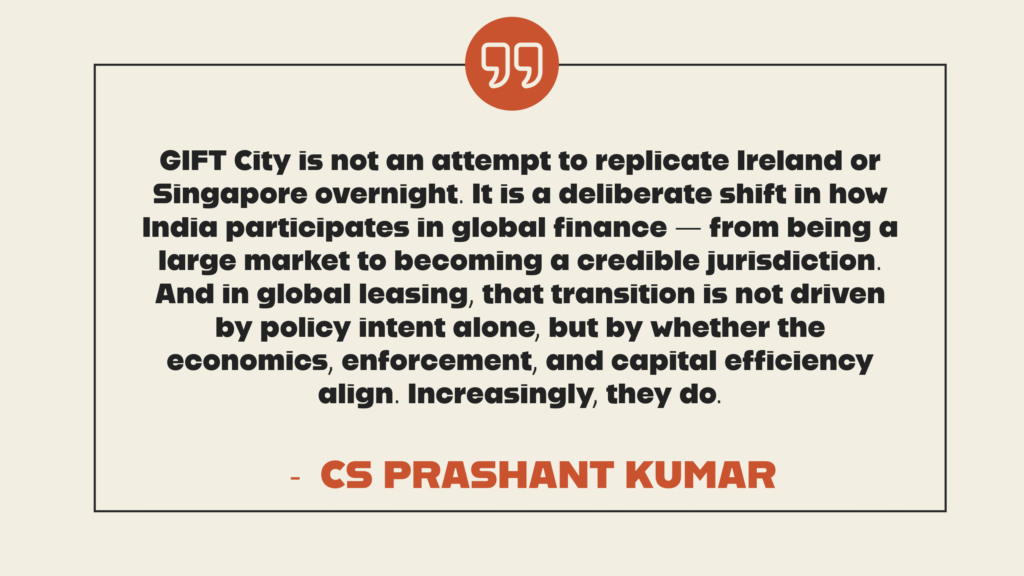
GIFT City addresses all three — not perfectly, but materially enough that the economics of choosing India over Ireland or Singapore have fundamentally changed.
Enforcement: The Single Biggest Unlock for Lessors
Let us be precise about what changed — because vague references to “improved enforcement” obscure the actual mechanism.
The Cape Town Convention and Its Indian Implementation
India ratified the Cape Town Convention and its Aircraft Protocol, which created an international legal framework for secured interests in aircraft assets. In theory, this gave lessors the right to repossess aircraft quickly upon default.
The practical problem was the interaction with Indian insolvency law. The IBC’s moratorium provision under Section 14 did not clearly carve out lessors’ rights, leading to litigation-heavy recoveries every time an airline went under.
What has shifted:
- Courts and tribunals have become more sophisticated in applying Cape Town principles
- Regulatory coordination between DGCA (aircraft deregistration), NCLT (insolvency proceedings), and lessors has improved
- IFSCA’s framework for GIFT-based leasing entities incorporates clearer recovery rights
The shift is from “legal right, uncertain execution” to “legal right, increasingly predictable execution.” That distinction — seemingly semantic — is worth hundreds of millions of dollars across a leasing portfolio.
What a Lessor Actually Cares About
When I talk to lessors about India risk, the conversation is not theoretical. They want to know:
- If an airline defaults tomorrow, how many days does it take to get my aircraft back?
- Will I be able to deregister the aircraft from the Indian registry without litigation?
- What is my exposure during a moratorium period — in days, not principles?
The honest answer is still: India is not yet Ireland or Singapore in speed. But the gap has narrowed significantly. And for a lessor that wants Indian market exposure — which almost every global platform does, given the growth trajectory of Indian aviation — the question is whether the risk is now manageable, not whether it is zero.
Increasingly, the answer is yes.
Tax Efficiency: How GIFT City Changes the Economics of Every Deal
This is where practitioners sometimes lose non-specialists, so let me make it concrete.
How Lease Economics Work
A lessor buys an aircraft for, say, $50 million. It finances $40 million through lenders at a cost of 5%. It leases the aircraft to an airline for a monthly rental that gives it a net spread — the difference between what it earns and what it costs to own and finance the asset.
That spread, over a 10–12 year lease, is the lessor’s return. It is not large in absolute percentage terms. Which means every tax leakage point matters.
What GIFT Offers
Entities registered in GIFT’s IFSC can access:
- Tax holidays under the Income Tax Act for IFSC units (currently a 20-year holiday on profits, subject to conditions)
- Reduced or exempted withholding tax on certain lease payments, reducing the gross-up cost for airlines
- GST clarity — leasing transactions structured within the IFSC do not attract GST in the same way domestic transactions do
- No Minimum Alternate Tax (MAT) exposure for IFSC units under certain conditions
The aggregate effect is a structurally lower tax cost compared to routing the same transaction through the domestic regime.
To illustrate: if a GIFT-based structure saves 150–200 basis points in effective tax cost versus an offshore structure, the lessor can either pocket that improvement or pass part of it to the airline as lower lease rates — making Indian lessors genuinely competitive on pricing.
This is not a niche advantage. Over a portfolio of 20–30 aircraft, it is a material commercial difference.
Foreign Currency Flexibility: Aligning India With the Global Standard
Ask any aviation finance professional what the standard currency for aircraft leasing is, and the answer is immediate: US Dollars.
This is not a preference — it is structural. Aircraft are purchased from Boeing and Airbus in USD. Maintenance events are priced in USD. Residual values are benchmarked in USD. Lenders price financing in USD. Lease rentals follow the same currency.
Historically, India’s regulatory architecture was rupee-centric. This created genuine friction: FEMA-related compliance for cross-border payments, hedging requirements, and currency mismatch between asset economics and local regulatory structure.
GIFT IFSC eliminates this friction for entities set up within it. Transactions can be fully structured, executed, and serviced in USD — no currency translation, no hedging mandated by regulatory compliance, no INR leg introduced artificially.
For a leasing company evaluating where to domicile its India-facing structures, this is not a minor operational detail. It is fundamental to whether the structure is clean or complicated.
The Market Access Argument: India’s Growth, Without India’s Legacy Risk
India’s aviation sector is among the fastest-growing in the world. IndiGo alone operates one of the largest single-airline order books globally. New carriers are entering. Passenger numbers are growing structurally, driven by demographics, rising incomes, and expanding route networks.
Global lessors cannot afford to be absent from this market. They need Indian airline exposure.
The traditional choice was: access India through your Dublin or Singapore entity, accepting the jurisdictional complexity that comes with cross-border enforcement. This worked — imperfectly, expensively, but it worked.
GIFT offers a different architecture: structure your India-facing leasing through a GIFT entity, and get the market access with significantly reduced structural friction.
The GIFT entity is not subject to the full weight of the domestic Indian regulatory regime. It operates under IFSCA. It can hold aircraft in foreign currency. And it benefits from the enforcement improvements discussed above.
Think of it as: Irish benefits, Indian proximity, improving Indian enforcement. That combination — even if imperfect in execution today — is directionally transforming India’s role in global leasing value chains.
Regulatory Architecture: The Advantage of One Authority
This is underappreciated by commentators who focus primarily on tax.
In the domestic Indian regime, a company involved in aviation finance might interact with: DGCA (for aircraft registration and deregistration), RBI (for FEMA and external commercial borrowings), SEBI (for capital market instruments), the Ministry of Civil Aviation, and various tax authorities. Each has its own process, timeline, and institutional culture.
GIFT entities deal primarily with IFSCA — a single, purpose-built authority designed for international financial services. IFSCA has taken a proactive approach to issuing guidance on aircraft leasing, ship leasing, and related financing structures, often in direct consultation with industry.
The practical result: faster approvals, clearer regulations, and a regulator that understands the commercial context of what you are trying to do.
For a leasing company that needs to structure a new transaction, respond to a default, or seek approval for a novel structure, dealing with one informed authority rather than five bureaucratic ones is not a minor convenience. It is a genuine competitive advantage.
Capital Markets and Lender Confidence: How GIFT Changes the Financing Equation
Leasing is a capital-intensive business. No lessor funds its portfolio from equity alone. Banks, insurance companies, pension funds, and capital market investors provide the debt that makes leasing economics work.
These lenders underwrite jurisdictional risk. Before extending a $30 million facility to a GIFT-based leasing entity, a lender’s credit team will ask: if this deal goes wrong, can the borrower recover the aircraft and repay us?
Three years ago, the honest answer to that question — for an India-based structure — was uncertain enough to command a significant risk premium, if lenders were willing to lend at all.
Today, with improved enforcement frameworks, IFSCA regulatory clarity, and growing precedent of successful GIFT-based transactions, lenders are becoming more comfortable. Comfort translates to lower risk premiums. Lower risk premiums translate to lower cost of capital. Lower cost of capital means better deal economics.
This is a reinforcing cycle: as more transactions are executed successfully through GIFT, lender confidence grows, capital becomes cheaper, more deals get done.
Ireland went through precisely this cycle between 1975 and 1995. GIFT is at an earlier stage of the same trajectory.
Ship Leasing: The Next Frontier
Aircraft leasing has seen faster traction at GIFT — partly because the Cape Town Convention provides a more mature international legal framework for aircraft than for ships, and partly because Indian aviation growth is more visible than maritime finance.
But the fundamentals for ship leasing are equally compelling:
- India is one of the world’s largest importers and exporters by volume
- Indian shipping companies operate significant fleets, most of which are financed offshore
- The maritime sector is capital-intensive, making tax-efficient financing highly valuable
The current gap is enforcement maturity. The legal framework for ship mortgages and recovery in the event of default is less internationally standardised than the aircraft regime. This is not an insurmountable problem — it is a legislative and regulatory gap that can be addressed.
IFSCA has already issued frameworks for ship leasing within the IFSC, and early transactions are being structured. The market is smaller than aircraft leasing today, but the long-term potential — tied to India’s trade growth — is substantial.
A Real-World Structuring Example: Sale and Leaseback at GIFT City
Let me make this concrete with a transaction type that is common in aviation finance: the sale and leaseback.
The Scenario
An Indian airline takes delivery of 10 new aircraft from Airbus. It needs to pay for them, but also wants to preserve liquidity for operations. The solution: sell the aircraft to a lessor immediately upon delivery, then lease them back under a long-term operating lease.
How This Works Through GIFT
- A leasing company incorporated in GIFT’s IFSC purchases the 10 aircraft from Airbus, paying in USD under a direct import transaction.
- The GIFT entity simultaneously enters into a lease agreement with the Indian airline, denominated in USD, for a 12-year term.
- The GIFT entity finances the purchase through a combination of equity and a USD-denominated loan facility from a foreign bank (lending into GIFT under the permissible framework).
- Lease rentals flow from the airline to the GIFT entity in USD. The GIFT entity services its debt and retains its spread.
What GIFT Adds to This Structure
- The lease rental withholding tax position is more favourable than a pure offshore-to-Indian-airline structure
- The GIFT entity benefits from the IFSCA regulatory framework, reducing approval complexity
- If the airline defaults, the GIFT entity can invoke Cape Town enforcement mechanisms with improving predictability
- The entire structure — ownership, financing, leasing — sits within a single, coherent regulatory perimeter
Both sides benefit: the airline gets liquidity and removes the aircraft from its balance sheet; the lessor gets a well-structured, tax-efficient Indian asset exposure.
Frequently Asked Questions About GIFT City Leasing
What types of leasing companies can set up in GIFT City? Aircraft leasing companies, ship leasing companies, and helicopter leasing entities can all register under IFSCA’s leasing framework. The regulator has issued specific guidelines for each category.
Is GIFT City leasing only for large global lessors? No. While global platforms like SMBC Aviation Capital and AerCap have strategic reasons to explore GIFT, the framework is also accessible to mid-sized platforms, family office-backed leasing vehicles, and Indian-promoted entities looking to structure international leasing activity.
What is the minimum capital requirement for a GIFT City leasing entity? IFSCA has prescribed minimum capital requirements for IFSC leasing entities. These vary based on the nature of the entity and the type of assets being leased. Specific requirements should be verified against current IFSCA circulars, as they are updated periodically.
How does GIFT City compare to Ireland for aircraft leasing? Ireland has a 50-year head start, an established ecosystem of lessors, lawyers, lenders, and technical managers, and a fully tested enforcement track record. GIFT is earlier in its development but offers advantages Ireland cannot: direct access to the Indian market, improving enforcement in the world’s fastest-growing aviation market, and a regulatory authority that is actively facilitating growth. The comparison is not Ireland versus GIFT — most sophisticated lessors will run structures in both jurisdictions depending on the asset and counterparty.
Are ship leasing transactions currently being executed through GIFT City? Yes, though in smaller numbers than aircraft leasing. The IFSCA has issued ship leasing frameworks and early transactions are being structured. The market is expected to grow as enforcement frameworks mature.
What This Means for India’s Economic Positioning
Stepping back from the transactional detail, what GIFT City’s leasing ecosystem represents is a fundamental change in India’s role in global asset finance.
For decades, India was a consuming nation — a market for aircraft, ships, and capital, but not a participant in structuring, financing, or managing those assets. The value added by Irish lessors, Singaporean SPVs, and Dubai-based holding companies flowed to those jurisdictions, not to India.
GIFT City, if it continues on its current trajectory, changes that equation. Indian-domiciled structures will originate, finance, and manage leasing transactions. The fees, the tax base, the employment in legal and financial services — these will accrue within India.
This is the deeper ambition behind the policy architecture. And unlike many policy ambitions, this one has genuine commercial momentum behind it — because the underlying business case is real.
Conclusion: A Structural Shift That Practitioners Should Take Seriously
The movement of aircraft and ship leasing to GIFT City is not a government press release. It is a commercial reality in formation — driven by the convergence of enforcement improvement, tax efficiency, currency flexibility, and market access that global lessors actually need.
It is not complete. Enforcement predictability still lags Ireland. The ecosystem of advisors and technical specialists is still developing. And ship leasing is at a much earlier stage than aircraft leasing.
But the direction is clear. And the practitioners who understand both the legal framework and the deal economics — who can structure transactions that leverage GIFT’s advantages while managing its current limitations — are the ones who will build meaningful practices in this space.
For Indian aviation and maritime businesses, the opportunity is equally significant. Access to capital through GIFT-based lessors, structured in a tax-efficient and legally clear manner, could materially change the cost and availability of fleet financing.
India is no longer just a consumer of leased assets. It is building the infrastructure to be a financier of them.
About the Author
CS Prashant Kumar is a Company Secretary, Published Author, and a seasoned professional in corporate and financial services regulation. He currently serves as Company Secretary & Compliance Officer at Global Horizons Capital Advisors (IFSC) Private Limited, an IFSCA-licensed Investment Banker based in GIFT City, with direct, on-ground exposure to capital market transactions within the IFSC ecosystem.
He brings hands-on experience in IPOs, direct listings, and exchange listings, along with deep expertise in GIFT IFSC structuring, fund setup (FME & AIF), corporate governance, and regulatory compliance. He regularly advises fund managers, startups, and institutions on building globally aligned, execution-ready structures.
For professional discussions on GIFT IFSC, IPOs, listings, fund structuring, and regulatory strategy, he can be reached at +91 9821008011 or prashant.kumar@global-horizons.in.