Section 188 has been amended three times since 2013 — and each amendment quietly rewrote a rule most of us memorised in our student days. “Special resolution” became “resolution.” Imprisonment became a civil penalty. The voidability option moved.
Which version is sitting in your memory?
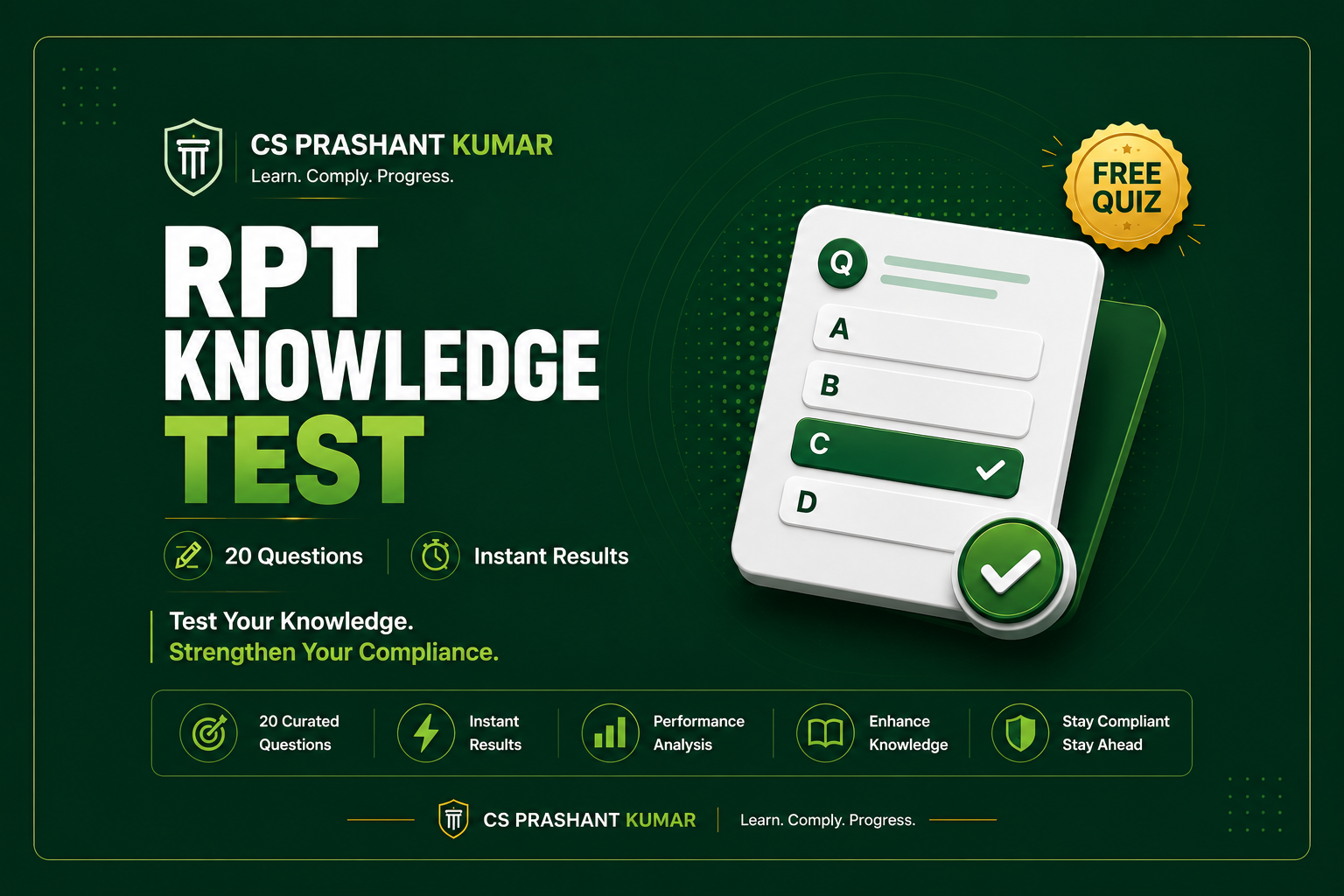
We’ve built a 20-question knowledge test on Related Party Transactions under the Companies Act, 2013 to help you find out — before an exam, a Board meeting, or a due-diligence call does it for you.
Try These Before You Start
Q1. A related party transaction crosses the Rule 15 threshold. The shareholders’ approval required is by — ordinary resolution or special resolution?
Q2. Mr. X is a director of ABC Ltd and also a director of PQR Ltd (a public company) in which he holds 1% along with his relatives. Is PQR Ltd a related party of ABC Ltd?
Q3. A ₹80 lakh transaction is entered into without Audit Committee approval and isn’t ratified within three months. Voidable at whose option — the Board, the shareholders, or the Audit Committee itself?
If you paused on any of these, the quiz will be twenty minutes well spent. (And yes — every one of them is a real question from the test, and at least one of the “obvious” answers is wrong.)
What the Quiz Covers
- Who is a related party — the Section 2(76) limbs, including the private-vs-public company trap and the group entities added in 2017
- The approval matrix — Audit Committee (Sec 177), Board resolution at a meeting (Sec 188), and shareholders’ ordinary resolution above thresholds
- The arm’s-length exemption — what it switches off, and the four things it doesn’t
- Voidability, ratification and penalties — the three-month clock, the 2017 and 2020 amendments, and penalty vs punishment
- The paper trail — Section 184 disclosures and the Section 189 register (MBP-4)
How It Works
- 20 questions — 8 Easy, 8 Moderate, 4 Advanced, in the CS exam pattern (MCQ, multiple-correct, True/False, Assertion–Reasoning)
- Every answer explained with the exact section, proviso and amendment citation — verified against the bare Act, not secondary summaries
- Instant results with a score, performance rating and topic-wise breakdown, so you know precisely which provision to revisit
- Free, no time limit — though most finish in 15–20 minutes
Who Should Take It
CS students preparing for Executive/Professional papers, practising Company Secretaries who want a quick self-audit, compliance teams onboarding new members, and directors who’d rather discover a gap here than at a Board meeting.
[statuteiq_rpt_quiz]Scored 80%+? Share your result and challenge a colleague. Below 60%? The detailed review screen gives you the exact citations to close every gap.